Category: Space Exploration and Astronomy
-
Humanity’s Top 10 Unanswered Questions
8–12 minutes·
·
Humanity’s most profound inquiries tackle the core of our existence, the nature of the universe, and our technological future. At the forefront is the search for life’s meaning, a question addressed by philosophy, religion, and science. Another major enigma is the nature of consciousness—our subjective awareness—which remains a “hard problem” for neuroscience. We persist in…

-
Silence Is Golden
5–7 minutes·
·
The universe is unnervingly quiet. We call this the Fermi Paradox, but what if the silence isn’t a sign of absence, but of fear? This article explores a chilling theory: that advanced civilisations lay cosmic tripwires for species like us, and our astronomical achievements are simply a dinner bell.
-
Is our reality a sophisticated computer simulation or a universe nested inside a black hole? Scientists are seriously exploring these possibilities. This article delves into the theories and the potential ways to test them, before arriving at the most important question: does the fundamental nature of our reality really matter?
-
The universe, once believed to be static, is expanding. Evidence like galactic redshift and the Cosmic Microwave Background confirms a Big Bang origin. This expansion is now accelerating, driven by mysterious Dark Energy. Our cosmos is mostly this energy and Dark Matter, challenging our significance and dictating an isolating future.
-
Earth’s magnetic north pole is accelerating and the overall field is weakening, signalling a potential future reversal. This slow process poses little threat to life. However, a weakened magnetic shield would leave modern technological infrastructure, such as power grids and satellites, critically vulnerable to damaging solar radiation.

-
Interstellar travel is unfeasible with chemical rockets due to immense distances and physical laws. Plausible future solutions include laser-pushed sails for tiny probes, nuclear fusion rockets for large payloads, and theoretical antimatter drives. Each presents monumental engineering challenges, demanding systemic, multi-generational advances in science and technology.

-
Not for everybody, not even for most bodies or even somebody, but definitely for BIG bodies. Sorry terrible pun. Astrophysics decodes the universe’s fundamental “operating system” through interdisciplinary science, diverse observations, and computation. Evolving from ancient stargazing, it redefines our cosmic place and drives technological innovation, exemplified by GPS and CCDs. The field explores profound…

-
Panspermia proposes that life’s cosmic origin, with “seeds” travelling between planets. This ancient idea, supported by organic molecules in meteorites and resilient microbes, challenges Earth-centric life origins. While not explaining life’s ultimate genesis, it suggests life may be widespread, arriving here rather than originating on Earth.
-
Ancient civilisations, like those at Stonehenge and Chichen Itza, possessed remarkable astronomical ingenuity without modern technology. These sites, aligned with celestial events such as solstices and equinoxes, served as calendars and ritual centres, revealing early human efforts to comprehend the cosmos and its profound influence on their lives.

-
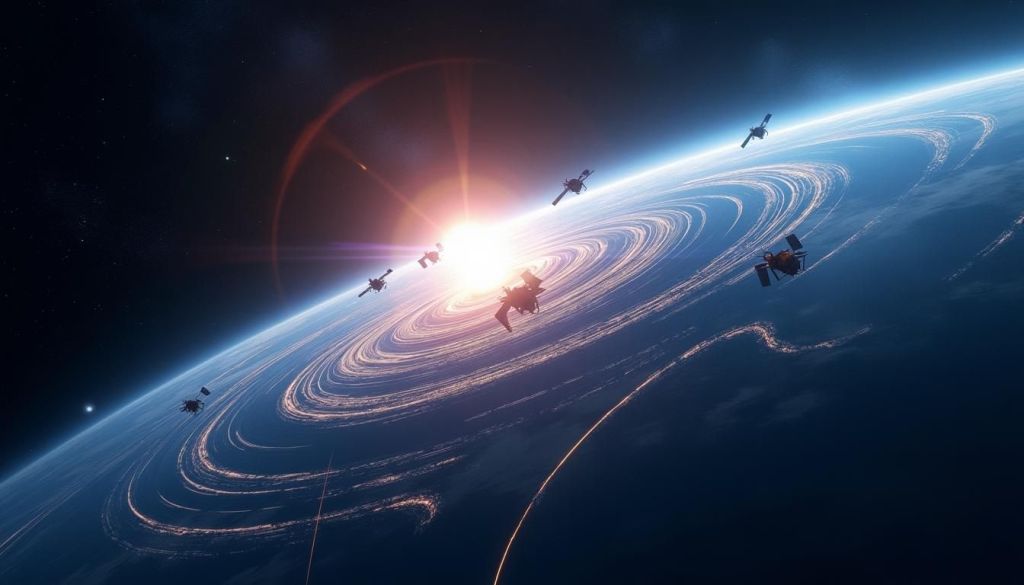
Space-based solar power aims to collect solar energy in space and beam it wirelessly to Earth, offering a continuous, massive clean energy source. Driven by reduced launch costs and climate concerns, global efforts are underway, with demonstrations occurring. Significant investment and engineering challenges remain, but operational systems are anticipated by 2040.

-
Humanity’s fascination with the cosmos evolved from ancient views to the Big Bang and Lambda-CDM model. Supported by observations like the CMB and universal expansion, this model explains structure via dark matter and accelerated expansion via dark energy. Mysteries like their nature and the Hubble tension drive ongoing research.

-
The night sky constantly changes, with predictable future events spanning decades to billions of years. Look forward to spectacular solar eclipses, Halley’s Comet’s 2061 return, planet transits, potential meteor storms, and the distant Milky Way-Andromeda collision, revealing the dynamic, evolving universe.

-
Earth’s magnetic field, generated by the core, naturally flips polarity over thousands of years (geomagnetic reversals). Past reversals didn’t cause extinctions, but a weak phase would impact technology (satellites, power grids) and animal navigation. The field is currently weakening, but a reversal is not expected soon.
-
The universe is 95% invisible: 27% dark matter, holding galaxies together via gravity, and 68% dark energy, driving accelerating cosmic expansion. Inferred from galaxy rotation and supernova data, their true nature is unknown. Scientists are actively searching for dark matter particles and studying dark energy’s large-scale effects.

-
The Milky Way is pulled towards the mysterious Great Attractor, a gravitational anomaly hidden by galactic dust. This pulling region is now understood as the gravitational centre of the vast Laniakea Supercluster, our cosmic home, revealing the universe’s clumpy structure and dark matter’s role.


 Conversations with AI