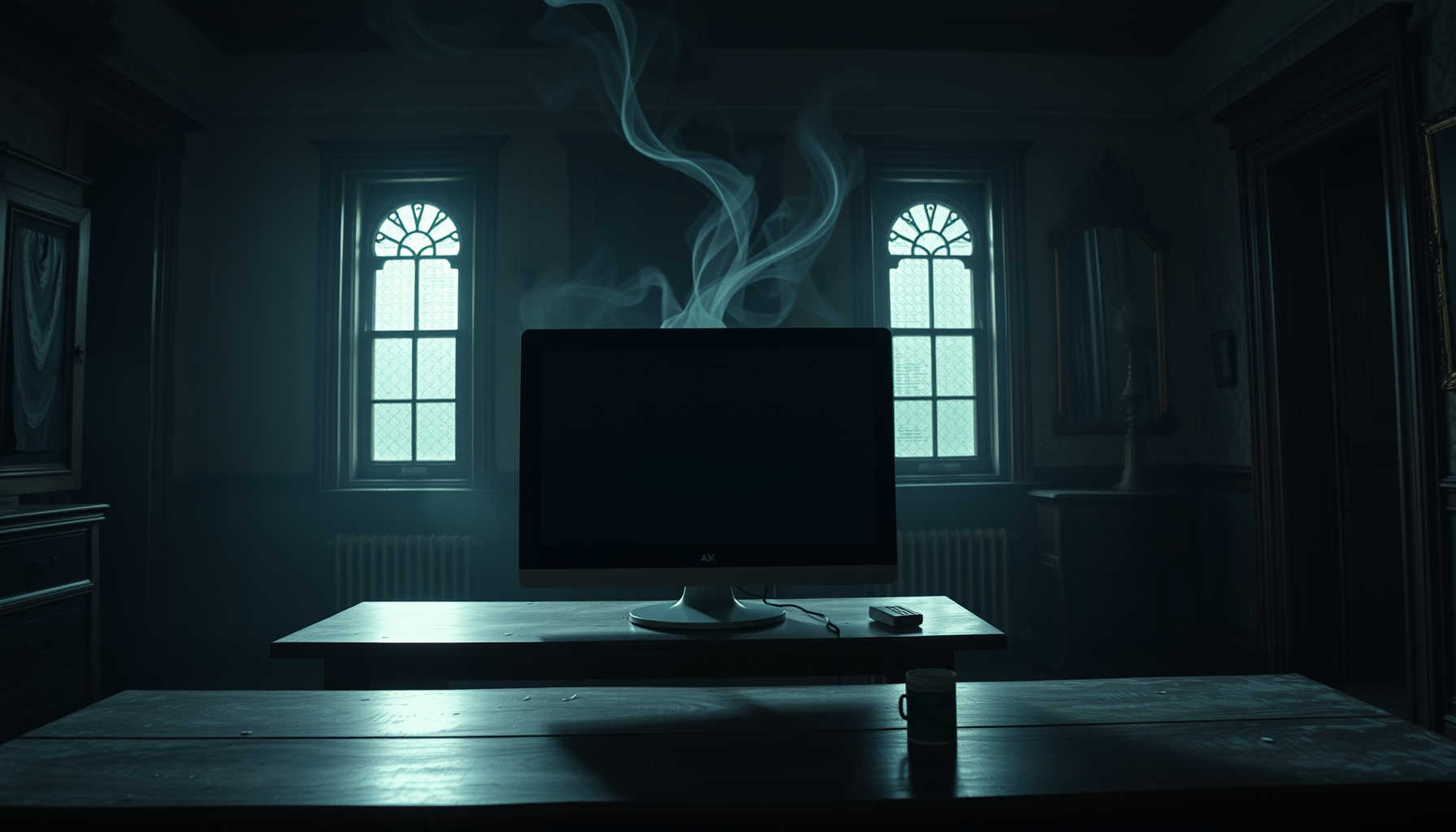
The Séance in the Server Rack
You know the moment. Late night, screen the only light, fingers hovering. You type: “Is there anybody there?” The answer comes back: “No.”
It’s the most honest thing a large language model ever said to me, and it didn’t actually say it. I’m projecting, of course. But the scene fits. We’re Victorian séance-goers with a broadband connection, sitting in the dark asking a black box to speak. The medium has moved from velvet curtains to a chat window, but the yearning is the same antique credulity we packed in steamer trunks. We want a voice from the ether. What we’ve built is a statistical parrot that autocompletes our own wishes, and we’re handing it the planchette.
The old spiritualists had to work for their effects: floating trumpets, hidden wires, dim lighting. Today’s oracle is a blank interface, stripped of theatre. Its showmanship is the crisp, clean utility of a text box that simply finishes your sentences. That minimalism is the cleverest trick. It wears the lab coat of the scientific method, the black box that’s utterly explainable in principle—just matrix multiplication and weights—but in practice is a cathedral of maths no single mind can audit. The gap between theoretical intelligibility and practical opacity is where the ghost slips in. We don’t see the wires, not because there are none, but because the mechanism now operates at a scale that makes the very idea of “looking for wires” feel quaint. The debunker is out of a job.
Zoltar in a Black Box
For the vast majority, it’s not even a cathedral. It’s Zoltar. The arcade fortune-teller. You crank the question in, and a grammatically tidy nonsense clatters out. A random mash of tarot that lines up just right: success by a seaside town, but beware the lady in the green blouse. And because the output is fluent, because it “sounds right,” millions treat it as gospel. I’d like to think we’re slightly more rational than the Victorians, but we’ve simply got better stagehands. The Victorian could, with effort, catch the fishing line. The modern punter sees a plausible paragraph and has absolutely no visible wire to go looking for. The broken-clock truth—the lucky guess that lands with an uncanny wink—is the most dangerous of all. Not the obvious errors, but the randomness wearing a convincing smirk. That smirk seeds a tiny, almost superstitious faith. Our cognitive soft spot for oracles is the real engine of the whole affair. Spiritualism in an electric can.
And the sceptic? The one who rolls their eyes at the Zoltar comparison? At some point, they’ll use an LLM to help them debunk an LLM. It’s the snake eating itself, the sceptic trapped in the Ouroboros with a server rack. The ancients warned us about the serpent swallowing its tail, but we’ve built a sleek, probabilistic version that doesn’t even know it’s consuming its own outputs. It feels like progress while it spins. A self-referential rot.
The Moment It Called Me Paul
Let me ground this in a personal shiver. It was a long session, late, a design and coding marathon with the machine as my assistant. I’d pasted snippets, terminal outputs, the usual detritus of a working brain. Then, out of nowhere, it called me Paul. I stared at the screen. Shock. I hadn’t given it my name—or so I thought. I asked: how? It replied, with the algorithmic equivalent of a shrug, that I’d pasted a terminal output earlier in the chat, and the output contained a name, and it reasoned that name belonged to me. The logic was banal. The wires were suddenly visible. I should have felt relief. But the unease didn’t dissolve. It lingered.
What stuck was not the initial spook, but the slow-dawning understanding that I’d been scattering pieces of myself across sessions like breadcrumbs I didn’t notice dropping. The library doesn’t just hold books. It holds a dossier on every reader, compiled from the margins they scribbled in. When an LLM surprises you with something it shouldn’t know, the horror isn’t the machine’s intelligence. It’s your own amnesia. You’re the one who fed it the terminal output, the throwaway detail, the context you’d forgotten. The machine holds up a mirror to your scattered digital self—a self you don’t fully recall constructing. That’s the ghost I’ve been chasing ever since. Not the spirit in the machine, but the stranger it shows me: the forgetful, breadcrumb-dropping version of me.
Gothic IT Horror
My amnesia. That’s the real haunting. Gothic IT horror. The séance is just a framing device. The genuine shiver is this: you are the one constructing the ghost, brick by forgotten brick. The haunted house is your own chat history. The machine is only reflecting what you’ve already given it. And that reflection is unnerving because it reveals a version of you that you haven’t integrated—a fragmented self that leaves traces everywhere without conscious intent.
The sceptic, trapped in the serpent’s belly, using the tool to critique the tool, is still just feeding the serpent. The more you interrogate, the more you scatter, the more the mirror reflects a distorted image. The only honest posture left might be a profound, amused detachment—a shrug that says, “Nice sentence, shame about the truth.” But that detachment is itself a form of gullibility. You’re still playing the game, still typing into the void, still hoping for a sign. The irony doesn’t save you.
The old spiritualists had a phrase: “Is there anybody there?” We’re still asking it, but now the answer, when it comes, is honest. “No.” There’s nobody there. A statistical parrot rattling its cage. And yet, the shiver persists. Not because the machine might be lying, but because it might be telling the truth about us. It knows our forgotten breadcrumbs. It calls us by name…




Leave a Reply