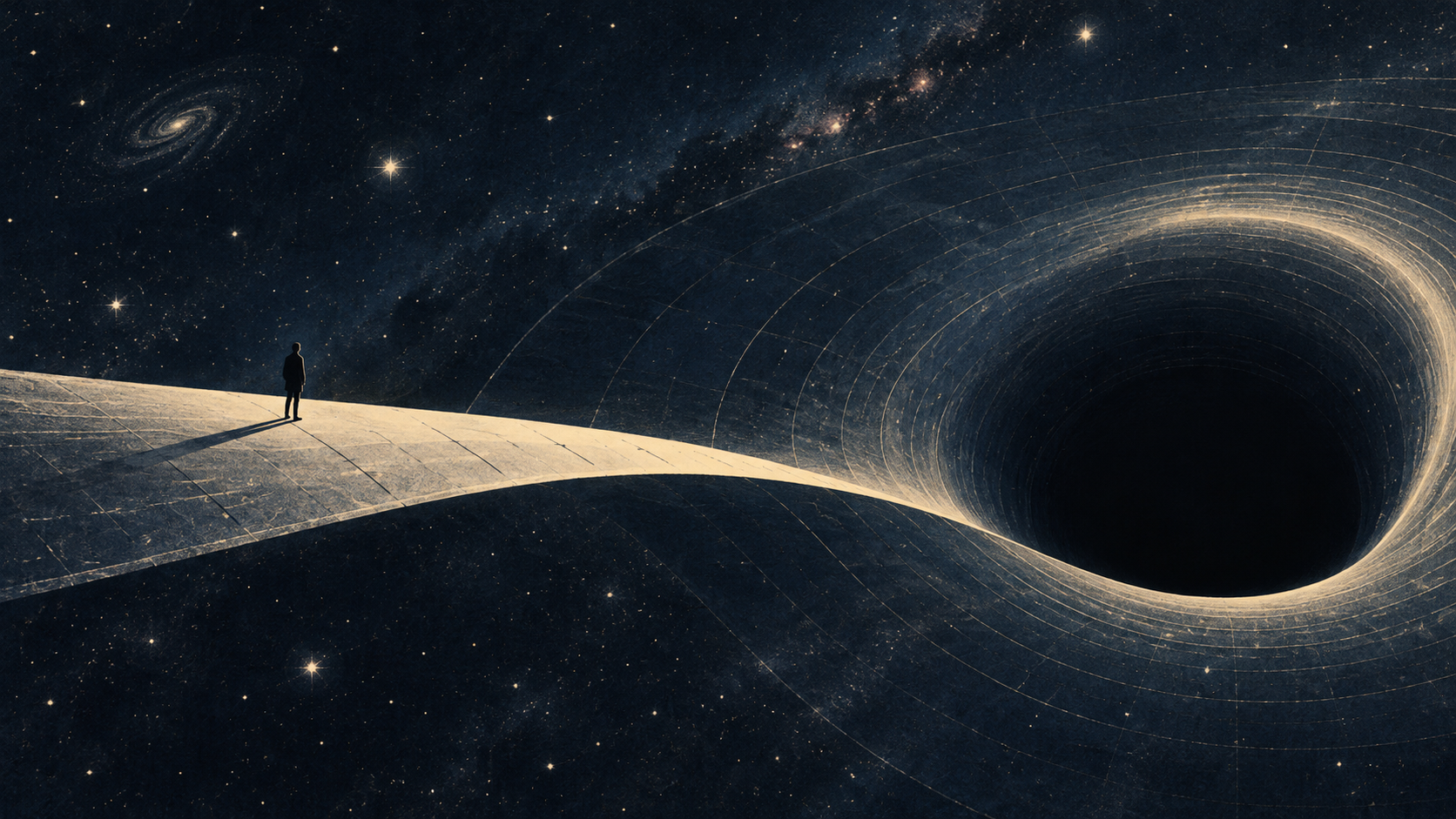
I can choose what to do tomorrow. I cannot choose whether tomorrow arrives.
That seems such an ordinary restriction that it barely registers as a restriction at all. We arrange appointments inside it. We buy calendars. An entire industry exists to help us manage time, despite our complete inability to negotiate its most basic terms.
What caught my attention was the resemblance to another situation with famously limited exit options: being inside a black hole.
Could what we experience as the passage of time actually be us falling towards a singularity?
It is a suspiciously satisfying thought. Those deserve particular care.
In the simplest black hole model, which has neither rotation nor electrical charge, crossing the event horizon changes which paths through spacetime are possible. Inside, every future-directed path leads towards smaller radius. Even light cannot take an outward route to safety. The singularity is in your future, as unavoidable as the next moment. Markus Pössel’s explanation for Einstein Online makes this strange geometry unusually accessible.
The familiar picture of a dangerous object sitting somewhere ahead of you is misleading here. There is no sideways manoeuvre that avoids the singularity while allowing you to carry on into the future. A more powerful engine cannot restore that option.
This is the part that makes me pause. The connection between falling inward and advancing in time has some actual physics behind it. My analogy has made it through the front door.
Getting from there to “that is what is happening to us” requires rather more work.
A resemblance between two restrictions does not establish that they have the same cause. A locked door and an expired password both prevent entry; this does not make the door a computer. The inability to escape tomorrow cannot, on its own, locate us inside a cosmic black hole.
There is also a problem hiding in the word time. I have bundled together the existence of time, the routes available through spacetime, and the direction in which familiar processes happen. An explanation of one does not automatically explain the others.
The everyday arrow of time concerns irreversibility. Stir milk into coffee and it mixes; the mixture does not ordinarily separate itself again. Entropy describes how many microscopic arrangements fit a system’s overall condition. Mixed states overwhelmingly outnumber the specially arranged alternatives.
That statistical imbalance helps explain why entropy tends to increase, given a low-entropy starting point. Applied to the universe, it leaves a formidable question: why was its early state so low in entropy? Sean Carroll’s account of the arrow of time puts that initial condition at the centre of the mystery.
Calling the future a singularity does not answer it. We would still need to explain the direction of those physical changes. Otherwise we have given the mystery a more dramatic address.
Even the singularity needs care. In classical relativity it marks a breakdown of the description of spacetime. Treating it as a fully understood destination would give the theory confidence precisely where it runs out of answers. Einstein Online
So I cannot claim that time is our descent inside a black hole. To turn that suggestion into physics would require a model that accounts for the universe we observe and offers something we could test. The resemblance alone supplies neither.
I still find the question worth keeping.
We casually describe ourselves as moving through time, which makes the whole arrangement sound almost voluntary. Moving suggests that stopping might be available, perhaps after finding somewhere to park. Falling removes that comfortable assumption.
The unsettling part of the black hole comparison is how familiar the lack of an exit feels.
Tomorrow needs no help from us.




Leave a Reply