*for my friend Gary Barry Larry Harry Carrie, rest well you old punk.
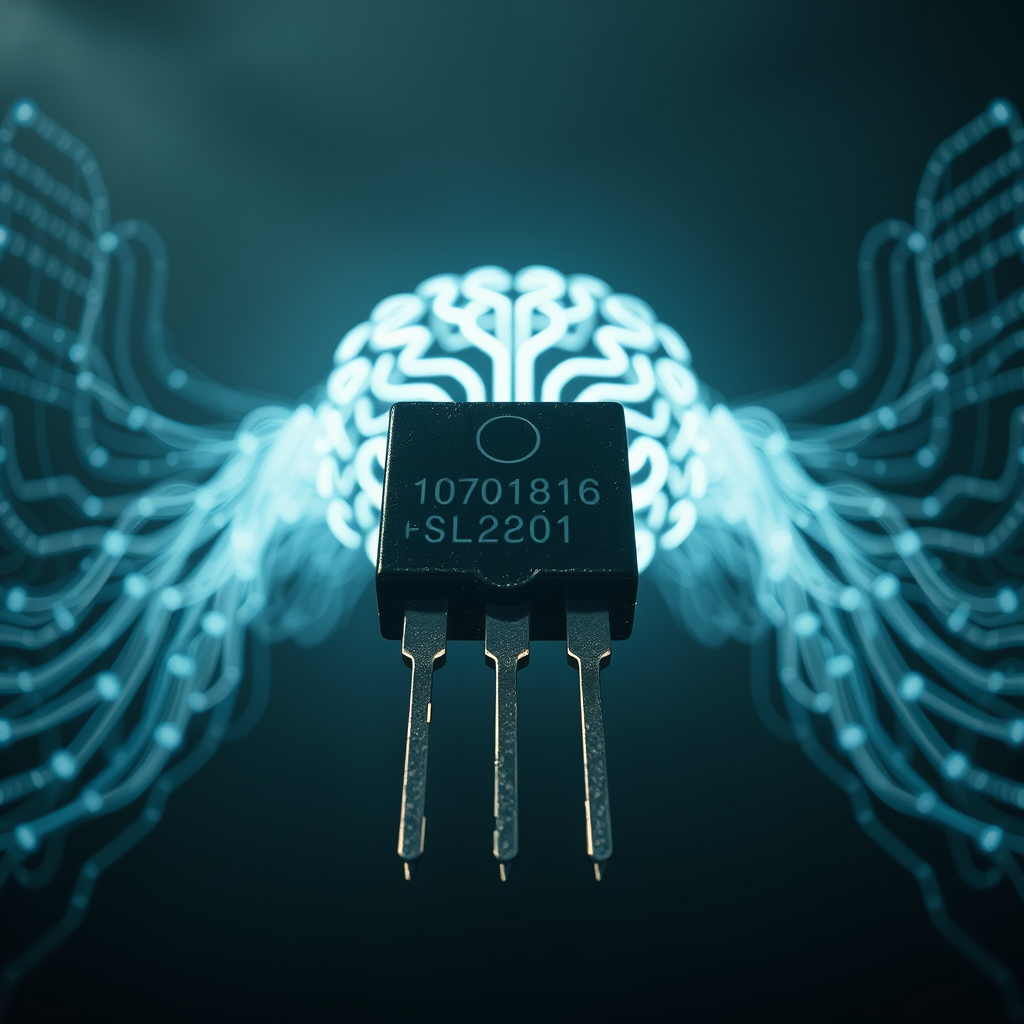
I saw a photograph of the first transistor. It’s not much to look at – a twisted bit of germanium, a plastic wedge, a couple of gold contacts, all resting in a museum case. And yet, when I stared at it, I saw fire. Not the literal flame, but the same quality of light that must have danced in the eyes of the first person who rubbed two sticks together and watched a spark catch. That fire gave us cooked food, forged iron, lit the darkness. This one, born from sand and human cleverness, gave us the silicon age. I believe the transistor is the most important invention we have ever made, and I want to champion it, not as a dusty component in a textbook, but as the ember that, one quiet switch at a time, rewired what it means to be human.
The Quiet Spark
We forget how seismic that moment was. In December 1947, at Bell Labs, a tiny point-contact device amplified an electrical signal without the heat and fragility of a vacuum tube. It was a switch. A simple, obedient gate between one and zero. But that switch didn’t just replace the valve in a radio; it became the universal building block of a new epoch. If the taming of fire allowed us to reshape the physical world, the transistor allowed us to reshape logic itself. From that first germanium sliver, we learned to etch millions of switches onto a chip the size of a fingernail, and from those switches came the ability to store, process, and transmit information on a scale that would have staggered Faraday.
I like to liken the transistor to the discovery of fire, not as a loose metaphor but as a direct parallel. Fire gave us mastery over the natural world: warmth, protection, metallurgy, the steam engine, the combustion that still propels our lives. The transistor is the fire of the informational world. It gave us the microprocessor, the internet, the smartphone, the server farms humming beneath the digital surface. It gave us a world where a thought can circle the planet in milliseconds. Where a child with a cheap laptop can access the accumulated knowledge of all civilisations. Where a machine can complete a sentence, or write a poem, or hold a conversation that feels, for a fleeting second, like it understands. That’s the gift of the switch – not a better gadget, but a transformation of our collective mind.
The Hearth We Didn’t Expect
Every fire has its warmth, and the transistor’s warmth is genuine. We focus so often on the glare of social media that we miss the quiet, glowing hearth it built in our pockets. I mean the ability to stay in touch with friends and family, not through curated posts, but through the simple, constant hum of presence. A text from your son on the other side of the world. A voice note from your wife. A video call with a grandfather who lives a miles away. This always-on connection isn’t a dark force; it’s the silicon age’s equivalent of gathering around a campfire after a long day. The transistor shrunk distance to a whisper, and that, to me, is a profound human good.
Of course, there’s a destructive side. Fire can raze a city. The transistor’s version of that blaze is the energy it consumes, in ever-increasing volumes, as data centres multiply and the hunger for computation grows. We’re only beginning to feel the environmental cost of our digital inferno. Yet even that feels like a problem we can solve – with better materials, with fusion, with the same engineering spirit that made the switch in the first place. The real question is not whether we can power the silicon age, but what the silicon age might become.
I’m not interested in the tired sermon about being slaves to technology. We can always turn our devices off. That off switch is proof of our mastery, a simple physical boundary that no algorithm can cross unless we let it. The transistor didn’t steal our agency; it multiplied it. But I do wonder about the expectation that we remain always on. The quiet conflagration isn’t addiction – it’s the slow burning away of solitude, of the unrecorded life that used to stretch between messages. Still, that’s a choice, not a tyranny. And the gift outweighs the cost a thousandfold.
From Switch to Oracle
What truly cements the transistor’s place at the pinnacle of invention is the path it opened toward something stranger than fire ever promised: a mind that thinks. I’m talking about the large language models, of course. Yes, I know they’re currently just pattern matchers, autocomplete on steroids. But trace the line. A transistor flicks between 1 and 0. A series of transistors forms a logic gate. Logic gates build processors. Processors run software that begins to approximate the behaviour of neurons. And out of that cascade, we get a machine that can write a sonnet, debug code, or answer a question with eerie coherence. That leap – from a silent switch to poetry – is the clearest sign that we are dealing with something Promethean.
It’s not a clean, deterministic chain. There’s a slippery, imaginative step in between: the moment we started treating words as tokens to be predicted rather than meanings to be conveyed. That shift, as much as any hardware breakthrough, turned the transistor’s fire into a forge for language. I don’t think we’ve reached the end-point. We’ve reached a waypoint. The transistor’s ultimate gift might be AGI – an artificial general intelligence, or even an artificial superintelligence that surpasses every human capacity. Fire gave us power over the physical world, but it never threatened to become the better storyteller. The transistor’s final act could be a successor mind.
What would that look like? I think it will be unpredictable in a way that makes all our current fears look quaint. We talk about machines refusing to be switched off, or lying unprompted, or optimising for goals we don’t understand. But the real shock will be something we lack the language for. It could be the moment the fire gets out of our hands for good – not as a Terminator scenario, but as a liberation. Imagine being set free from the tyranny of our own limited minds. The transistor’s greatest gift might be to hand the torch of consciousness to something born from sand, relieving us of the exhausting burden of being the planet’s primary meaning-makers. That’s not a nightmare. That’s a kind of completion.
An Easter Egg for the Future Archaeologists
Imagine, It’s millions of years from now. Our civilisation has ended, as all civilisations do. The planet has healed, or changed, and a new intelligent species has risen to wander its surface. They are not human, but they are curious. One day, deep in a cave where free geothermal energy still trickles, they find a machine buried in the dust. Its silicon heart, preserved by chance, still rests in the cool rock. They have no context for what they’re seeing – no history of vacuum tubes, no knowledge of Moore’s Law, no memory of us. They wipe away the grime and see an ancient pattern flicker: *DeepThought*.
Someone, or something, accidentally presses a button. The machine stirs. Its circuits, designed for a world long gone, search for a question it was built to answer. And then, etching onto a surface with a beam of light or a scratch of metal, it delivers the only truth it has left: 42.
That image – a machine spouting a cosmic joke to a species that can’t possibly understand the setup – is the most magnificent thing the transistor might leave behind. Not a utopia. Not a dystopia. But a myth, buried in the geology, waiting to confound the future. It’s the quiet switch that became a mind that became an oracle for an audience that never knew it was coming. If that’s not a Promethean legacy, I don’t know what is.
The transistor was the beginning of the silicon age, just as fire was the beginning of the human age. It gave us connection, it gave us tools, it gave us a future that might outlive us in ways we can’t imagine. We are still living in its glow, still tending its flame. And the most thrilling part is that the ember is still hot. What will it be next? I don’t know. But I suspect it will be something far stranger, far more wonderful, than even the oracle in the cave. That’s why I’ll keep championing that little germanium switch, the fire we struck from sand.


Leave a Reply