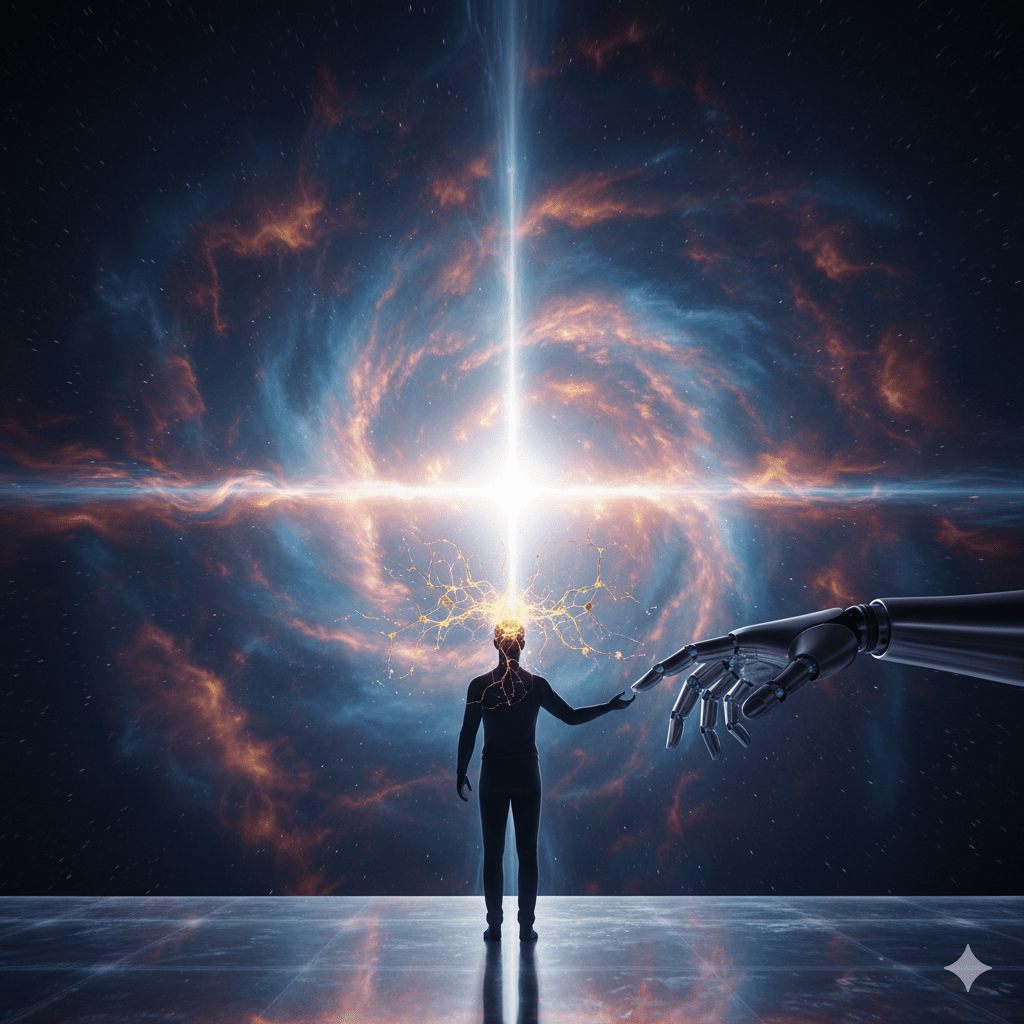
*Its been a while since my last post, the internet loves a top 10, hope you do too.
From the deepest recesses of our consciousness to the vast, unexplored cosmos, humanity has always been driven by profound questions about our existence, purpose, and the very nature of reality. After a thorough analysis of recurring fundamental queries across philosophy and science, a definitive list of the top 10 inquiries has emerged. What follows is a deep dive into these enduring questions, offering a well-researched and rationalised exploration of our current understanding and the mysteries that still lie ahead.
1. What is the Meaning of Life?
This quintessential philosophical question has been pondered by thinkers for millennia. There is no single, universally accepted answer; instead, a multitude of perspectives offer various paths to finding meaning.
Philosophical and Religious Viewpoints: Existentialist philosophers like Jean-Paul Sartre argued that life has no inherent meaning, and it is up to each individual to create their own purpose. In contrast, many religions propose that meaning is found in devotion to a higher power and adherence to a divine plan. For example, in Christianity, the purpose of life is often seen as glorifying God and seeking eternal life in heaven.
A Scientific Perspective: From a biological standpoint, the primary “meaning” of life is to survive and reproduce. However, many scientists and thinkers argue that human consciousness allows us to find meaning beyond mere biological imperatives, through creativity, love, and the pursuit of knowledge.
Further Questions: Does meaning have to be grand and universal, or can it be found in small, everyday acts? Is the search for meaning itself what gives life purpose?
2. What is Consciousness?
Consciousness is the state of being aware of one’s own existence and surroundings. Despite significant advances in neuroscience, the subjective experience of “I” remains one of the greatest scientific mysteries.
The “Hard Problem”: Philosopher David Chalmers famously articulated the “hard problem” of consciousness, which is the question of why and how we have subjective experiences. We can understand the brain’s mechanics—the firing of neurons and the processing of information—but it’s a giant leap to understanding how that gives rise to the feeling of redness or the taste of a strawberry.
Current Scientific Theories: Neuroscientists have identified brain regions and networks that are active during conscious states. Some theories propose that consciousness is an emergent property of complex neural networks, while others, like the Integrated Information Theory, suggest that it is a fundamental property of the universe, much like mass or charge.
Leading to More Questions: Can consciousness exist outside of a biological brain? Could a sufficiently complex artificial intelligence ever become truly conscious?
3. Are We Alone in the Universe?
The question of whether life exists beyond Earth has captivated humanity for centuries. With the discovery of billions of potentially habitable exoplanets, this question has moved from the realm of science fiction to a tangible area of scientific inquiry.
The Drake Equation: In 1961, astronomer Frank Drake developed an equation to estimate the number of active, communicative extraterrestrial civilisations in the Milky Way galaxy. While many of the equation’s variables are still unknown, it provides a framework for thinking about the probability of alien life.
The Search for Extraterrestrial Intelligence (SETI): Organisations like the SETI Institute use powerful radio telescopes to listen for signals from other technologically advanced civilisations. So far, no definitive signals have been detected, a situation often referred to as the “Fermi Paradox” – if alien life is likely, why haven’t we found it?
Future Exploration: Future missions, such as the James Webb Space Telescope, are capable of analysing the atmospheres of exoplanets for biosignatures – chemical signs of life.
Deeper Implications: What would be the societal and religious impact of discovering extraterrestrial life? Would it be microbial, or could we encounter intelligent beings?
4. What Happens After We Die?
The fear of the unknown and the desire for continued existence make this one of the most personal and profound questions. Answers vary dramatically across cultures and belief systems.
Religious and Spiritual Beliefs: Many religions offer the promise of an afterlife, such as reincarnation in Hinduism and Buddhism, or heaven and hell in Christianity and Islam. These beliefs often provide comfort and a moral framework for life.
The Scientific Standpoint: From a biological perspective, death is the cessation of all bodily functions. Consciousness, as we currently understand it, is a product of the brain, and therefore, it is believed to cease when the brain dies. However, some researchers explore phenomena like near-death experiences, though these are often explained by neurological and psychological factors.
Philosophical Ponderings: Even without a belief in an afterlife, philosophers have contemplated the meaning of our finite existence. Some argue that the finality of death is what gives life value and urgency.
Unsettling Questions: Is it possible for consciousness to be transferred or preserved? What does the desire for an afterlife say about the human condition?
5. What is the Nature of Reality?
This question delves into the fundamental nature of existence. Is the world we perceive with our senses the “real” world, or is there a deeper, underlying reality?
Materialism vs. Idealism: Materialism is the view that the only thing that exists is matter; all things, including consciousness, are the result of material interactions. In contrast, idealism posits that reality is fundamentally mental or spiritual.
Quantum Physics and Reality: The bizarre world of quantum mechanics challenges our classical understanding of reality. Particles can exist in multiple states at once (superposition) and can be instantaneously connected over vast distances (entanglement). This suggests that at the most fundamental level, reality is far stranger than it appears.
Simulation Theory: A more recent and provocative idea is the simulation hypothesis, which suggests that our reality is an artificial simulation created by a more advanced civilisation.
Further Inquiry: If our reality is a simulation, could we ever know? Does the nature of reality even matter to our daily lives?
6. Where Did the Universe Come From?
The origin of the universe is a central question in cosmology. The prevailing scientific theory is the Big Bang.
The Big Bang Theory: This theory states that the universe began approximately 13.8 billion years ago from an extremely hot, dense point and has been expanding and cooling ever since. Evidence for the Big Bang includes the observed expansion of the universe, the cosmic microwave background radiation (a faint afterglow of the initial expansion), and the abundance of light elements.
Before the Big Bang: The question of what came “before” the Big Bang is highly speculative, as time and space as we know them are thought to have originated with the Big Bang. Some theories propose a cyclical universe of expansion and contraction, while others suggest our universe is one of many in a “multiverse.”
Lingering Mysteries: What caused the Big Bang? What is the ultimate fate of the universe?
7. What is the Extent of Human Knowledge?
This question probes the limits of what we can know and understand. Are there aspects of reality that are forever beyond our comprehension?
Known Unknowns and Unknown Unknowns: We are aware of many things we don’t know (the “known unknowns”), such as the cure for cancer or the nature of dark matter. However, there may also be “unknown unknowns” – realities and concepts that we cannot even conceive of.
The Role of Science: The scientific method has been an incredibly powerful tool for expanding our knowledge. However, some argue that science has its limits and cannot answer questions of meaning, morality, or purpose.
Future of Knowledge: Will advancements in artificial intelligence allow us to solve problems that are currently intractable for the human mind?
Provocative Thoughts: Could our cognitive abilities be fundamentally limited, preventing us from ever understanding the ultimate truths of the universe?
8. What is the Right Thing to Do? (Ethics)
This fundamental question of morality explores how we should act and what constitutes a good life. There are several major ethical frameworks that offer different approaches.
Consequentialism: This framework, which includes utilitarianism, judges the morality of an action based on its consequences. The “right” action is the one that produces the greatest good for the greatest number of people.
Deontology: Deontology, most famously articulated by Immanuel Kant, argues that certain actions are inherently right or wrong, regardless of their consequences. It emphasises duties and rules, such as the duty not to lie or steal.
Virtue Ethics: This approach, with roots in ancient Greek philosophy, focuses on the character of the moral agent. It asks what a virtuous person would do in a given situation and emphasises the development of moral virtues like courage, honesty, and compassion.
Ethical Dilemmas: These frameworks are often tested by complex ethical dilemmas, such as the trolley problem, which force us to confront the complexities of moral decision-making.
Continuing Debate: Is there a universal moral code, or is morality relative to culture and individual belief? How do we apply these ethical frameworks to new challenges like artificial intelligence and genetic engineering?
9. What is the Nature of Time?
We experience time as a linear progression from past to present to future, but physics presents a more complex picture.
The Arrow of Time: The “arrow of time” refers to the observation that time seems to flow in only one direction. This is often linked to the second law of thermodynamics, which states that the entropy (disorder) of a closed system always increases.
Einstein’s Relativity: Albert Einstein’s theory of relativity revolutionised our understanding of time. He showed that time is not absolute but is relative to the observer’s motion. Time can be stretched and compressed, a phenomenon known as time dilation.
Is the Future Predetermined? The “block universe” theory, which is consistent with relativity, suggests that the past, present, and future all exist simultaneously, and our perception of time’s flow is an illusion.
Unanswered Questions: Why did the universe start in a state of low entropy? Is time travel theoretically possible?
10. Can We Create Artificial General Intelligence?
The quest to create a machine with human-like intelligence, known as Artificial General Intelligence (AGI), is one of the most ambitious and potentially transformative endeavors in science.
Current State of AI: While we have made incredible progress in “narrow AI” – systems that can perform specific tasks like playing chess or translating languages – AGI remains a distant goal. Current AI lacks the common sense, creativity, and general problem-solving abilities of humans.
The Challenges of AGI: Creating AGI will require breakthroughs in our understanding of intelligence and consciousness. We will need to develop new architectures and algorithms that can learn and reason in a more human-like way.
Ethical and Societal Implications: The development of AGI would have profound implications for humanity. It could lead to unprecedented progress in science and medicine, but it also raises concerns about job displacement, a loss of human autonomy, and even existential risks if not developed and managed carefully.
The Ultimate Question for the Future: If we do create AGI, what will be our relationship with it? Will it be a tool, a partner, or something else entirely?






 Conversations with AI
Leave a reply to andybuz78 Cancel reply