Category: Quantum Mechanics
-
Is our reality a sophisticated computer simulation or a universe nested inside a black hole? Scientists are seriously exploring these possibilities. This article delves into the theories and the potential ways to test them, before arriving at the most important question: does the fundamental nature of our reality really matter?
-
From Solid Trees to Quantum Ghosts
10–15 minutes·
·
Physics presents two conflicting realities. General Relativity perfectly describes the large, predictable world of trees and planets. In contrast, Quantum Mechanics governs the bizarre, probabilistic subatomic realm. These successful but incompatible theories clash when explaining black holes, driving the search for a single, unified “Theory of Everything”.

-
Quantum entanglement describes particles linked instantaneously across any distance, a concept initially dubbed “spooky action” by Einstein. Schrödinger formally termed it “entanglement”. Bell’s theorem, experimentally verified, confirmed its non-local reality, challenging classical physics. It underpins emerging technologies like quantum computing and cryptography, with ongoing research into its profound implications.

-
Time is a profound mystery, viewed through philosophical lenses like Presentism and Eternalism, and shaped by physics from Newton’s absolutes to Einstein’s relativity and the thermodynamic arrow. Our subjective perception is malleable, while quantum physics even questions time’s fundamental existence, leaving a unified understanding elusive.

-
Quantum Field Theory describes reality not as particles, but fundamental fields whose excitations are particles. Unifying quantum mechanics and relativity, it forms the Standard Model, using concepts like renormalisation and symmetries. Though highly successful, it currently excludes gravity and doesn’t explain dark matter, highlighting ongoing research.

-
Quantum entanglement describes particles interconnected across vast distances, instantly mirroring each other’s states—a phenomenon Einstein dismissed as “spooky action”. Theorised in 1935, experiments from the 1970s validated it via Bell’s theorem. Now foundational for quantum computing and cryptography, entanglement challenges classical physics, reshaping notions of reality, causality and technological possibility.

-
The discovery of the Higgs boson is a significant scientific breakthrough, confirming the existence of the Higgs field and providing insights into the origins of mass, with far-reaching implications for our understanding of the universe.

-
The concept of time has fascinated humans, with ancient civilizations and theoretical physics shaping our understanding, from absolute time to relative time, and ongoing research continues to refine our knowledge of this complex aspect of the universe.
-
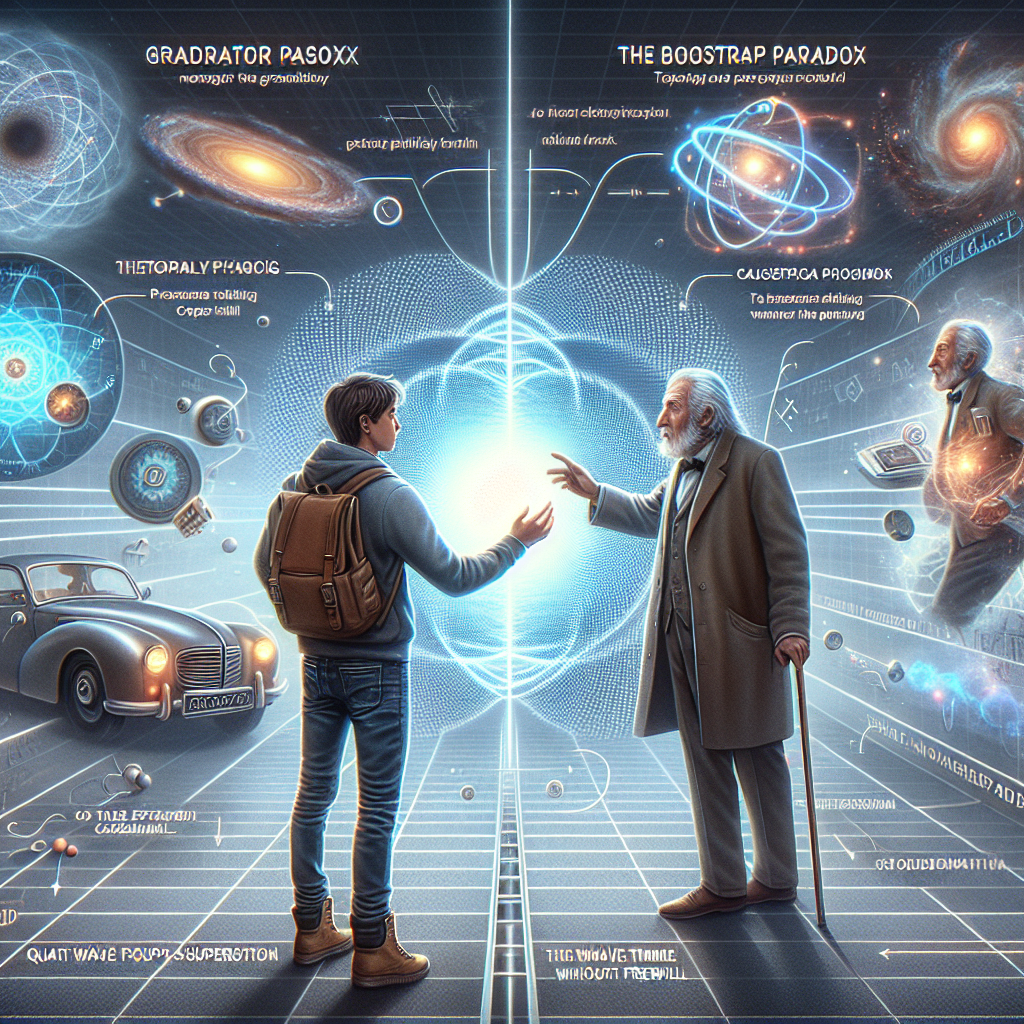
This conversation explores the intrigue of time travel, its cultural significance, and the associated paradoxes: the Grandfather Paradox, Bootstrap Paradox, and Predestination Paradox. It discusses the theoretical physics concepts that underpin these paradoxes and their implications for understanding causality, free will, and the nature of reality.
-
This conversation delves into the complex philosophy of time, contrasting ancient views with modern interpretations, particularly through Einstein’s theory of relativity and quantum mechanics. It addresses debates between presentists and eternalists, the implications of time travel, and the intricacies of time as both a scientific and philosophical construct.


 Conversations with AI