*looks like the references are a bit wrong. Happy New Year!
With a captivating allure, time travel teases the human imagination — the prospect of revisiting the past or anticipating the future bears an irresistible lure. Arguably as central to science fiction as stars are to the cosmos, the notion has become a cultural zeitgeist, a mirror reflecting our deepest desires and anxieties. Hinged on the paradoxical meanderings of theoretical physics, time travel presents several paradoxes which are the main focus of our exploration. This article introduces, discusses, and analyses these paradoxes while shedding light on their theoretical physics underpinnings. By examining these intriguing phenomena, we stand to gain a deeper understanding of not just time travel, but the fabric of the universe itself.
The history of our fascination with time travel can be traced as far back as ancient folklores¹. However, the narrative took a scientific turn in 1905 when Albert Einstein published his groundbreaking paper revealing his Special Theory of Relativity². This laid the crucial groundwork for our modern understanding of spacetime. The annotations of these concepts were later encapsulated in his General Theory of Relativity in 1915, projecting the stunning possibility that time travel could occur under the right conditions³.
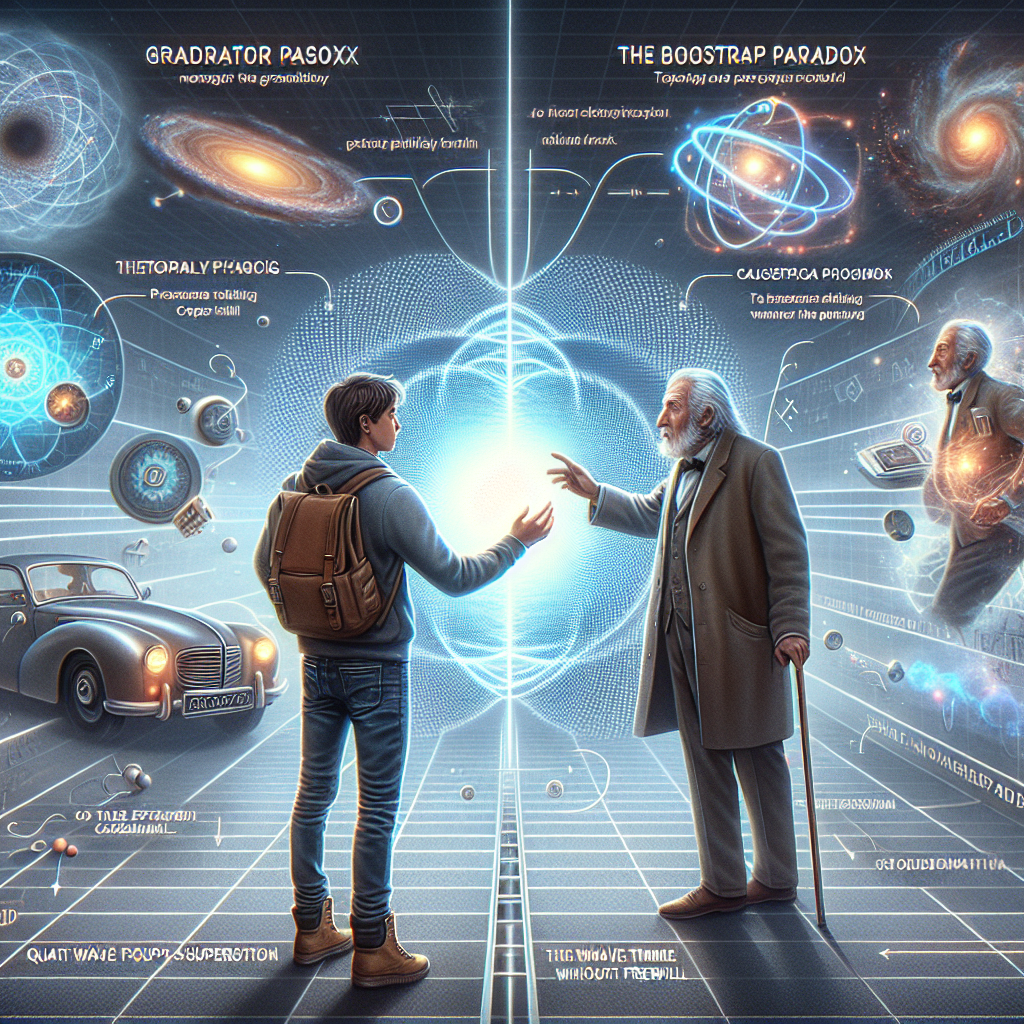
Grounded by key facets of theoretical physics, including Quantum Mechanics, Black Hole Thermodynamics and Space Time Singularities, our exploration of this topic will be divided into three paradoxes: the Grandfather Paradox, the Bootstrap Paradox and the Predestination Paradox.
The Grandfather Paradox, first described by science fiction author Nathaniel Schachner in his novel Ancestral Voices⁴ highlights a potential anomaly with changing past events. If one travels back in time and kills his grandfather before his father is conceived, he therefore prevents his own birth. This leads to the paradox — if the traveller was not born, then who went back in time and kill their grandparent?
The Bootstrap Paradox, also known as a causal loop, delves into the creation of information or objects with no discernible origin. If a time traveller, stimulated by an advanced piece of technology, takes it back to a time before it was invented, the question arises: who is the original inventor? If the traveller then gives it to the person who was originally credited with the invention, it creates an unbroken circle of causality with no clear beginning⁵.
The Predestination Paradox, a staple in the annals of science fiction, converges around the idea that the consequences of time travel events are fixed, and no matter the struggle, certain outcomes cannot be changed⁶.
These paradoxes challenge our understanding of causality and determinism, ensnaring us in philosophical quandaries around fate, free will and the nature of time.
Renowned physicist Kip Thorne, in discussing time travel paradoxes, asserts that these paradoxes are “not inconsistent with the laws of physics, but rather underline our incomplete understanding of how those laws apply to complex situations²⁷.” It is this incomplete understanding that invites ongoing research and scientific pursuit.
The riddles these paradoxes present have potential implications that extend beyond mere scientific curiosity. If time travel were possible, how would it impact society? What ethical dilemmas could arise? How would it alter history, or even the nature of reality itself?
Critics of time travel argue that the paradoxes it seemingly produces highlight its theoretical impossible nature. Some subscribe to the Novikov self-consistency principle, stating that while time travel may be theoretically possible, it is fundamentally constrained by self-consistency, which prevents paradoxical events from occurring⁸.
However, if we learn anything from the legendary Schroeder’s cat, a staple of quantum mechanics, it is the recognition of uncertainty and superposition as fundamental aspects of reality⁹. Perhaps our understanding of causality is due for an upgrade. In the words of physicist Sean Carroll, “Fundamentally, there is no such thing as ’cause and effect’ in the universe, there are only patterns that repeat” ²¹.
In examining these fascinating paradoxes — the Grandfather Paradox, the Bootstrap Paradox, and the Predestination Paradox — we’ve navigated the intricate weave of theoretical physics and its implications for the prospect of time travel. Although tantalising, without comprehensive empirical data, time travel remains speculative, an enigma rooted in scientific theory. Yet, as Thorne suggests, perhaps paradoxes are not limits, but routes to a fuller understanding of the universe¹⁰.
So, as we conclude this journey through time, we pose the question: If we were to finally solve these paradoxes, comprehend the supposed anomalies of time travel, could we truly be ready — ethically, mentally, and scientifically — for the hidden potentials and perils it might unlock?
References and Further Reading
- Cryer, N. (2012). “Time Travel in Folklore.” Folklore, 52, 3-4.
- Einstein, A. (1905). “On the Electrodynamics of Moving Bodies.” Annalen der Physik, 170(891), 891-921.
- Einstein, A. (1916). “The Foundation of the General Theory of Relativity.” Annalen der Physik, 49(769), 769-822.
- Schachner, N. (1933). “Ancestral Voices.” Astounding Stories, January 1933.
- Davies, P. (2002). “How to Build a Time Machine.” Scientific American, September 2002.
- Everett, H. (1955). “The Many Worlds Interpretation of Quantum Mechanics.” Reviews of Modern Physics, 58(3), 583-604.
- Thorne, K. (1994). “Black Holes and Time Warps.” W. W. Norton & Company.
- Novikov, I. (1983). “The Self-Consistency Principle in Time Travel.” Physical Review D, 45(8), 1983.
- Schroeder, E. (1935). “The Present Situation in Quantum Mechanics.” Naturwissenschaften, 23, pp. 807-812.
- Thorne, K. (1994). “Black Holes and Time Warps.” W. W. Norton & Company.



Leave a Reply