*its taken me a lot longer than I thought it would to create this post following my latest trip to hospital..
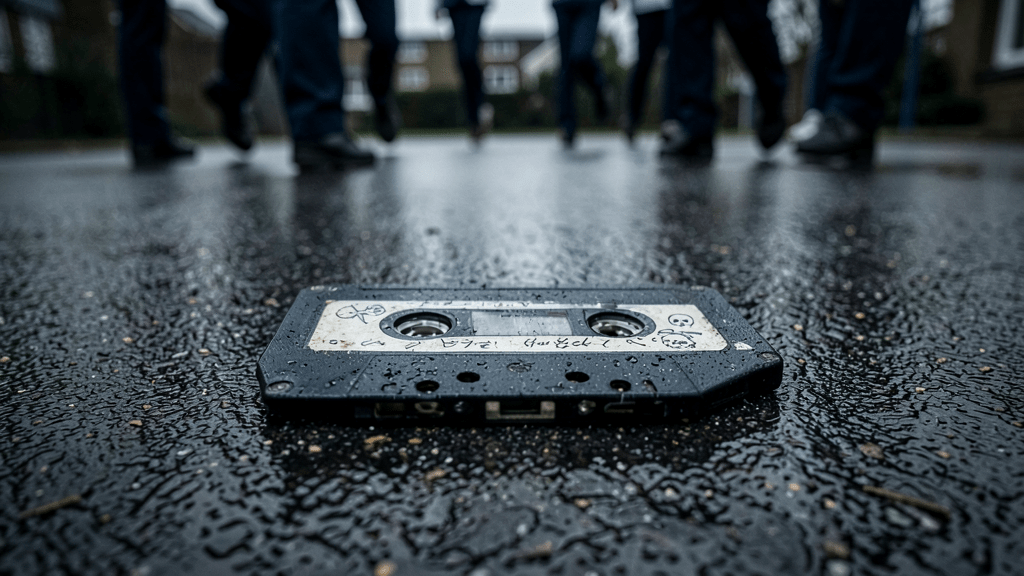
There is a specific kind of grey that only exists in a British state school playground. It’s the colour of damp asphalt, cheap wool jumpers, and the heavy, humid air of a Birmingham morning. It was in one of these playgrounds, back in the nineties, that I handed a cassette tape to my mate Ross. For a time I was the token long-haired goth in the village—a bit of a “Little Britain” anomaly in a leafy suburb that preferred its teenagers to be a bit more “Topman” and a bit less “The Mission.”
The tape was a TDK or a Maxell, I forget which, but the inlay was a mess of black biro scribbles. Skulls, crosses, the usual gothic architecture of a bored suburban mind. I’d curated it with the kind of focus usually reserved for bomb disposal. The “shock” track was by a band called Christian Death. I didn’t know it then, but by handing that tape over the heads of younger pupils rushing to avoid being late for double-period maths, I was planting a “flag” in the source code of my life. I was writing an initial condition into a program that wouldn’t bother to close the loop for another thirty or so years.
Most people talk about déjà vu as the ultimate “glitch in the matrix.” They describe that flickering moment where you feel you’ve lived a second before. But déjà vu is a cheap trick. It’s a neurological hiccup—a bit of lag between the eye and the brain. If you want to see the real glitches, the moments where the simulation is actually struggling to render your reality, you have to look at the coincidences. You have to look at the “random” happenschances that are far too on-the-nose to be mathematical accidents.
I call it the “Dorridge Singularity.”
For years, I’ve felt like my gut was more “hardware-compatible” with the universe than my brain. There’s a feeling you get when the world starts to fray at the edges. It’s an all-encompassing, visceral sensation—as if your stomach is telling your brain what to do, shouting, “The gut’s mad as hell and it’s not going to take it anymore!”
I felt it about six or seven years ago whilst tinkering with my first statistical horse-racing models. The program spat out three long-shot horses. When I read the names, I didn’t just see words; I knew them. I hadn’t seen them on the form earlier, but the recognition was absolute. I put a whopping £1 each-way on all three. They all came in. I won over £400, instead of really enjoying it, I spent the rest of the day kicking myself. I’d treated the “glitch” as a “spooky little thing” rather than listening to the system failure. I should have gone big. I should have trusted the error in the feed.
The scientific community calls this “Apophenia”—the human tendency to perceive meaningful patterns within random data. They’d say my brain was simply looking for a “win” and retrofitted the feeling to the result. But when the patterns start involving people, locations, and decades of history, “random data” starts to feel like a very thin excuse for a very lazy simulation.
The “Six Degrees of Dorridge”
Years after that playground tape-swap, I was working at IBM in Portsmouth. A senior graduate named Lawrence joined my team. As soon as he opened his mouth, I knew that accent. It wasn’t just “Brummie”; it was my Brummie. Turns out he was born and raised in Dorridge. Same school, just a few years older.
Then there was Phil. Another IBM colleague, he was born and raised in Portsmouth. Out of the blue, he offers me a lift up to Birmingham because his uncle is getting married there. I ask him where. He drops a “Dorridge” in his worst possible accent. Holy moly! shocked I ask which road. It’s a road with a footpath that leads directly to my old primary school—a four-minute stroll from my childhood front door.
But the real “mic drop”—the moment the simulation practically gave up trying to hide its shortcuts—involved my best mate from school, Chris. We’d lost touch since the mid-nineties, save for one random afternoon in 1994 when he turned up at my mum’s house just after I’d been accepted by IBM.
Fast forward to the year 1998ish. I’m sat at my desk at IBM, surrounded by the smell of heated A3 tractor-feed paper and the rhythmic clatter of keyboards. The phone rings. “Hello Paul, it’s Chris.”
He’d just landed a job in Portsmouth. Well, Fareham. Specifically, Whiteley—the exact spot where I was living. How did he know I was at IBM? Because of that one chance visit years prior. If he hadn’t turned up that one afternoon, we wouldn’t be in touch. He wouldn’t have introduced me to the woman who became my wife. My children wouldn’t exist. What if I had left following my degree?
But it gets lazier. I asked Chris how he’d found my direct line. “Oh,” he says, “I know a bloke called Lawrence at IBM. His sister is married to my dad.”
There it is. Lawrence—the random colleague from Portsmouth—is connected to my childhood best mate’s family. The simulation didn’t bother to create a new social circle for my adult life. It just took the “Dorridge” folder, copied it, and pasted it into the “Portsmouth” directory.
In the early 20th century, Carl Jung spoke about “Synchronicity.” He argued that these weren’t just coincidences, but “meaningful cross-connections” that suggest an underlying order to the universe. Even Einstein was bothered by “spooky action at a distance”—the idea that two particles could be inextricably linked across vast distances, reacting to one another instantly.
Maybe we aren’t particles. Maybe we’re just “assets.” If you’re a programmer building a world as complex as ours, you’re going to find ways to save memory. You’re going to re-use family trees. You’re going to link the same group of people over and over again because it’s computationally cheaper than rendering seven billion unique lives.
We think we’re living in a sprawling, infinite universe, but these glitches might be suggesting we’re actually living in a very small, very busy village where the “source code” keeps tripping over its own shoelaces.
Which brings us back to the tape.
Recently, Ross—the mate from the playground—got in touch. He’s a designer now. He’d been commissioned to create a poster for a new movie about the life of a troubled musician. The musician was born in California, raised in a strict religious household, and lived about 5,500 miles away from that damp Birmingham playground.
The musician’s name? Rozz Williams. The band he formed? Christian Death.
Over thirty years after I handed a cassette of Christian Death to a boy named Ross, the universe decided it was time to close that specific file. Ross was designing for Rozz. The “Initial Flag” I’d planted as a 16-year-old goth had finally been triggered.
We like to think we are the masters of our own “Sliding Doors” moments. We think our choices define us. But every now and then, the system glitches. Your stomach turns, a name from the past rings your desk phone, or a long-lost band reappear years later.
Next time you have a “small world” moment, don’t just laugh it off. Look at the rendering. Look at the lazy shortcuts. And for heaven’s sake, if your gut tells you to put more than a quid on those long shots, listen to it! The universe might be trying to tell you something.
*heres a link to the IMDB showcasing the movie and poster
**heres the youtube trailer for the movie.





 Conversations with AI
Leave a comment