*or how long is now? If you need me, I’ll be tucked up listening to The Smiths.
**Inspired by my father-in-law, thanks Dave xx
Take a moment to look at the room around you. Perhaps there is a cup of tea cooling on the desk, its steam twisting lazily into the air. Perhaps you can hear the faint, rhythmic hum of traffic from a nearby road, or the erratic patter of rain against the windowpane. You are reading these words, in this specific room, at this exact moment.
You are here, right now.
It feels like the most solid, undeniable truth in human experience. The past is a collection of fading charcoal sketches, safely locked away in the archives of memory. The future is a hazy realm of probabilities, unformed and unwritten. But the present? The present is real. It is the solid ground upon which we stand, the vibrant, high-definition theatre in which our lives unfold.
Yet, if you try to reach out and grab this thing we call ‘the present’, it vanishes between your fingers like smoke. If you ask a physicist to measure its duration, a neuroscientist to locate it in the brain, or a philosopher to define its boundaries, the comforting solidity of the present moment completely unravels.
We find ourselves trapped in a beautiful, permanent paradox: we live our entire lives within a moment that technically has no duration, experiencing a reality that has already happened, while hurtling toward a future that might already exist.
To understand how long ‘now’ truly is—and how the future continuously decays into the past—we have to tear down our everyday intuition and look at the universe through three distinct lenses: the absolute precision of physics, the delayed theatre of the human brain, and the existential landscape of philosophy.
The Mathematician’s Razor
Let us begin with the cleanest, most unforgiving perspective available to us: pure mathematics and classical physics.
In the neat, orderly universe envisioned by Sir Isaac Newton, time was an absolute, objective reality. Newton imagined time as an invisible, cosmic river, flowing at an identical, unalterable speed throughout the entire universe, completely independent of anything external. In this classical framework, if you wanted to define the present moment, you would look at time as a continuous geometric line.
But here lies the first trap. In geometry, what happens when you cut a line? You create a point. And what is the mathematical definition of a point? It is an entity that marks a position, but possesses zero width, zero length, and zero depth.
THE PAST <------------------------- | -------------------------> THE FUTURE THE NOW (Zero Thickness)
If the present is simply the boundary line that separates the past from the future, then classical mathematics forces us to an uncomfortable conclusion: the present has zero duration. It is an infinitely thin, dimensionless razor’s edge. The moment you attempt to measure it, it has already crossed the boundary. The future does not slowly fade into the present; it crashes through a mathematical fiction of zero thickness and instantly becomes history.
For centuries, this geometric abstraction sufficed. But when modern physics pushed past the smooth surfaces of classical mechanics and dove into the bizarre, pixelated world of quantum mechanics, scientists found that the universe dislikes infinity—and it equally dislikes zeroes. Nothing in the physical world seems to be truly continuous; everything, at its most fundamental level, is broken down into indivisible, discrete packets.
Enter Max Planck, the father of quantum theory. In the late 19th and early 20th centuries, Planck calculated a set of fundamental limits for the universe, constants below which the very laws of physics break down. Among these was the Planck time.
Calculated as approximately seconds, the Planck time is the briefest imaginable tick of the cosmic clock. To put that number into perspective, there are more Planck times in a single second than there have been seconds since the Big Bang occurred 13.8 billion years ago. It is an unimaginably microscopic duration.
If we apply quantum mechanics to our question, we can argue that the universe does not flow smoothly like a river, but rather stutters forward like a digital film projector. Each frame of reality stays on screen for exactly one Planck time. In this quantum view, the future becomes the present, stays there for seconds, and then becomes the past.
For a physicist looking at the fundamental fabric of spacetime, that is your answer. “Now” is a flicker so brief that it defies human comprehension. It is the ultimate cosmic shutter speed.
Einstein’s Slicing Machine
Just as we might get comfortable with the idea of a universal, quantum tick of the clock, Albert Einstein arrives to shatter the clockface entirely.
Before Einstein published his theory of Special Relativity in 1905, humanity operated under the assumption that “now” was a universal constant. If you checked your watch in London at exactly 3:00 PM, you could confidently assume that it was 3:00 PM across the surface of the Moon, on the rings of Saturn, and in the furthest reaches of the Andromeda galaxy. Surely, the present moment was a cosmic blanket draped evenly over the entire universe?
Einstein proved that this is an illusion caused by our slow, provincial lives. Time, he revealed, is intricately woven with space into a four-dimensional fabric called spacetime. Crucially, the rate at which time passes depends entirely on two variables: your speed through space and the strength of the gravitational field around you.
This realization destroyed what physicists call the relativity of simultaneity. Imagine two colossal lightning bolts striking the ground miles apart. To an observer standing precisely halfway between them, the two flashes might appear to happen at exactly the same time—in the same “now.” But to an observer traveling at high speed in a train towards one of the bolts, the light from the closer strike will reach their eyes first. Because the speed of light is absolute, that moving observer will legitimately, scientifically conclude that one lightning bolt struck before the other.
[Observer on Train ->]Lightning A ----------------- *Train* --------- Lightning B(Light from B reaches observer first; therefore, B happens before A in their 'now')
Neither observer is wrong. Both realities are perfectly valid within their own frames of reference.
What this means for our quest is profound: there is no single, objective “now” that encompasses the universe. Your present moment is entirely local, a bespoke construct of your current speed and gravitational environment. If an alien civilization in a distant galaxy were to change its speed by just a few kilometres per hour relative to Earth, their calculation of what is happening on Earth right now could shift by days, weeks, or even centuries into our past or future.
This led Einstein and many modern physicists to embrace a philosophical view known as Eternalism, or the Block Universe.
In the Block Universe model, time does not pass at all. Instead, the past, the present, and the future all co-exist simultaneously as a giant, four-dimensional block of space-time. Think of it like a loaf of sliced bread. The childhood version of you exists at one slice near the crust; your current self reading this post exists on a slice somewhere in the middle; and the moment of your death exists on a slice further down the loaf. They are all equally real, permanently etched into the architecture of the cosmos.
If Eternalism is correct, the future doesn’t “become” the present, because the future already exists. “Now” is not an objective property of time; it is merely a subjective coordinate in space-time. Just as the word “here” simply describes the specific physical location you happen to occupy right now without implying that the rest of the world doesn’t exist, the word “now” simply describes the temporal location your consciousness currently inhabits.
As Einstein himself beautifully wrote upon the death of his lifelong friend Michele Besso: “For us believing physicists, the distinction between past, present and future is only a stubbornly persistent illusion.”
The Auditory Ghost
If physics reduces the present to either an infinitesimal quantum tick or a subjective coordinate in a static block of space-time, how do we reconcile that with our vibrant, fluid experience of life? We do not feel like we are trapped on a single, frozen slice of a cosmic loaf of bread, nor do we feel like we are experiencing reality in stuttering bursts of septillionths of a second.
To bridge this gap, we must turn away from the stars and look inward, into the dark, gelatinous confines of the human skull.
The human brain is a magnificent engine of illusion. It goes to extraordinary lengths to construct a smooth, coherent version of reality for us, but this construction takes work—and more importantly, it takes time. The truth is, we do not live in the present. Biologically speaking, we are permanently living in the past, watching a carefully edited, tape-delayed broadcast of the world.
Think about how your brain receives information from the environment. If you drop a book on your foot, two distinct sensory events occur simultaneously: your eyes see the book hit your skin, and the nerve endings in your foot register the impact.
But light travels at roughly 300,000 kilometres per second, meaning the visual information reaches your eyes almost instantly. The neural signals from your foot, however, must travel up your leg, through your spinal cord, and into your brain at a sluggish speed of about 30 metres per second. Furthermore, the auditory information from the thud of the book hitting the floor travels at the speed of sound, arriving at your ears somewhere between the speeds of light and touch.
If your brain passed these signals to your conscious awareness as soon as they arrived, your world would be a disjointed, chaotic mess. You would see the book hit your foot, hear the sound a fraction of a second later, and finally feel the pain moments after that.
To prevent this sensory dissonance, the brain operates a buffer system. It holds onto the faster sensory inputs (vision and sound) to allow the slower inputs (touch from distant nerve endings) time to catch up. Neuroscientists have discovered that this integration window lasts roughly 80 milliseconds.
[Simultaneous Event: Book Hits Foot]Light signal ------> (Arrives in 0.000003 ms) ---> [ BRAIN BUFFER ] ---> [CONSCIOUS NOW]Sound signal ------> (Arrives in 3.000000 ms) ---> [ BRAIN BUFFER ] (After ~80ms)Touch signal ------> (Arrives in 40.000000 ms) --> [ BRAIN BUFFER ]
If two sensory events occur within an 80-millisecond window, the brain retroactively stitches them together, syncs them up, and delivers them to your consciousness as a single, unified “now.”
This phenomenon is dramatically illustrated by the famous “flash-lag” effect. If a light flashes at the exact millisecond a moving object passes it, your brain, busy calculating where the moving object should be based on its trajectory, will actually perceive the flash as lagging behind the object. Your brain is gambling on the immediate future to construct its version of the present.
So, when does the future become the present in the human brain? It doesn’t. By the time your neural networks have collected the data, cross-referenced the inputs, smoothed out the chronological discrepancies, and lit up the theatre of your conscious mind, the physical events that caused those signals occurred nearly a tenth of a second ago. You are looking at history, wrapped up in a bow and labelled “the present.”
The Specious Present
Even an 80-millisecond window is too brief to describe our psychological experience of time. We do not experience life as a rapid-fire sequence of decoupled, 80-millisecond snapshots. When you listen to a melody, you do not just hear the single, isolated note playing at this precise millisecond; if you did, music would be entirely meaningless. You hear the current note in the context of the notes that just preceded it, anticipating the notes that are about to follow. Your mind holds a phrase of time together in a single conscious grasp.
In the late 19th century, the philosopher E.R. Clay coined a magnificent phrase to describe this phenomenon, which was later popularized by the psychologist William James: the specious present.
James argued that the real, physical present is a mathematical fiction—the knife-edge we discussed earlier. But the psychological present is not a knife-edge; it is a “saddleback” upon which we sit, looking in two directions at once.
               THE SPECIOUS PRESENT (2 to 3 Seconds)
                _________________________________
               /                                 \
              /   Past Context  |  Future Horizon \
             /                  |                  \
<------- THE PAST               |               THE FUTURE ------->
                            TRUE NOW
“The practically cognized present,” James wrote, “is no knife-edge, but a saddle-back, with a certain breadth of its own, to which we sit astride, and from which we look in two directions into time.”
How wide is this saddleback? Modern cognitive psychology suggests that the human specious present lasts anywhere from two to three seconds.
This three-second window appears to be a fundamental building block of human culture and biology. If you look closely across human activities, you will see the three-second metric repeating itself with uncanny regularity:
- Speech: The average length of a spoken phrase or clause across almost all human languages is roughly three seconds.
- Music: Musical phrases and motifs in classical and modern compositions typically last between two and three seconds before resolving or changing.
- Poetry: When poetry is read aloud, the individual lines or stanzas are consistently structured to take about three seconds to utter.
- Biology: Spontaneous human gestures, from a wave hello to a comforting embrace, tend to linger for around three seconds before breaking.
This three-second window is the maximum amount of time our working memory can hold information in active, immediate awareness without having to consciously rehearse it or relegate it to long-term memory retrieval. It is the true size of our conscious canvas. Within this three-second bubble, the future smoothly transforms into the past, filtered through the lens of our current attention.
The Alchemy of Becoming
This brings us to the second half of our great riddle: How does this transition happen? When does the future become the present, and when does the present become the past?
If we step out of the cold mechanics of neuroscience and into the philosophical domain of phenomenology—the study of how we actually experience consciousness—the movement of time reveals itself as a profound piece of cosmic alchemy. It is the process by which fluid probability is permanently cast into solid stone.
Think of the future as a landscape made of liquid. It is a realm of infinite potential, a cloud of quantum wave functions where nothing is entirely certain. Will it rain tomorrow? Will you finish that project? Will a rogue asteroid disrupt the orbit of Mars? Until the moment arrives, these events exist only as mathematical probabilities. The future is malleable, soft, and unformed.
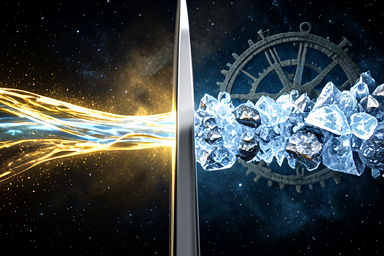
The present moment acts as a sort of cosmic freezing mechanism, an existential crystallization point. As the river of time rushes through this point, the liquid potential of the future hits the freezing air of the present. In that exact fraction of a second, the wave functions collapse. The liquid freezes instantly into solid ice.
[ THE FUTURE ] =============> [ THE PRESENT ] =============> [ THE PAST ]Fluid Potential Crystallization Solid History(Probability) (The Collapse) (Immutability)
Once that transformation occurs, the event moves into the past, and it becomes utterly immutable. The ice cannot be un-frozen; the stone cannot be un-carved. The past is the realm of absolute certainty, a permanent record of what the universe chose to do when presented with the endless possibilities of the future.
This continuous flip from fluid to stone happens smoothly, without a single pause or stutter, because time is tied directly to the concept of entropy—the physical law stating that the universe naturally progresses from a state of order to a state of disorder.
The arrow of time always points forward because it requires less energy for things to break apart than it does for them to spontaneously assemble. A coffee cup falls from a table and shatters on the floor; we never see a collection of ceramic shards leap off the ground and fuse back into a pristine, steaming mug. The present moment is the exact point of shattering. The future is the unbroken cup on the table; the past is the debris on the floor; the present is the violent, beautiful instant of impact.
Living in the Delayed Broadcast
So, where does our journey leave us?
If you look to the stars and the equations of relativity, “now” is nothing more than a local illusion, a subjective frame of reference inside a massive, static block of four-dimensional space-time where yesterday, today, and tomorrow are already written.
If you look to the quantum microscopic world, “now” is a frantic, hyper-fast shutter that ticks every septillionth of a second, transforming future probabilities into past certainties at the speed of Planck time.
And if you look into the mirror, “now” is a beautifully curated, 80-millisecond-delayed theatrical production constructed by a biological computer that keeps you trapped a fraction of a second behind reality, wrapped up in a comfortable, three-second blanket of conscious awareness.
+-------------------------------------------------------------------------+| THE THREE FACES OF NOW |+-------------------+-----------------------------------------------------+| The Quantum View | A discrete tick lasting 5.39 x 10^-44 seconds. |+-------------------+-----------------------------------------------------+| The Einsteinian | A subjective local coordinate with zero thickness. |+-------------------+-----------------------------------------------------+| The Human View | A 3-second biological bubble built on a delay. |+-------------------+-----------------------------------------------------+
There is something deeply poetic about this realization. We spend so much of our modern lives obsessing over the idea of “living in the moment.” We practice mindfulness, we download apps, we try desperate techniques to anchor ourselves in the elusive present.
But science tells us that, physically and biologically, we can never truly catch the present moment. By the time we realise we are experiencing it, it has already slipped through the zero-thickness razor’s edge of physics and hardened into the permanent architecture of the past.
Perhaps, then, the secret to existence is not to fret about pinning down the exact millisecond of the present. Instead, we can learn to appreciate the magnificent illusion our brains create for us. We are passengers on a three-second biological sailing boat, navigating a sea where the future is an open ocean of liquid possibility, and the past is a solid wake trailing behind us.
We live in the delay, we think in the lag, and we feel in the saddleback. And in a universe as cold, vast, and indifferent as ours, that beautifully constructed, three-second illusion is more than enough room to live an entire life.





Leave a Reply