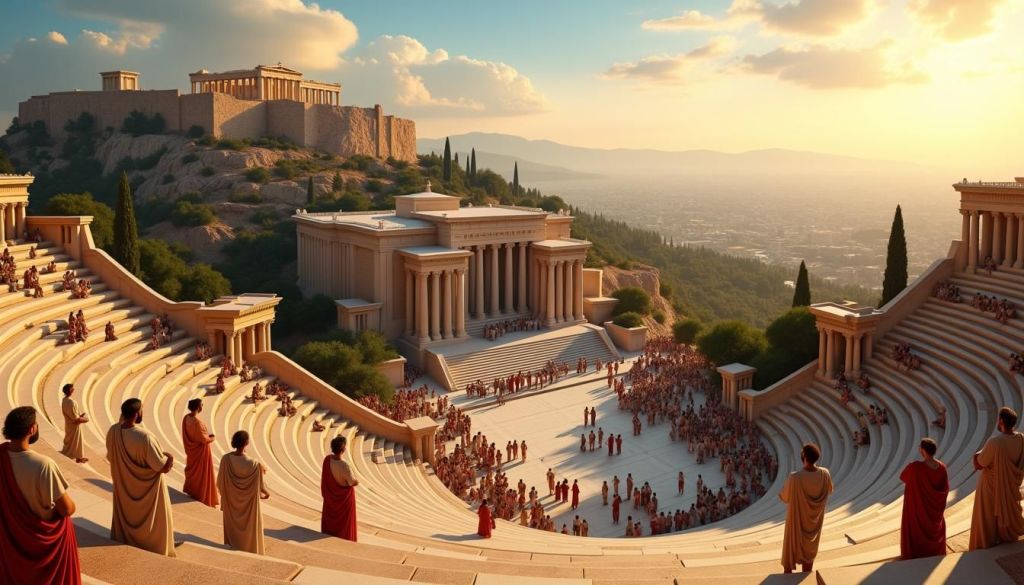
Imagine standing in the heart of Athens, 2,500 years ago. The air buzzes with heated debates about justice, truth, and the nature of existence. A stone’s throw away, crowds gather in open-air theatres, weeping at tragic heroes’ downfalls or roaring with laughter at satirical jabs. This was ancient Greece—a civilisation that didn’t just invent democracy and Olympic games but fundamentally shaped how humans think, argue, and tell stories. From the Socratic method taught in modern classrooms to the three-act structure of Hollywood blockbusters, the fingerprints of ancient Greek philosophy and theatre are everywhere. Let’s explore how a cluster of city-states clinging to the Mediterranean coastline became the cradle of Western thought and dramatic arts.
Understanding ancient Greece’s contributions requires stepping into its historical context. Between roughly 800 BCE and 146 BCE, Greek civilisation evolved through three key periods: the Archaic (800–500 BCE), Classical (500–323 BCE), and Hellenistic (323–146 BCE). The 5th century BCE—the height of the Classical era—saw Athens emerge as a cultural powerhouse following its victories in the Persian Wars (499–449 BCE). With wealth from maritime trade and tribute from its Delian League allies, Athens invested in philosophy, drama, and public discourse. This was a society obsessed with arete (excellence) and logos (reason), values that permeated its intellectual and artistic output. Crucially, the Greeks’ shift from mythological explanations to rational inquiry—a transition scholars call the “Greek Miracle”—laid the groundwork for systematic philosophy and structured theatre.
When discussing Greek philosophy, three names tower above the rest: Socrates, Plato, and Aristotle. Socrates (470–399 BCE), the quintessential gadfly, revolutionised thinking by prioritising questions over answers. His dialectic method—probing assumptions through relentless questioning—was as revolutionary as it was controversial. “The unexamined life is not worth living,” he declared during his trial for “corrupting the youth” [1]. Though Socrates left no writings, his student Plato (428–348 BCE) immortalised his ideas in dialogues like The Republic, which explores justice, governance, and the philosopher-king ideal. Plato’s Theory of Forms, proposing that abstract concepts (beauty, truth) exist beyond the physical world, influenced Christian theology and Renaissance humanism alike [2].
Aristotle (384–322 BCE), Plato’s pupil, took a more empirical approach. His Nicomachean Ethics dissected virtue, while Poetics analysed tragedy’s mechanics. Unlike Plato’s idealism, Aristotle believed truth resided in observable reality. His syllogistic logic became the bedrock of Western rationalism. As philosopher Bertrand Russell noted, “Aristotle’s influence… has been immeasurable and transcends the details of his system” [3]. Beyond the big three, schools like the Stoics (emphasising self-control) and Epicureans (prioritising pleasure as absence of pain) offered competing visions of the good life.
Greek theatre, meanwhile, was both entertainment and civic ritual. Originating from Dionysian festivals honouring the wine god, tragedies and comedies were performed in monumental amphitheatres like Athens’ Theatre of Dionysus (capacity: 17,000). Tragedians like Aeschylus, Sophocles, and Euripides explored hubris, fate, and divine will through mythic tales. Sophocles’ Oedipus Rex, with its themes of self-discovery and inevitable doom, remains a masterclass in dramatic irony. Comedies, particularly Aristophanes’ Lysistrata (where women end war via a sex strike), blended slapstick with biting political satire.
The Greeks’ theatrical innovations were structural and philosophical. They introduced the trilogy format, mechanised stage devices (deus ex machina), and the three-actor rule, enabling complex dialogue. Crucially, theatre was a democratic space: plays were state-funded, with free tickets for the poor, ensuring all citizens could engage with societal issues. As classicist Edith Hamilton argued, Greek drama “reached for the universal… making the spectator feel he was watching his own struggles” [4].
The interplay between philosophy and theatre was profound. Tragedies grappled with existential questions philosophers systematised. When Oedipus declares, “I must know my birth, no matter how common,” he echoes Socrates’ insistence on self-knowledge [5]. Conversely, Plato famously banned poets from his ideal republic, fearing their emotional appeals undermined reason—a stance Aristotle countered by defending tragedy’s cathartic value.
These contributions didn’t emerge in a vacuum. Athens’ democracy (however limited to male citizens) fostered a culture of debate, while military conflicts like the Peloponnesian War (431–404 BCE) prompted soul-searching about human nature. The decline of city-states and rise of Alexander’s empire later spread Greek ideas across the Mediterranean, blending with Eastern traditions in the Hellenistic synthesis.
Critically, Greek thought had blind spots. Women, enslaved people, and foreigners were largely excluded from intellectual life. Socrates’ trial underscores tensions between free inquiry and societal norms—a tension still relevant today. Moreover, the emphasis on reason sometimes dismissed emotional or spiritual truths, a critique later Romanticists would amplify.
Yet the legacy is undeniable. Roman thinkers like Cicero and Seneca were steeped in Greek philosophy, medieval scholastics debated Aristotle via Arabic translations, and Enlightenment figures like Voltaire drew on Greek rationalism. Theatrically, Shakespeare’s tragedies and modern psychological dramas owe debts to Sophocles, while sitcoms inherit Aristophanes’ irreverence. Even the word “theory” (theoria) comes from Greek, meaning “contemplation.”
What can today’s readers take from this? Firstly, that questioning assumptions—a core Socratic value—remains vital in an age of misinformation. Secondly, that storytelling, as the Greeks knew, isn’t mere escapism but a mirror to examine our lives. Finally, their legacy reminds us that human flourishing thrives where free inquiry and artistic expression intersect.
So, next time you debate ethics in class or lose yourself in a Netflix drama, remember: you’re participating in traditions forged under the Attic sun. The Greeks may have worshipped Olympian gods, but their greatest gift was making us gods of our own minds, armed with reason and imagination. Are we using those gifts as wisely as they hoped?
References and Further Reading
- Plato. Apology, 38a. Translated by Benjamin Jowett.
- Kitto, H.D.F. The Greeks. Penguin, 1951.
- Russell, Bertrand. A History of Western Philosophy. Simon & Schuster, 1945.
- Hamilton, Edith. The Greek Way. W.W. Norton & Company, 1930.
- Sophocles. Oedipus Rex. Translated by David Grene. University of Chicago Press, 1991.
- Aristotle. Poetics. Translated by Malcolm Heath. Penguin Classics, 1996.
- Cartledge, Paul. Ancient Greece: A Very Short Introduction. Oxford University Press, 2011.
- Nussbaum, Martha. The Fragility of Goodness. Cambridge University Press, 1986.





 Conversations with AI
Leave a comment