*Inspired by ‘Fluke’ by Brian Klaas and ‘Nexus’ by Yuval Noah Harari – thanks to my father-in-law, Dave, for the gift.
**and this quote “If you tell the truth, you don’t have to remember anything“, Mark Twain
Reach into your pocket and pull out a banknote. Physically, it is nothing special—a blend of cotton and polymer. You cannot eat it, it will not keep you warm, and it certainly will not shelter you from a storm.
Yet, for this flimsy rectangle, armies march, forests are cleared, and we trade away the best hours of our lives.
Why? Because we have all agreed to a specific story: that this coloured paper holds value. It is a shared illusion, a narrative that has been repeated so many times it has hardened into a concrete fact. We treat it as if it were a law of physics, like gravity, yet it exists entirely within our collective imagination.
This begs a rather unsettling question: At what precise moment does a fiction—a story, a rumour, or a belief—cross the threshold to become our reality? And once that transformation is complete, is it even possible to reverse it?
The Collective Hallucination
If we zoom out, we see this phenomenon operating on a massive scale. Historian Yuval Noah Harari calls these “inter-subjective realities”—entities that exist solely because a large group of people believe they do.
Consider a national border. In the physical world, there is no red line drawn across the earth. The soil on one side is identical to the soil on the other; the birds fly across it without a second thought. But because enough humans believe the story of that border, it becomes a rigid reality. We build fences, we staff checkpoints with armed guards, and we demand passports.
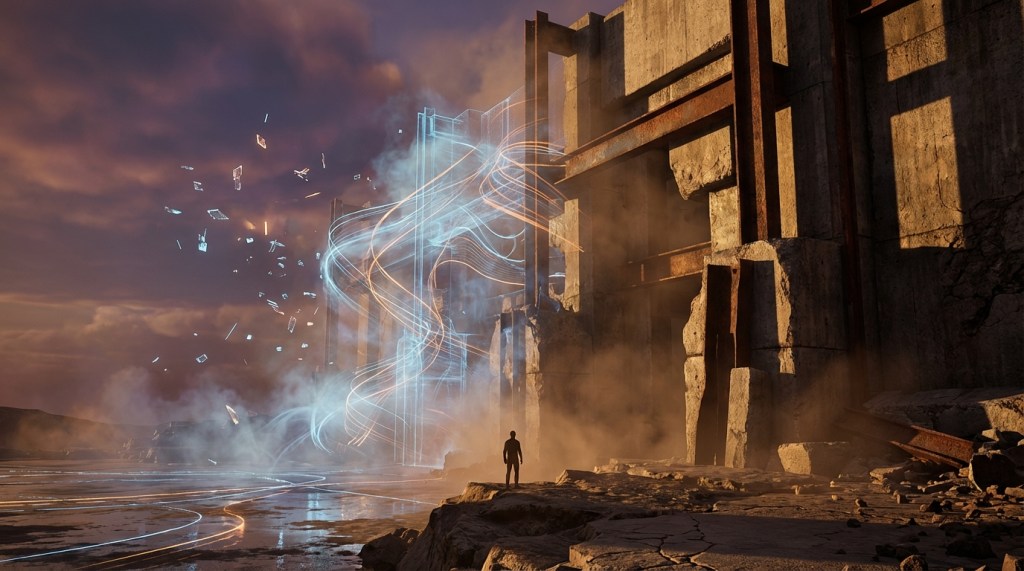
The fiction (the line on the map) has commanded the physical world (the concrete wall). The story effectively willed the matter into existence. Corporations operate the same way. A company is not the building, nor the employees, nor the products. It is a legal fiction—a piece of paper in a filing cabinet. Yet, that fiction can be sued, it can own property, and it can shape the economy. We are living inside a library of stories that have become so dense, we mistake them for the walls of the world.
The Stories We Tell Ourselves
This mechanism is not limited to empires and economies; it is running quietly in the background of our own minds, too. We are all constant narrators of our own lives, and the scripts we write are often dangerous.
Take, for instance, a child who is told repeatedly that they are “the clumsy one.” Initially, this is just words—noise in the air. But eventually, the child accepts the narrative. They begin to move with hesitation. They anticipate the fall before it happens. The belief alters their physical behaviour, making them actually clumsier.
Psychologists might call this a self-fulfilling prophecy, but it is really just another form of reality creation. We tell ourselves we are imposters, or that we are unlucky, or that we are destined to fail. We repeat the story until it solidifies. The internal fiction dictates our external actions, and suddenly, the story has become the biography.
The Tipping Point
So, to answer the question that started this inquiry: at what precise moment does the fiction become reality?
It is not when the idea is formed, nor even when it is shared. The transition—the “compilation” of the code—happens the moment belief precipitates action.
A border is just a line on a map (fiction) until someone lays the first brick of a wall (reality). A currency is just paper until a baker hands over a loaf of bread in exchange for it. The moment the physical world is altered to accommodate the story, the fiction has secured its foothold.
It is the point where the internal narrative forces a material consequence. If you believe you are unworthy of a promotion, that is just a thought. But the moment you don’t apply for the role because of that thought, the fiction has altered the timeline of your life. It has manifested. The script is no longer just words on a page; it is now the direction the actors are moving.
The Weight of Legacy Code
This brings us to the second, more difficult question: once the reality is set, is there any way to say otherwise?
The short answer is: yes, but the cost is astronomical.
Once a fiction has hardened into reality, it develops inertia. You cannot simply decide that money has no value tomorrow, because the entire infrastructure of the world—supply chains, governments, pension funds—relies on that specific story remaining true. To “say otherwise” would require a total collapse of the system.
Similarly, in our personal lives, dismantling a decades-old narrative is an act of demolition. If you have built your entire identity around the belief that you are a victim or an outsider, changing that story means acknowledging that years of behaviour were based on a lie. It requires tearing down the walls you built to protect yourself.
Most people, and most societies, find it easier to keep patching the old, broken system than to undergo the pain of a rewrite. The concrete has set; chipping it away takes a force far greater than the imagination that built it.
Conclusion
Reality, then, is not something we merely inhabit; it is something we are constantly participating in. We are the architects of the next moment.
We must be careful with the stories we tell—about our nations, our economies, and ourselves. Because if we repeat them with enough conviction, and back them with enough action, they threaten to come true. And once they do, we are forced to live in the house we have built.




 Conversations with AI
Leave a comment