*Light reading for a Sunday morning, sorry.
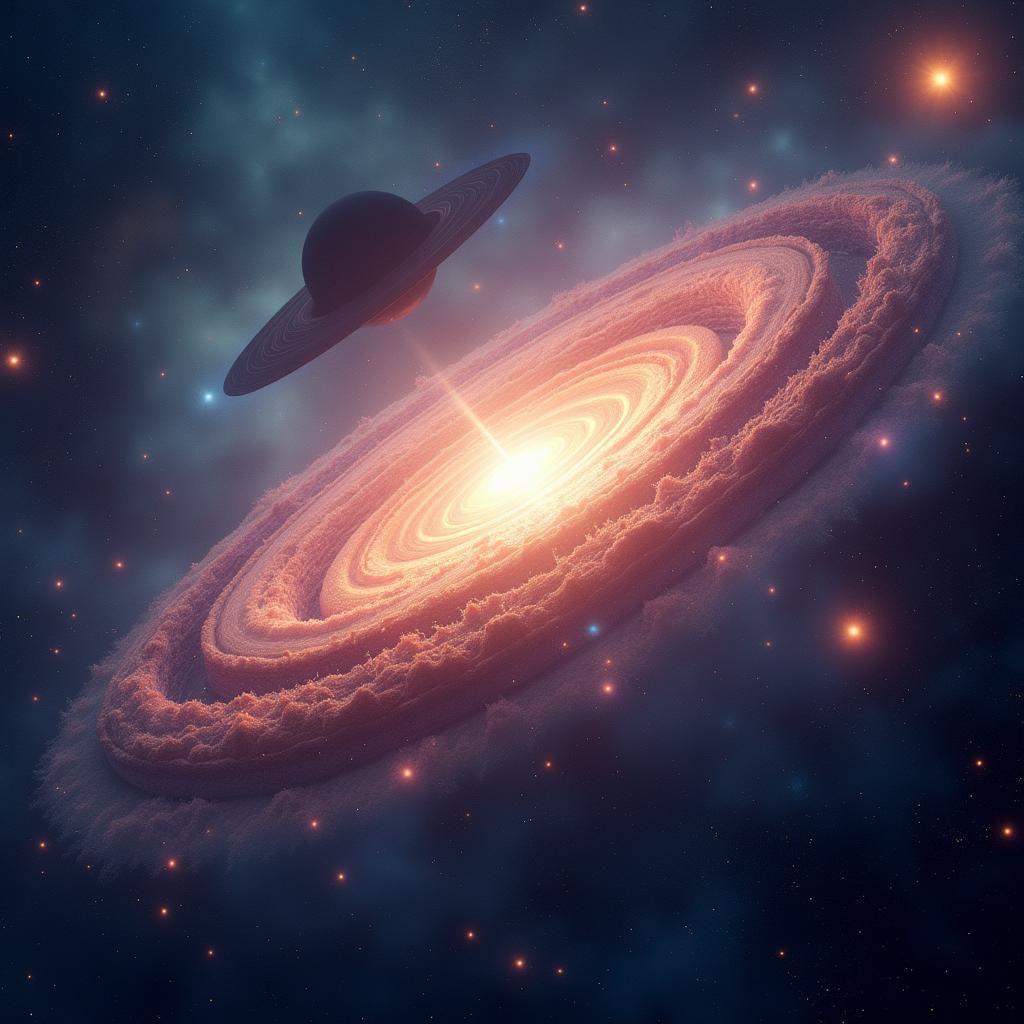
Imagine looking up at the vast, starry night sky. You see the graceful dance of planets, the swirling beauty of galaxies, all governed by the elegant laws of gravity, described so perfectly by Albert Einstein over a century ago. Now, imagine shrinking down, smaller than an atom, smaller even than the nucleus, entering a realm where particles pop in and out of existence, where energy comes in discrete packets, and where uncertainty reigns supreme. This is the bizarre world of quantum mechanics. For decades, these two descriptions of reality – the cosmic grandeur of general relativity and the fuzzy uncertainty of quantum mechanics – have been the bedrock of modern physics. They work spectacularly well in their own domains. But there’s a colossal problem: try to use them together, in places where gravity is incredibly strong and distances are incredibly small, like the heart of a black hole or the very first moments of the universe, and the equations break down. They give nonsensical answers, infinities popping up where solid predictions should be. This clash of titans signifies one of the deepest mysteries in science, the need for a new theory, a theory of Quantum Gravity. This journey into the quest for quantum gravity isn’t just about reconciling equations; it’s about understanding the fundamental fabric of reality itself, exploring the very nature of space and time at their most elementary level. It’s a quest that pushes the boundaries of human imagination and intellect.
To appreciate the chasm that quantum gravity seeks to bridge, we need to understand the two pillars it attempts to unite. First came Albert Einstein’s theory of General Relativity, unveiled in 1915 [1]. It revolutionised our understanding of gravity, describing it not as a force pulling objects together, but as the curvature of spacetime itself. Massive objects warp the spacetime around them, and other objects follow these curves, like marbles rolling on a stretched rubber sheet distorted by a heavy ball. General Relativity has been stunningly successful, accurately predicting phenomena like the bending of starlight by gravity, the existence of black holes, and the ripples in spacetime known as gravitational waves, first detected in 2015 [2]. It is the theory of the very large, governing planets, stars, galaxies, and the expansion of the universe. Then, in the early 20th century, another revolution was brewing: Quantum Mechanics. Pioneers like Max Planck, Niels Bohr, Werner Heisenberg, and Erwin Schrödinger developed this strange new set of rules to describe the world of atoms and subatomic particles [3]. Quantum mechanics revealed that energy, momentum, and other quantities are often restricted to discrete values (quanta), that particles can also behave like waves, and that there’s an inherent uncertainty in measuring certain pairs of properties, like a particle’s position and momentum simultaneously (Heisenberg’s Uncertainty Principle). It governs the behaviour of matter and energy at the smallest scales, underpinning everything from semiconductors in your phone to nuclear reactions in stars. Both theories are incredibly accurate within their own spheres of influence. The problem arises when we encounter situations involving both immense gravity and tiny scales. Inside a black hole, general relativity predicts a point of infinite density and zero volume – a singularity. At the Big Bang, the entire observable universe is thought to have originated from a similarly extreme state. In these regimes, both gravity (requiring GR) and quantum effects (requiring QM) are crucial, but the existing theories contradict each other fundamentally. General relativity assumes spacetime is smooth and continuous, while quantum mechanics suggests that at the smallest scales, everything, possibly even spacetime itself, might be lumpy and quantised. Finding a theory that seamlessly blends these two frameworks is the central goal of quantum gravity research.
The quest, therefore, is to find a theory that treats gravity according to the principles of quantum mechanics. What would this look like? Physicists hypothesise that just as the electromagnetic force is mediated by quantum particles called photons, gravity might also be mediated by a quantum particle, dubbed the ‘graviton’. A theory of quantum gravity should explain how these hypothetical gravitons arise and interact, effectively describing gravity’s behaviour at the quantum level. However, simply trying to apply standard quantum techniques to Einstein’s theory of gravity leads to mathematical disasters – those uncontrollable infinities again. This indicates that a more radical rethinking of space, time, or both might be necessary. Over the decades, physicists have developed several candidate theories, each offering a different perspective on how gravity might operate quantum mechanically. Two leading contenders dominate the landscape: String Theory and Loop Quantum Gravity.
String Theory proposes a radical departure from the idea of fundamental point-like particles. Instead, it suggests that the ultimate constituents of reality are unimaginably tiny, vibrating, one-dimensional ‘strings’ [4]. Different modes of vibration of these strings correspond to different particles, much like different vibrations of a violin string produce different musical notes. Remarkably, one specific vibration mode naturally corresponds to a particle with the properties expected of the graviton, the carrier of the gravitational force. This was a major breakthrough, suggesting string theory inherently incorporates quantum gravity. However, string theory comes with its own set of unique features and challenges. For mathematical consistency, it requires the existence of extra spatial dimensions beyond the three we experience (usually six or seven additional dimensions), which are thought to be curled up, or ‘compactified’, to sizes far too small to detect directly [4]. Furthermore, it turns out there isn’t just one string theory, but five consistent versions, which were later understood to be different aspects of a deeper, underlying theory called M-theory, operating in eleven dimensions. Physicist Edward Witten, a leading figure in string theory, remarked on its richness: “String theory is a part of twenty-first-century physics that fell by chance into the twentieth century” [5]. A significant challenge for string theory is the ‘landscape problem’ – the theory seems to allow for a vast number (perhaps 10^500 or more) of possible vacuum states, each corresponding to a different universe with potentially different physical laws, making it incredibly difficult to pinpoint the specific predictions for our universe [6].
An alternative approach is Loop Quantum Gravity (LQG). Unlike string theory, which starts with particle physics and finds gravity emerging, LQG attempts to directly quantise Einstein’s theory of general relativity itself, applying quantum rules to spacetime [7]. It takes seriously the idea that spacetime geometry is dynamic, as described by Einstein. LQG predicts that space itself is not smooth and continuous but has a granular structure at the incredibly small Planck scale (around 10^-35 metres). Imagine space as being woven from fundamental, discrete loops, forming what’s called a spin network. These loops represent quantised units of area and volume. Time also progresses in discrete steps. As Carlo Rovelli, one of the pioneers of LQG, puts it: “Space is created by the interaction of quantum gravitational fields… it is a dynamic entity, not an inert background container” [8]. LQG is background-independent, meaning it doesn’t assume a pre-existing spacetime background on which physics unfolds; instead, spacetime itself emerges from the theory’s fundamental entities. This is seen as an advantage by its proponents, as it aligns closely with the spirit of general relativity. However, LQG also faces challenges. Reconciling its picture of discrete spacetime with the smooth spacetime of classical relativity at larger scales (the ‘classical limit’) is complex, and incorporating matter and other forces from the Standard Model of particle physics into the framework remains an active area of research [7].
While String Theory and LQG are the most prominent contenders, they are not the only ideas. Other approaches include Asymptotic Safety, which explores the possibility that gravity might become well-behaved quantum mechanically at high energies without needing new structures like strings or loops; Causal Dynamical Triangulations, which models spacetime as being built from tiny triangular building blocks following quantum rules; and various approaches inspired by information theory and thermodynamics. The existence of multiple distinct approaches highlights how challenging and wide-open this field of research truly is. A major hurdle for all quantum gravity theories is the lack of experimental evidence. The Planck scale, where quantum gravity effects are expected to become dominant, corresponds to energies vastly beyond the reach of current particle accelerators like the Large Hadron Collider [9]. This makes direct testing incredibly difficult, forcing physicists to look for subtle, indirect clues. Potential signatures might be hidden in the faint patterns of the Cosmic Microwave Background radiation (the afterglow of the Big Bang), in the precise timing of signals from distant cosmic events, or perhaps in the behaviour of gravitational waves originating from extreme astrophysical phenomena like merging black holes or neutron stars [10]. As Lee Smolin, another key figure in LQG, noted regarding the need for testability, “A theory that makes no predictions is unfalsifiable and therefore unscientific” [11]. This challenge pushes theorists to develop models that might yield even tiny, potentially observable effects.
The search for quantum gravity isn’t merely a technical exercise in unifying mathematical frameworks; it probes the very foundations of our understanding of reality. If spacetime is indeed quantised, as suggested by LQG, what does that mean for the continuity of motion? Does time itself flow smoothly, or does it tick by in discrete steps? Some interpretations of these theories even suggest that time might not be a fundamental property of the universe, but rather an emergent phenomenon arising from more basic quantum relationships, a concept that challenges our deepest intuitions [8]. The implications are profound, forcing us to question the nature of space, time, and existence. Furthermore, a successful theory of quantum gravity would unlock the secrets of the universe’s most extreme environments. It could provide a complete description of what happens inside black holes, potentially resolving the singularity problem and shedding light on Stephen Hawking’s discovery that black holes aren’t truly black but emit radiation [12]. It could also describe the universe’s first fraction of a second, explaining the conditions that led to the Big Bang and the subsequent evolution of the cosmos. While direct technological applications are likely centuries away, if they ever materialise, the fundamental understanding gained could eventually reshape our relationship with the universe in ways we can’t yet imagine. However, the field is not without controversy. The dominance of string theory for several decades, despite its lack of testable predictions and the landscape problem, has drawn criticism for potentially stifling alternative approaches [11]. The difficulty in making experimental progress leads some to question whether these highly mathematical pursuits still qualify as empirical science, blurring the lines between physics and philosophy. Yet, the drive to understand remains. Researchers continue to refine existing theories, explore new mathematical tools, and eagerly analyse cosmological and astrophysical data for any hint of quantum gravity effects. The future likely lies in either finding subtle experimental evidence, achieving a major theoretical breakthrough that unites different approaches, or perhaps even developing entirely new conceptual frameworks.
In summary, the quest for quantum gravity represents one of the most significant challenges in modern theoretical physics. It stems from the fundamental incompatibility between our best theory of gravity, General Relativity, and our best theory of the small, Quantum Mechanics. This clash becomes apparent in extreme scenarios like black hole interiors and the Big Bang, signalling the need for a deeper, unified description of reality. Leading candidates like String Theory, positing vibrating strings in extra dimensions, and Loop Quantum Gravity, suggesting a discrete, granular structure for spacetime itself, offer tantalising but unproven paths forward. Both face immense theoretical hurdles and the profound challenge of experimental verification, as the energies required to probe the quantum gravity realm directly are far beyond our current capabilities. Despite these difficulties, the pursuit continues, driven by the desire to comprehend the fundamental nature of space, time, and the cosmos. The journey forces us to confront deep philosophical questions about reality and pushes the limits of mathematical and conceptual innovation. While a final theory remains elusive, the insights gained along the way continually refine our understanding of the universe. Perhaps the ultimate question isn’t just what the theory of quantum gravity is, but whether our current conceptions of space, time, and physical law are even adequate to grasp the universe’s deepest secrets?
References and Further Reading:
- Einstein, A. (1916). The Foundation of the General Theory of Relativity. Annalen der Physik, 49(7), 769–822. (The original paper establishing General Relativity).
- Abbott, B. P., et al. (LIGO Scientific Collaboration and Virgo Collaboration). (2016). Observation of Gravitational Waves from a Binary Black Hole Merger. Physical Review Letters, 116(6), 061102. (Announces the first direct detection of gravitational waves).
- Kumar, M. (2009). Quantum: Einstein, Bohr and the Great Debate About the Nature of Reality. Icon Books. (Provides a historical overview of the development of quantum mechanics).
- Greene, B. (2000). The Elegant Universe: Superstrings, Hidden Dimensions, and the Quest for the Ultimate Theory. Vintage. (A popular science classic explaining string theory accessibly).
- Witten, E. Quoted in Overbye, D. (2000, October 24). Searching for the True Glue of the Universe. The New York Times. (Quote source example – actual interview/article context might differ slightly).
- Susskind, L. (2005). The Cosmic Landscape: String Theory and the Illusion of Intelligent Design. Little, Brown and Company. (Discusses the landscape problem in string theory).
- Rovelli, C. (2004). Quantum Gravity. Cambridge University Press. (A more technical but foundational text on LQG).
- Rovelli, C. (2018). The Order of Time. Allen Lane. (A popular science book by an LQG pioneer, discussing the nature of time in physics).
- Hossenfelder, S. (2018). Lost in Math: How Beauty Leads Physics Astray. Basic Books. (Critically examines the lack of experimental progress in fundamental physics, including quantum gravity).
- Amelino-Camelia, G. (2013). Quantum Spacetime Phenomenology. Living Reviews in Relativity, 16(1), 5. (Reviews potential observational tests for quantum gravity effects).
- Smolin, L. (2006). The Trouble with Physics: The Rise of String Theory, the Fall of a Science, and What Comes Next. Houghton Mifflin Harcourt. (Offers a critical perspective on string theory and the state of theoretical physics).
- Hawking, S. W. (1974). Black hole explosions? Nature, 248(5443), 30–31. (The seminal paper on Hawking radiation).
Further Reading Suggestions:
- Greene, B. (2000). The Elegant Universe. (As listed above – excellent starting point).
- Rovelli, C. (2017). Reality Is Not What It Seems: The Journey to Quantum Gravity. Penguin Books. (Accessible introduction to LQG and the ideas behind it).
- Cox, B., & Forshaw, J. (2011). The Quantum Universe: Everything That Can Happen Does Happen. Allen Lane. (Explains quantum mechanics clearly).
- Reputable science websites like Physics World (physicsworld.com), Quanta Magazine (quantamagazine.org), and the physics sections of Nature (nature.com) and Science (sciencemag.org) often feature articles on quantum gravity research.






 Conversations with AI
Leave a reply to satyam rastogi Cancel reply