*Sorry bad pun again
**Human Computer Interaction (HCI) was one of the most frustrating subjects I had during my degree. It seemed to be a world of pipe-dreams. I don’t think we ever imagined a world of mobile technology or generative AI.
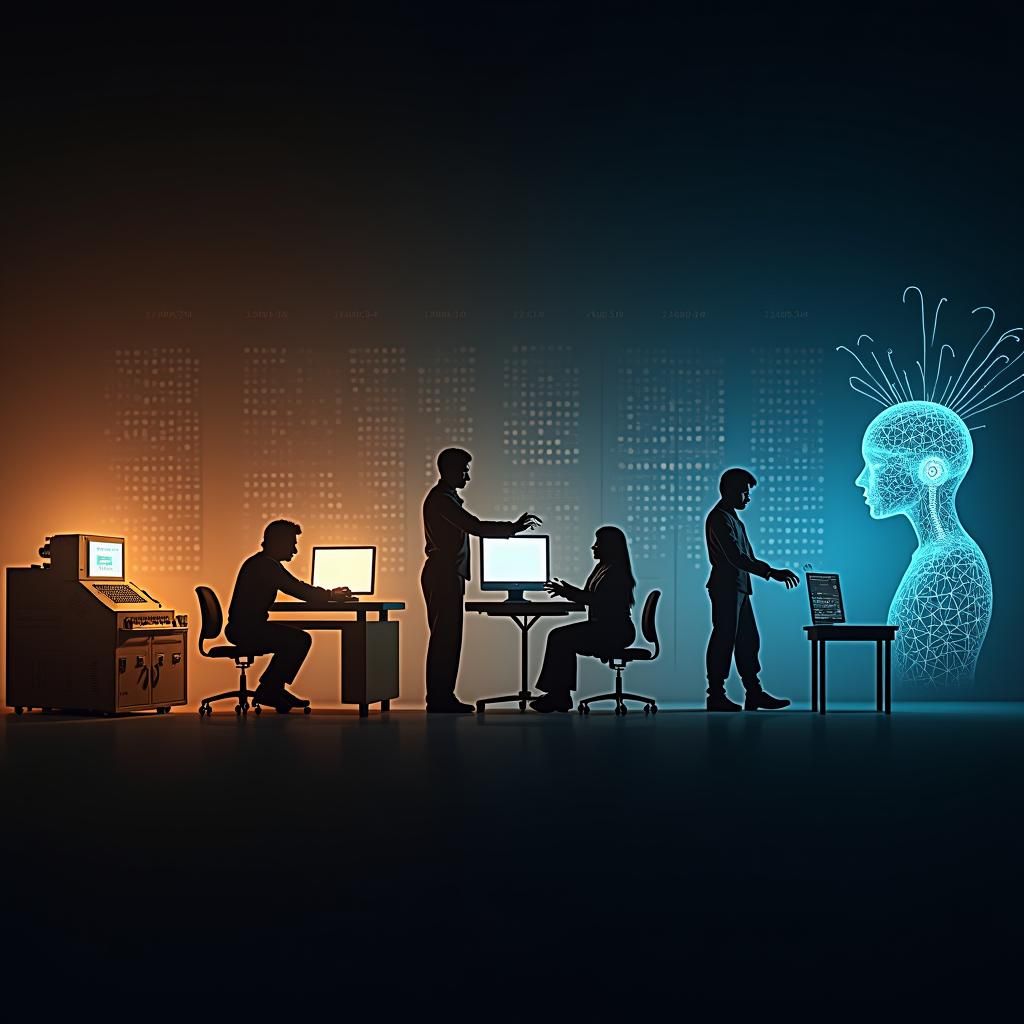
Imagine a world where you can control your computer with a glance, or where your smartphone anticipates your needs before you even touch it. This isn’t science fiction—it’s the reality being shaped by human-computer interaction (HCI), a field that has quietly revolutionised how we live, work, and play. From the clunky punch cards of the 1940s to the sleek voice assistants in our homes today, HCI has transformed our relationship with technology. But how did we get here, and where are we headed? This article explores the fascinating journey of computing and the development of HCI, revealing how this discipline has become the invisible hand guiding our digital lives.
The story of HCI begins long before smartphones or touchscreens. In the 1940s, the earliest computers, like the ENIAC, required users to physically rewire circuits or feed paper tapes to perform calculations [1]. These machines were tools for specialists—mathematicians and engineers—who interacted with them through abstract, machine-centric commands. The concept of “user-friendly” design didn’t exist; efficiency was paramount, even if it meant spending hours debugging a single program.
The 1960s marked a turning point. Douglas Engelbart’s 1968 “Mother of All Demos” introduced the world to the mouse, graphical user interfaces (GUIs), and even video conferencing—concepts so ahead of their time that they seemed like magic [2]. Engelbart’s vision wasn’t just about new gadgets; it was about “augmenting human intellect” through collaborative tools. This philosophy laid the groundwork for HCI as we know it, shifting focus from what machines could do to how humans wanted to use them.
The 1980s brought computers into homes and offices, thanks to pioneers like Apple and Xerox. The Macintosh’s 1984 launch popularised the GUI, replacing command-line interfaces with intuitive icons and windows [3]. Suddenly, you didn’t need a PhD to use a computer—a seismic shift that democratised technology. By the 2000s, touchscreens and motion sensors (think Nintendo Wii) further blurred the line between physical and digital interactions, while the 2010s saw voice assistants like Siri and Alexa turn sci-fi fantasies into everyday conveniences [4].
At its core, HCI is about bridging the gap between human capabilities and machine functionalities. Early theories, like Fitts’s Law (1954), quantified how quickly people could reach targets—a principle still used in touchscreen design today [5]. Don Norman’s The Design of Everyday Things (1988) introduced concepts like “affordances” (clues about how objects should be used), urging designers to prioritise user intuition over technical prowess [6].
Methodologies in HCI have evolved alongside technology. The 1990s embraced “user-centred design,” involving real people in prototyping and testing—a stark contrast to earlier top-down approaches. Iterative design cycles, where products are refined through repeated feedback, became industry standards. Modern HCI now employs eye-tracking studies, biometric sensors, and AI-driven analytics to understand user behaviour at microscopic levels [7].
Technological breakthroughs have consistently redefined HCI’s possibilities. The iPhone’s 2007 debut popularised multi-touch gestures—pinching, swiping—that felt as natural as turning a page [8]. More recently, virtual reality (VR) headsets like Meta Quest 3 use hand-tracking algorithms to let users “grab” digital objects mid-air, while brain-computer interfaces (BCIs) like Neuralink aim to translate neural signals into commands [9].
HCI’s impact extends far beyond gadgetry. It has reshaped entire industries: touchscreens revolutionised retail through self-service kiosks, while collaborative tools like Slack and Zoom (born from HCI research on groupware) transformed remote work [10]. Socially, HCI has democratised creativity—apps like TikTok put video editing tools in everyone’s pockets—but also raised ethical questions. Are endless smartphone notifications hijacking our attention? Does algorithm-driven content create filter bubbles? As HCI researcher Ben Shneiderman warns, “Technology should empower, not enslave” [11].
The rise of generative AI, like ChatGPT, presents both promise and peril. These systems can anticipate user needs (e.g., auto-completing emails) but risk perpetuating biases present in their training data. Timnit Gebru, a leading AI ethics researcher, cautions that without diverse input, HCI innovations may “reinforce existing inequalities” [12]. Meanwhile, the digital divide persists: while some gesture-control smart homes, millions lack basic internet access—a stark reminder that HCI’s benefits aren’t universal.
Looking ahead, HCI is poised to become even more immersive. Augmented reality (AR) glasses, like Apple’s Vision Pro, overlay digital information onto the physical world, while haptic feedback suits let users “feel” virtual objects [13]. BCIs, though still experimental, could one day help paralysed individuals communicate through thought alone. Yet with these advancements come dilemmas. Should employers monitor workers’ focus via BCIs? Who owns the data generated by our interactions?
As we stand on the brink of an HCI-driven future, one thing is clear: how we interact with technology shapes how we interact with each other and our world. From the humble mouse to mind-reading interfaces, HCI has continually redefined what’s possible—but its greatest test lies ahead. Can we design systems that enhance humanity without eroding our privacy, autonomy, or shared reality? The answer may depend on whether we, the users, demand technology that serves not just our convenience, but our collective wellbeing.
References and Further Reading
- Haigh, T., Priestley, M., & Rope, C. (2016). ENIAC in Action: Making and Remaking the Modern Computer. MIT Press.
- Bardini, T. (2000). Bootstrapping: Douglas Engelbart, Coevolution, and the Origins of Personal Computing. Stanford University Press.
- Hertzfeld, A. (2005). Revolution in the Valley: The Insanely Great Story of How the Mac Was Made. O’Reilly Media.
- Norman, D. A. (2013). The Design of Everyday Things. Revised edition. Basic Books.
- Fitts, P. M. (1954). “The information capacity of the human motor system in controlling the amplitude of movement.” Journal of Experimental Psychology.
- Apple Inc. (2007). “iPhone Introduction Keynote.” [URL]
- Shneiderman, B. (2020). “Human-Centered Artificial Intelligence: Reliable, Safe & Trustworthy.” Journal of Human-Computer Interaction.
- Gebru, T. (2020). “Race and Gender in the Age of AI.” MIT Press.
- IEEE Spectrum. (2023). “Next-Gen HCI: Beyond Screens and Keyboards.” [URL]
- ACM Interactions Magazine. (2022). “Ethics in HCI: A Decade of Challenges.” [URL]
Food for Thought
If future interfaces can read our thoughts, where do we draw the line between private reflection and digital interaction? What happens to “human” communication when machines mediate even our unspoken intentions?





 Conversations with AI
Leave a comment