*I love this story
It was a warm summer night in 1977 when a lone astronomer in Ohio picked up something extraordinary—a burst of radio waves so powerful and unusual that it would ignite decades of speculation, debate, and wonder. Jerry Ehman, a volunteer researcher for the Search for Extraterrestrial Intelligence (SETI), was reviewing data from the Big Ear radio telescope when he spotted a signal unlike anything he’d seen before. So stunned was he that he scrawled “Wow!” in red ink next to the readings. That simple exclamation gave the signal its name, but the mystery behind it remains unsolved. This article dives into the enigma of the Wow! Signal, exploring its origins, the scientific frenzy it sparked, and what it means for our quest to answer one of humanity’s oldest questions: are we alone in the universe?
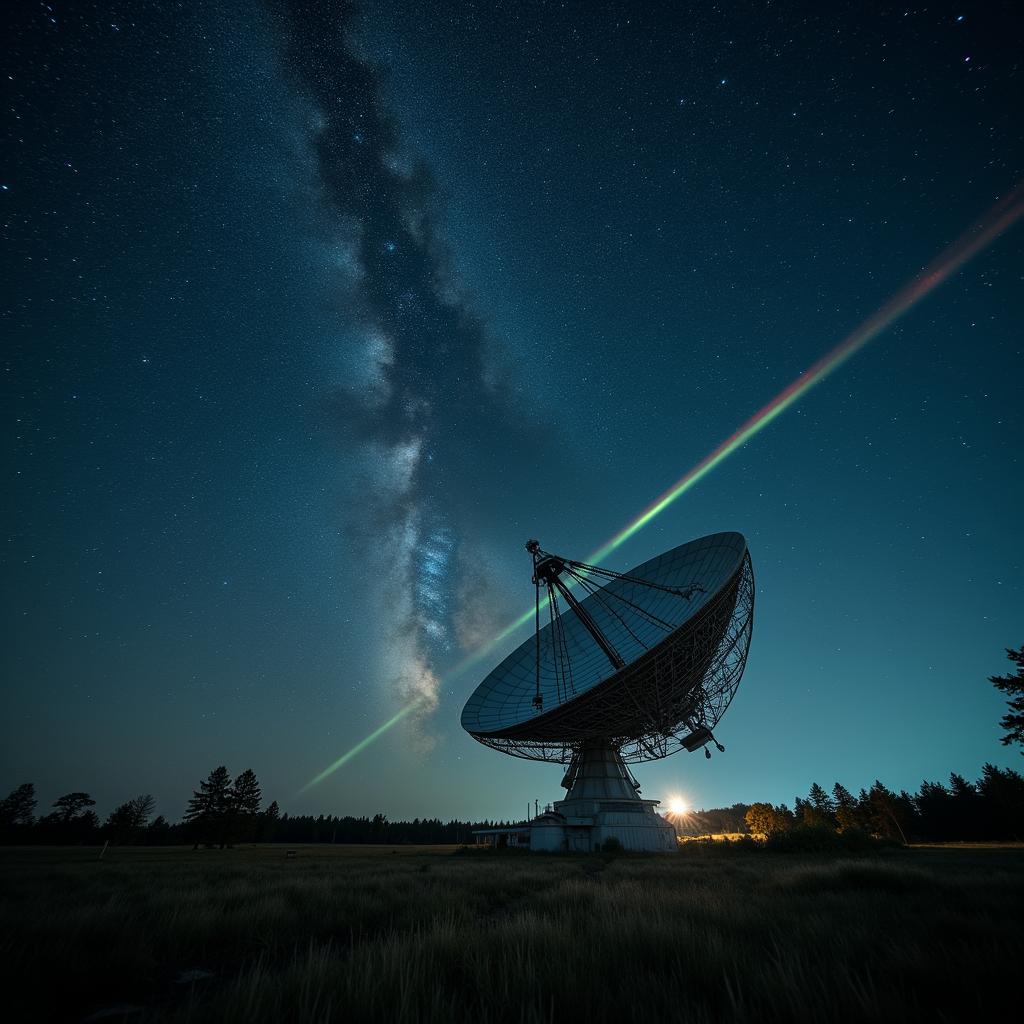
To understand the Wow! Signal’s significance, we need to rewind to the mid-20th century, when the idea of scanning the cosmos for alien messages gained traction. SETI, founded in 1984 but active in various forms earlier, aimed to detect artificial signals from space using radio telescopes. These instruments, like Ohio State University’s Big Ear, were designed to “listen” for narrowband radio waves—frequencies that natural cosmic phenomena rarely emit but which hypothetical advanced civilisations might use for communication. On 15 August 1977, Big Ear was pointed toward a cluster of stars in the constellation Sagittarius when it recorded a 72-second burst of intense radiation at 1420 MHz, the frequency of hydrogen, a element abundant in space and often cited as a potential “cosmic hello” beacon [1]. The signal’s intensity spiked to 30 times the background noise, represented by the now-iconic alphanumeric sequence “6EQUJ5” on the printout [2].
The signal’s brevity and the limitations of 1970s technology made immediate follow-up impossible. By the time Ehman found the data days later, the signal had vanished. Subsequent scans of the same region—including over 100 studies by telescopes like the Very Large Array in New Mexico—detected nothing [3]. This fleeting nature deepened the mystery. Was it a one-off cosmic event? A glitch? Or, as some dared to hope, a fleeting message from an alien civilisation?
Scientists have debated the signal’s origins for decades. One theory posits that it was a human-made transmission, perhaps a satellite or military experiment. However, the 1420 MHz frequency is protected internationally for astronomical research, making unauthorised terrestrial use unlikely [4]. Another explanation involves natural phenomena. Comets, for instance, emit radio waves, but none were in the area at the time [5]. In 2017, researcher Antonio Paris suggested that hydrogen clouds from two passing comets, undiscovered in 1977, might have been the source, but this was later debunked as the comets’ positions didn’t align with the signal’s direction [6].
The possibility of an extraterrestrial origin, while tantalising, faces scepticism. As SETI senior astronomer Seth Shostak notes, “The Wow! Signal checks many boxes for an alien broadcast, but without repetition, it’s just an intriguing outlier” [7]. The signal’s narrow bandwidth and frequency stability suggest artificiality, but natural cosmic events can sometimes mimic these traits. For example, “fast radio bursts” (FRBs)—millisecond-long cosmic flashes discovered in 2007—were initially thought to be artificial until their natural origins were confirmed [8]. Could the Wow! Signal be an early example of such a phenomenon?
The cultural impact of the Wow! Signal has been profound. It has inspired documentaries, novels, and even a symphony. For many, it symbolises the tantalising possibility that we’re on the brink of contact. Astronomer Jill Tarter, a pioneer in SETI, reflects: “The Wow! Signal reminds us that the universe is vast and full of surprises. It keeps us humble and curious” [9]. Yet, it also highlights the challenges of SETI. The universe is unimaginably large, and even a powerful signal like Wow! could be a cosmic mirage—a rare alignment of chance and physics.
Recent technological advances have reignited hope. Projects like Breakthrough Listen, launched in 2015, use AI to analyse petabytes of data from telescopes worldwide, searching for patterns humans might miss [10]. New instruments, like the Square Kilometre Array (SKA), set to become operational in the 2030s, will scan the sky with unprecedented sensitivity [11]. Could these tools finally solve the mystery? Or will Wow! remain a cosmic riddle?
The debate over the signal’s origin reflects broader questions about how we search for extraterrestrial life. Should we focus on radio waves, as SETI does, or look for laser pulses, megastructures, or even robotic probes? Astronomer Paul Davies argues for a diversified approach: “Putting all our eggs in the radio basket might mean missing other forms of communication” [12]. Meanwhile, critics like astrophysicist Ethan Siegel contend that the odds of detecting an alien signal are vanishingly small, given the vastness of space and time [13].
The Wow! Signal also raises philosophical questions. If it was artificial, why hasn’t it repeated? Could it have been a targeted message that Earth briefly passed through? Or a beacon long since switched off? These uncertainties underscore the challenge of interpreting cosmic data. As Ehman himself cautioned, “We’d need more than one signal to claim a detection” [14].
So, nearly half a century on, the Wow! Signal remains a captivating enigma. It’s a reminder of how little we know—and how much there is to discover. Whether it was a cosmic coincidence, an undiscovered natural phenomenon, or the first whisper of an alien civilisation, it has cemented its place in scientific lore. And perhaps that’s its greatest legacy: keeping our gaze fixed on the stars, wondering what else might be out there.
In the end, the Wow! Signal challenges us to balance scepticism with optimism. It’s a lesson in patience for a generation raised on instant answers. As we develop new tools to explore the cosmos, maybe one day we’ll look back on Wow! as the spark that ignited a revolution in our understanding of the universe—or as a beautiful mystery that keeps us reaching for the unknown. After all, in a universe as vast as ours, isn’t the possibility of wonder enough?
References and Further Reading
- Ehman, J. R. (1998). The Big Ear Wow! Signal: What We Know and Don’t Know. Cosmic Search Magazine.
- Kiger, P. (2022). The Wow! Signal: A Deep Dive into the Mystery. National Geographic.
- Gray, R. H. (2017). The Elusive Wow! Signal Revisited. Journal of the British Interplanetary Society.
- International Telecommunications Union. (2020). Radio Regulations. ITU Publications.
- Paris, A. (2016). Hydrogen Clouds and the Wow! Signal. Journal of the Washington Academy of Sciences.
- Shostak, S. (2017). Could Comets Explain the Wow! Signal? SETI Institute Blog.
- Shostak, S. (2019). Confessions of an Alien Hunter. National Geographic Books.
- Sokol, J. (2020). Fast Radio Bursts: A Cosmic Mystery. Nature.
- Tarter, J. (2015). Why SETI Matters. TED Talk.
- Isaacson, H. et al. (2017). Breakthrough Listen: A New Frontier in SETI. Astronomical Journal.
- Dewdney, P. (2021). The Square Kilometre Array: A 21st-Century Telescope. SKA Observatory.
- Davies, P. (2010). The Eerie Silence: Renewing Our Search for Alien Intelligence. Penguin Books.
- Siegel, E. (2018). The Copernican Principle and the Fermi Paradox. Forbes.
- Ehman, J. R. (2001). Personal Communication. Ohio State University Archives.





 Conversations with AI
Leave a comment