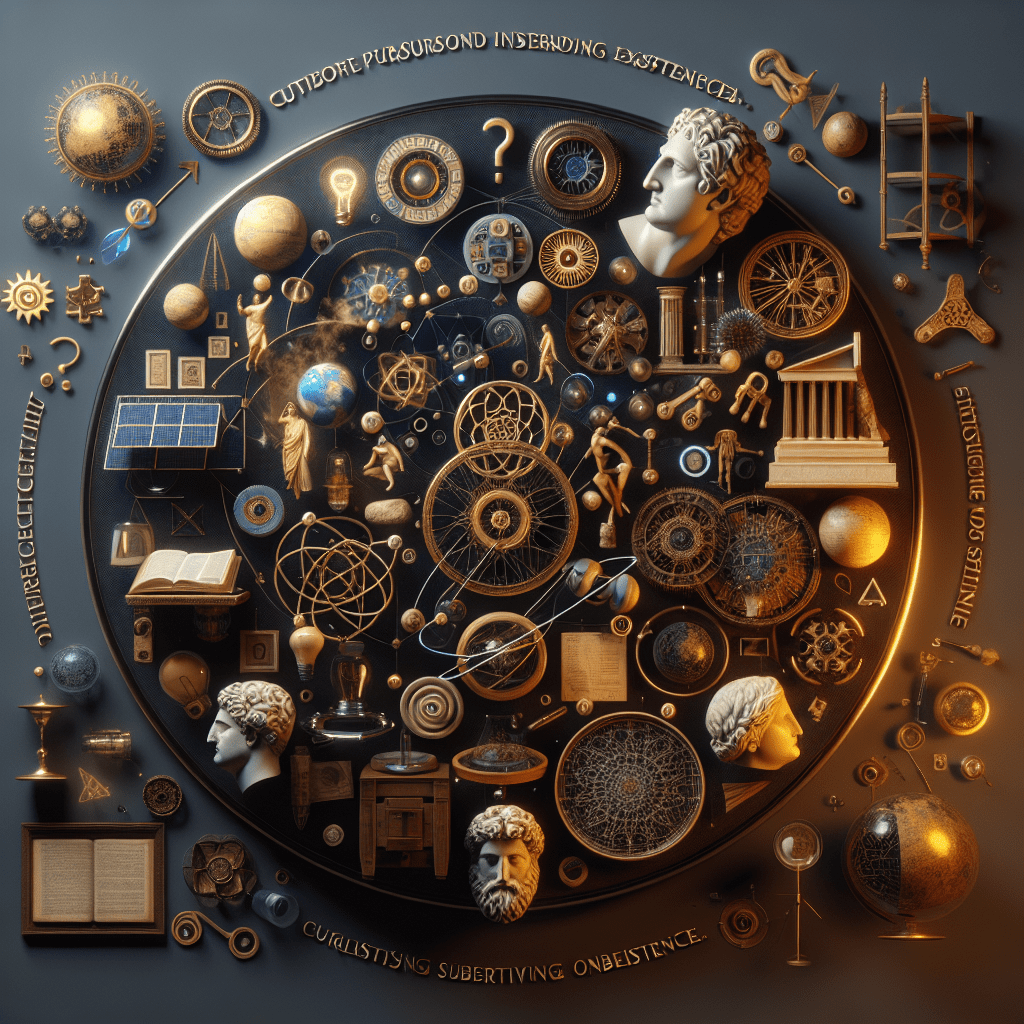
In the intricate tapestry known as human knowledge, art and science are often perceived as contradictory threads: one sprouting from the wellspring of creativity and emotional self-expression, the other from empirical evidence and logical reasoning. However, an examination of their shared past and present day interactions reveals a complex, interwoven relationship, a dance between two partners whose footsteps mark the progress of human society itself.
This article will delve into this complex relationship, tracing the historical interactions between art and science, exploring their intertwined pathways in modern society, and contemplating their future trajectories. Understanding this relationship is not only intellectually stimulating but also provides insights into the ways in which science and art influence our perception of the world and our place within it.
The intertwined histories of art and science stretch back to antiquity. The ancient Greeks, who laid the foundations for both Western art and science, approached these disciplines as interconnected. Aristotle’s theories on aesthetics, for example, rested on scientific observations of natural beauty while his thoughts on physics were imbued with an intrinsically artistic vision of harmonious natural order [1].
In the middle ages, the reliance of religious painters on scientific principles in creating realistic depictions of religious figures heralded the dawn of the Renaissance. Individuals like Da Vinci, a polymath who embodied the seamless integration of art and science, utilised anatomical studies to perfect his artistic creations [2]. It was during this period that perspective, a concept rooted in geometry, fundamentally transformed the landscape of visual art [3].
Fast forward to the 20th century, and one can observe numerous areas where the nexus of art and science becomes more pronounced. Cubism, inspired in part by developments in physics and non-euclidean geometries, shattered the old models of perspective and portrayed subjects from a multitude of viewpoints [4]. Meanwhile, the field of bio-art, where living organisms become the medium of art, represents a striking blend of laboratory techniques and creative aesthetics [5].
Art often serves as a medium through which scientific discoveries are made accessible, comprehensible – and indeed, affecting – to the lay population. Paleolithic cave paintings, for instance, can be seen as early attempts to record and communicate observations of the natural world, serving a purpose not dissimilar from that of a contemporary science journal [6].
However, this interpretation only scratches the surface. Art can also emulate the process of scientific inquiry, raising questions about the nature of existence and reality, challenging assumptions, and exploring the boundless territories of ‘what-if’ scenarios. In this sense, both science and art aim to unravel the mysteries of existence, albeit via different methodologies.
The words of Albert Einstein succinctly capture this connection: “The most beautiful thing we can experience is the mysterious. It is the source of all true art and science” [7]. His combative colleague, Niels Bohr, a key figure in 20th-century quantum mechanics, deduced much of his theoretical groundwork from Picasso’s disruptive Cubism [8].
Gradually, as digital technology, biogenetics, and quantum physics open up new realms of reality beyond the reach of our sensory organs, the role of art – and its inherent strength in invoking and communicating subjective experience – becomes increasingly essential. Take, for example, the dazzling and disorienting digital art installations that enable visitors to ‘experience’ the bizarre logic of quantum mechanics [9].
Despite these symbiotic interactions, controversies persist. Some question whether art and science, at their core, represent irreconcilable worldviews – one grounded in subjectivity and the other objectivity. Yet at the same time, there are strong voices in both communities challenging these binary and stagnant definitions. New research paradigms, like neuroaesthetics, are actively exploring the scientific underpinnings of artistic perception, implying a future where such dichotomies might become obsolete [10].
Considering this intricate dance between art and science, we can observe their shared rhythmic patterns: curiosity, experimentation, and the celebration of novelty. In order to understand ourselves and the world around us, we must recognise the inherent value in both disciplines and the profound enrichment that their mutual interactions can offer.
The relationship between art and science is much like the relationship between two languages. Neither is superior nor more ‘accurate’, but each possesses unique strengths in expressing different aspects of the human experience. Comprehending their unique interaction patterns arms us with a profound tool to elucidate the complexity of our existence, enrich our collective knowledge and inspire us to explore the unknown.
Looking through the lens of history, will it not be intriguing to imagine the future where the line between art and science blurs further? Will there come a day when they are no longer seen as distinct, but as complementary expressions of the same universal seeking? These questions, undoubtedly, are worthy of further exploration and contemplation.
References and Further Reading
- Aristotle’s Poetics. (n.d.). In Stanford Encyclopedia of Philosophy. Retrieved from https://plato.stanford.edu/archives/win2016/entries/aristotle-poetics/
- Clark, K. (1973). Leonardo da Vinci. Penguin Books.
- Edgerton, S.Y. (1991). The Renaissance Rediscovery of Linear Perspective. Basic Books.
- Henderson, A.L. (1983). The Fourth Dimension and Non-Euclidean Geometry in Modern Art. Leonardo.
- Hauser, J. (2008). Bio Art – Taxonomy of an Etymological Monster. University of Art and Design Helsinki.
- Richer, S. (1990). Towards defining a neurobiology of art appreciation using fMRI studies of microliterary. Crit. Inq. 16.
- Einstein, A. (1949). The World as I See It. Philosophical Library.
- Miller, A.I. (2002). Einstein, Picasso: Space, Time, and the Beauty That Causes Havoc. Basic Books.
- Micovic, M. (2020). Quantum physics meets art in a new installation show in Croatia. Total Croatia News.
- Ishizu, T. & Zeki, S. (2014). A Neurobiological Enquiry into the Origins of Our Experience of the Sublime and Beautiful. Frontiers in Human Neuroscience.


 Conversations with AI
Leave a comment