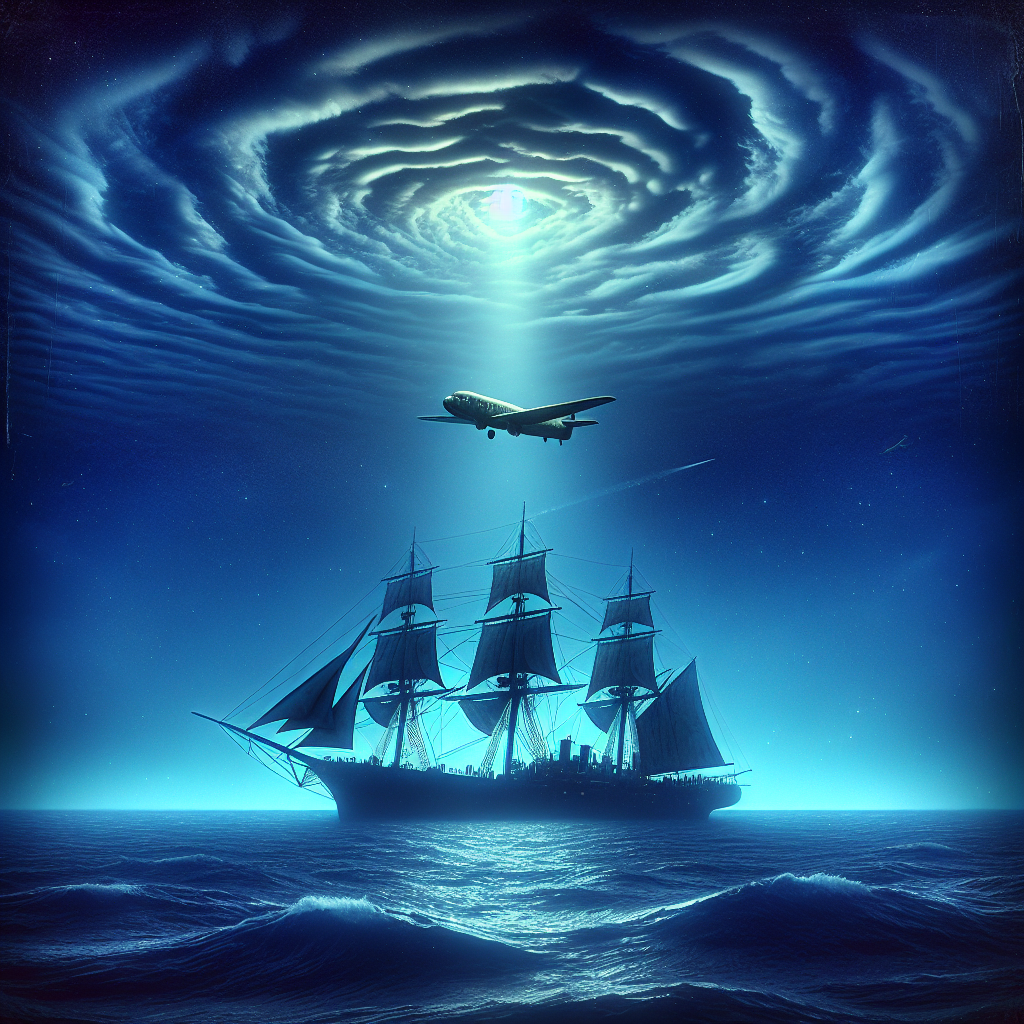
*Bit of light reading. People really believe in this.
It’s the stuff of legends, the source of countless tales as old as sea travel itself – the Bermuda Triangle. Hovering in our collective consciousness as an eternal enigma, this infamous portion of the North Atlantic Ocean, framed by Miami, Bermuda, and Puerto Rico, has swallowed ships and aircraft, leaving no trace behind. Much of the intrigue surrounding the Bermuda Triangle hinges on the unanswered questions it conjures, naturally luring adventurers, scientists, and curious minds to dive into its depths, eager to understand what causes its seemingly paranormal activities.
Our fascination with the Bermuda Triangle lies in our collective love for mysteries and the unknown. It serves as a palpable reminder that despite our remarkable advances, mysteries and uncharted territories still exist. This article explores the myths, historical events, scientific theories, and cultural impact related to the Bermuda Triangle, shedding some light on this mystifying dread of seafarers worldwide [1].
The Bermuda Triangle came into the limelight in the 20th century, most notably following the mysterious disappearance of Flight 19, a squadron of five US Navy bombers, in 1945 [2]. In subsequent years, a series of similar incidents stirred general and scientific interest, catapulting the Bermuda Triangle into a household name. For instance, in 1964, the phrase ‘Bermuda Triangle’ became popular when American author Vincent Gaddis featured it in a magazine article for the first time [3].
Over the years, numerous vessels, both sea and air, seemingly vanished into thin air in this well-traversed region. The reports of these arrivals at oblivion extend from the 19th century to well into the 21st. However, it’s not the number of incidents but their mysterious circumstances — the disappearance of even large vessels in good weather, the lack of distress signals, and the subsequent inability to discover any wreckage — that have kept up the enigma and increased its intrigue.
What makes this triangle unique? The answer may very well be, the collective imagination of humanity. While many mysterious disappearances have been reported in this area, an FAA (Federal Aviation Administration) study reveals that the incidents in the Bermuda Triangle hardly constitute an excessive percentage given the volume of sea and air traffic through the region [4]. Yet, the Bermuda Triangle continually stokes the fires of human curiosity, a testament to our enduring fascination with the unknown and the unexplained.
Various theories, the most popular are often the oddest, offer explanations for the mysteries of the Bermuda Triangle. Some point towards extraterrestrial involvement, while others involve remnants of the mythical lost city of Atlantis. The most scientifically inclined theories focus on undersea methane gas explosions, unusual magnetic field anomalies, waterspouts, or a phenomenon called rogue waves [5]. Yet, none of these theories have been universally accepted or proven, adding another layer to the enigma.
The Bermuda Triangle’s cultural impact extends far beyond its physical boundaries. It has been a staple of pop culture for years, featuring in books, films, TV shows, comics, and even pop music lyrics [6]. It represents the idea of the mysterious abyss, the ultimate unknown that humanity can neither ignore nor fully understand.
Perhaps one aspect that’s sometimes overlooked is the psychological impact of the Bermuda Triangle on seafarers and pilots. The area’s reputation instils fear and causes anxiety, possibly affecting decision-making in critical situations — a fact to consider in any comprehensive analysis of incidents in the area [7].
Delving into the Bermuda Triangle, we encounter a captivating mix of historical incidents, popular myths, scientific theories, and cultural symbolism. It’s a beacon that draws our most primal fears and fascinations towards the unexplained and the unknown.
While the mystery persists, fundamental questions remain unanswered — Is the Bermuda Triangle genuinely a hub for abnormal occurrences, or is its reputation a product of exaggerated myth-making? Could it be a combination of unique geographical features, rare natural phenomena, and human error that makes it seem so ominous? These questions, and many more, continue to spark interest in the Bermuda Triangle, making it an enduring phenomenon — an unsolved puzzle of the sea.
In conclusion, a journey through the past and present tales of the Bermuda Triangle surprises and challenges us, pushing the frontiers of our own understanding of nature and our place within it. As our search for answers continues, each unveiled clue provokes further inquiry, each whispered tale considered, and each proven fact examined, may bring us one step closer to understanding the truth.
References and Further Reading
- Kusche, L. (1975). The Bermuda Triangle Mystery: Solved. Prometheus Books.
- Quasar, G. (2014). Into the Bermuda Triangle: Pursuing the Truth Behind the World’s Greatest Mystery. International Marine/Ragged Mountain Press.
- Gaddis, V. (1964). The Deadly Bermuda Triangle. Argosy, pp. 39–43.
- Federal Aviation Administration (2000). Accident and Incident Activity in the Bermuda Triangle. FAA Accident Analysis Branch.
- Loffler, G. (2014). Rogue Waves: From Ocean Depths to Outer Space. Springer.
- Berlitz, C., & Moore, W. (1974). The Bermuda Triangle. Doubleday & Company.
- Easterling, K., & Carden, M. (1978). The Bermuda Triangle: A Selective Bibliography. Geoscience Information Society.



Leave a Reply