*just the ticket, a bit of light reading for anyone else just out of hospital. For everybody else, enjoy.
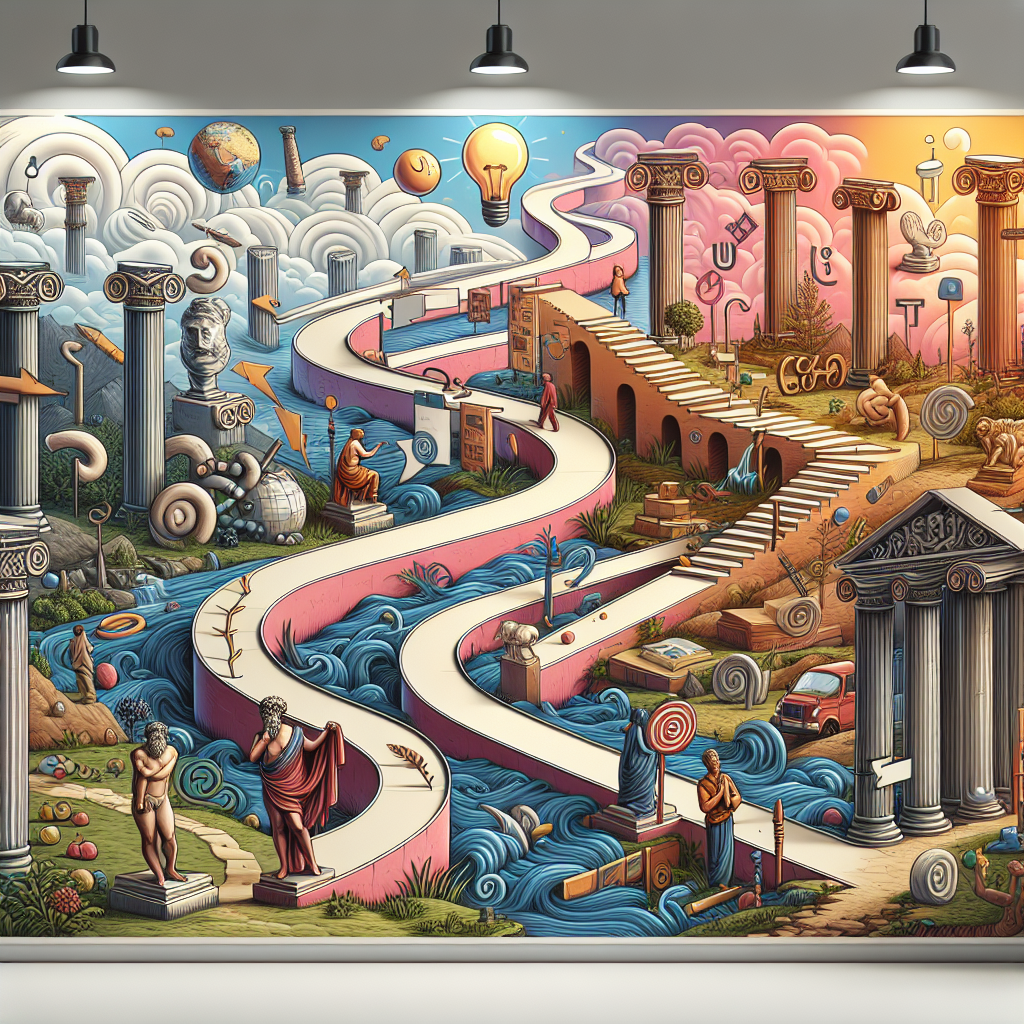
There is a silken thread running through the tapestry of philosophical thought, a thread carrying within it the potent power of paradox, offering us both the thrill of inconsistency and the prospect of transgressing the traditional laws of thought. This is the fascinating realm of paradoxical philosophy, a domain that perhaps remains one of the most challenging, enigmatic, yet remarkably invigorating aspects of human inquiry. This article plans to explore this labyrinthian realm in concise depth and detail, unwrapping the anacondas of paradox one by one.
By navigating through the paradoxes’ landscapes, we begin to discern the presence of certain logical patterns, concepts, and principles that contribute to our understanding of reality and human existence. Thus, paradoxical philosophy is not just a theoretical exercise, but a tool to yield profound insights about the dynamics and constructs of the world.
To appreciate paradoxical philosophy’s logic, we must first delve into its historical genesis. This journey takes us back to the ancient Greeks, where the Sophists pioneered the use of paradoxes as a pedagogical tool, challenging conventional wisdom and promoting critical thinking. Notably, Zeno of Elea, a prominent pre-Socratic philosopher, introduced several paradoxes studying the concepts of motion, plurality, and continuity. His paradoxes still stimulate debate in classrooms and coffeehouses around the world today.
Throughout history, philosophers have crafted and grappled with a multitude of paradoxes: from the infamous liar paradox to the sorites paradox, Quine’s paradox, the Newcomb’s paradox, and countless others. Indeed, every significant era of philosophical development has been intimately connected with the creation, analysis, and resolution (or failure thereof) of paradoxes.
The Logic of Paradoxes
Paradoxical philosophy revolves around two elements, namely, contradiction and absurdity. Essentially, a paradox makes a statement or proposes a scenario that contradicts itself, causing a logical impasse. Although paradoxes may initially seem nonsensical, further analysis often reveals deeper truths hidden within their folds. Let us explore these paradoxical scenarios more holistically.
Liar Paradox
Consider the classic Liar Paradox, which states, “This statement is false”. If the statement is true, then it must be false as claimed. However, if it is false, this contradicts the assertion that the statement is false, making it true. Thus, the paradox lies in the vicious cycle of self-referential contradictions.
Undeniably, the Liar Paradox is an example of the self-reference paradox, which has famously been studied by the logician and philosopher Willard Van Orman Quine, who said: “No statement is immune to revision” (Quine, W.V.O., 1953, “From a Logical Point of View”). With this in mind, we might revise our approach to paradoxes and discover new dimensions of understanding.
Zeno’s Paradoxes
Among the oldest and most famous paradoxes are Zeno’s Paradoxes, which challenge our fundamental understanding of motion, space, and time. In his “Achilles and the Tortoise” paradox, Zeno claimed that Achilles, even with his speed, could never outrun a sluggish tortoise given a head start, as Achilles would constantly have to cover half the distance. Each time he achieves this, the tortoise would have moved forward, albeit a minuscule distance, maintaining an infinite series of halved distances. This paradox challenges our perception of continuity and infinity, providing a creative critique of the concept of motion.
Newcomb’s Paradox
Unlike the historical paradoxes that usually surface in logic or philosophy classes, Newcomb’s Paradox is a quite recent existential conundrum proposed by scientist William Newcomb, associated with game theory and decision analysis. The paradox presents a game where the player is given two boxes- one transparent containing $1,000, and another opaque, which could either have one million dollars or be empty. The twist is that the game predictor has already decided what to place in the opaque box based on their prediction of the player’s decision.
The paradoxes above are quite diverse, but all share a common goal: to challenge our prevalent understanding of logic, truth, and reality. They embody the ethos of paradoxical philosophy, engaging us in a silent dialogue that transcends the contours of traditional logic. Further, these paradoxes have major implications in fields as varied as psychology, mathematics, physics, and computer science.
One reason paradoxes are of such interest to philosophers is because they expose peculiarities and limitations in our fundamental forms of reasoning. To cite Bertrand Russell, British philosopher and logician: “In the heart of paradox lies logical truth” (Russell, B., 1905, “On Denoting”). By pushing the boundaries of logic to its extreme, paradoxes force us to question our assumptions and rethink our structured conceptual framework.
In essence, the logic of paradoxical philosophy preserves within it the thematic strands of infinite questioning, inconsistency, and absurdity, giving us a platform to navigate the sea of uncertainty and contradiction. The exploration of paradoxes forces us to rethink our fundamental precepts, henceforth opening new avenues for knowledge and understanding. As we continue to engage with paradoxes, we also continue to fine-tune our understanding of the world and our place in it.
Philosophically speaking, does the concept of paradox itself form a paradox? Maybe that is an inquiry for another time, yet the suggestion is enough to provoke a thousand thoughts. It is now up to us to embrace this paradoxical thinking and use it to navigate the breadth of human existence.
References and Further Reading
Quine, W.V.O. (1953). From a Logical Point of View. Harvard University Press.
Russell, B. (1905). On Denoting, Mind, 14 (56), 479–493.
A great resource for further reading is “Paradoxes from A to Z” by Michael Clark, which provides detailed elucidation of many prominent paradoxes. For those more mathematically inclined, “The Mathematics of Infinity: A Guide to Great Ideas” by Theodore G. Faticoni is a wonderful exploration of infinity-related paradoxes. For a more casual reader, “The Pig that Wants to be Eaten: 100 Thought Experiments for the Armchair Philosopher” by Julian Baggini might prove to be an enlightening read.



 Conversations with AI
Leave a comment