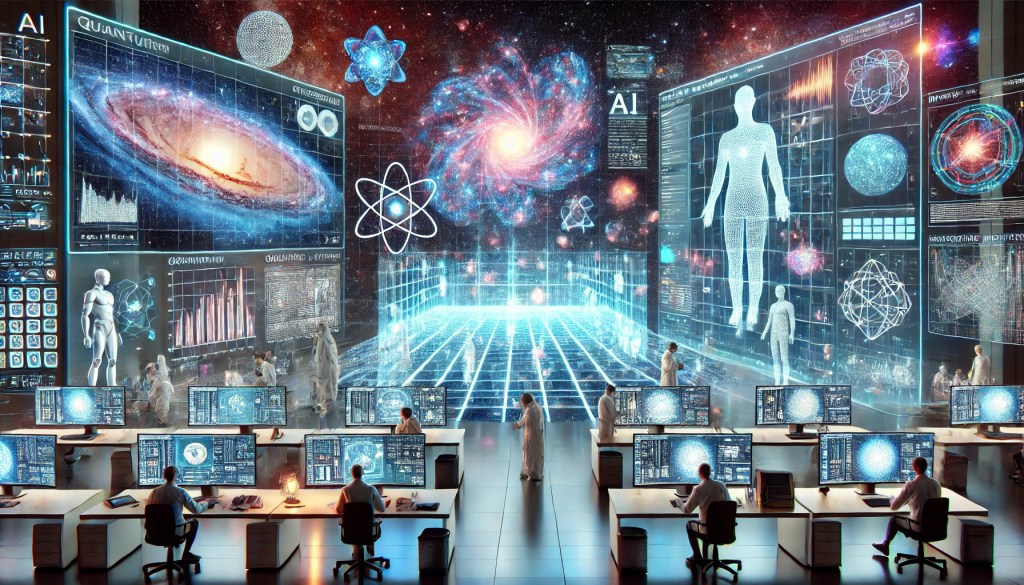
Testing whether our reality is a simulation is a difficult task, but several ideas have been proposed by scientists and philosophers to explore the possibility. These ideas mostly revolve around identifying anomalies or “footprints” of a computational framework. While we don’t have a definitive test yet, here are some theoretical ways we could try to test the nature of reality:
1. Look for Computational Limits
One possible approach is to search for signs that the universe has computational limitations, similar to a video game’s limitations, such as finite processing power or graphical resolution:
- Search for a “pixel” structure in space-time: Just as images on a screen are composed of pixels, some physicists have speculated that space-time might be “pixelated” at an incredibly small scale, such as at the Planck length (~1.6 x 10^-35 meters). If the universe is a simulation, then at extremely small scales, we might find evidence of this grid-like structure.
- How to test: Advanced experiments in quantum gravity or particle physics could look for discontinuities or minimum units of space-time, indicating that reality is quantized rather than continuous.
- Explore energy limits: In a simulation, there might be upper limits to how much energy or matter can be processed. Some physicists propose testing for a maximum energy limit, similar to how simulations have processing ceilings.
- How to test: High-energy physics experiments, such as those at particle colliders (like CERN), could test if there’s a maximum energy level beyond which particles cannot be accelerated.
2. Check for Anomalies in Physical Laws
The laws of physics are remarkably consistent across the universe, but if the universe is a simulation, there may be inconsistencies or errors in how those laws are applied, particularly in extreme conditions.
- Quantum mechanics and observer effects: In quantum physics, particles behave differently when observed, leading to phenomena like the collapse of a wave function. Some argue this could resemble the way simulations optimize computational resources, only rendering details when observed.
- How to test: By pushing quantum experiments to their extremes, such as with superposition or entanglement, we might find evidence that reality only “renders” when observed, hinting at computational underpinnings.
- Cosmic anomalies: Unexplained phenomena in cosmology, such as dark matter and dark energy, could be interpreted as simulation artifacts—placeholders or simplifications to manage complexity in a simulated universe.
- How to test: Continued observation of these phenomena with better technology could reveal patterns that don’t match our expectations of a smooth, natural universe.
3. Study High-Precision Simulations
A theoretical approach is to simulate a smaller version of the universe or its components with increasing precision to see if discrepancies arise between the simulation and the real universe.
- Simulating quantum systems: Quantum computers, which mimic quantum behavior, may allow us to simulate parts of reality at an extremely detailed level. If discrepancies arise between the results of these simulations and real-world quantum systems, it could suggest that our universe behaves like a simulation.
- How to test: By comparing highly detailed quantum simulations to physical experiments, scientists could check for unexplained deviations that might indicate our reality itself is simulated.
4. Look for Evidence of Computational Efficiency
Simulations often use computational shortcuts to save resources. We might find evidence that reality is being optimized in a similar way.
- Observer-dependent physics: If the universe only renders details as needed, we might expect to see more evidence of “lazy” or optimized rendering—parts of the universe that aren’t being simulated in full detail until observed, much like how video games only render what is in view.
- How to test: Experiments that isolate or study distant regions of the universe, such as the cosmic microwave background radiation, might reveal inconsistencies in areas that haven’t been “observed” in detail.
- Symmetries in physical laws: Some simulations simplify reality by using symmetries to reduce complexity. If our universe uses similar shortcuts, we might discover patterns that suggest certain regions or phenomena are simplified representations.
- How to test: Careful analysis of physical constants or symmetries at a cosmological scale could reveal unnatural patterns or simplifications.
5. Examine the Cosmic Background for Messages
If we are in a simulation, the creators might leave behind a message or signature, much like an Easter egg in a video game or software program.
- Look for coded messages: The cosmic microwave background (CMB), which is the afterglow of the Big Bang, could potentially carry hidden information left by the creators of the simulation.
- How to test: Analyze the CMB for patterns or signals that are statistically unlikely to occur naturally, such as numerical sequences or messages encoded in binary.
6. Test the Probability Argument
One of the core ideas behind the simulation hypothesis is a statistical argument: if advanced civilizations are likely to create numerous simulations of conscious beings, then the probability we’re in one of those simulations is higher than the probability we’re in the original, base reality.
- Anthropic reasoning: This is a probabilistic test rather than an empirical one. If humanity eventually develops the ability to simulate billions of conscious beings, and if we start running such simulations, it would bolster the argument that we might be in one ourselves.
- How to test: Philosophers and mathematicians could refine models of anthropic reasoning, analyzing the likelihood that advanced civilizations create many simulations and how that influences the probability we are in one.
7. Use Advanced AI to Explore Reality
If we can create highly intelligent artificial intelligence, it might help us explore the nature of reality in ways we cannot yet imagine.
- Simulating the mind: If we can simulate a human brain accurately enough to create consciousness, we could study the simulation’s behavior and compare it to our own experiences of reality.
- How to test: Compare the experiences of AI systems that are designed to mimic consciousness with human experiences of reality. Differences or common patterns might reveal clues about the nature of both simulated and real-world consciousness.
Challenges in Testing Reality
- The Perfect Simulation Problem: If the simulation is sufficiently advanced, it could be designed in such a way that it’s impossible to detect. The creators might have built the simulation to prevent the inhabitants from realizing the truth.
- Technological Limitations: Our current understanding of physics and technology may simply be too primitive to test for such a complex phenomenon. It could be that we need to reach a much more advanced state of scientific development before we can devise practical tests for the simulation hypothesis.
- Unfalsifiability: One of the core criticisms of the simulation hypothesis is that it may not be falsifiable, meaning that even if it’s true, we might never have the ability to test or prove it definitively. This makes it more of a philosophical argument than a scientific theory in some views.
In conclusion, while the simulation hypothesis remains speculative, there are intriguing theoretical avenues for testing it. Advances in quantum physics, cosmology, and AI may someday provide clues or even direct evidence. However, proving or disproving the hypothesis might require technologies or ideas beyond what we currently possess.
How can we prove it?
Proving that we live in a simulation would be extremely challenging, but several hypothetical methods have been proposed. These methods revolve around finding physical, computational, or philosophical evidence that reality is artificially constructed. While none of these approaches guarantee proof, they represent some of the best ideas currently available.
1. Find “Glitches” or Anomalies in Reality
One way to prove we are in a simulation would be to identify errors, inconsistencies, or glitches that point to an underlying computational framework.
- Unexplained physical anomalies: If we observe phenomena that cannot be explained by our current understanding of physics—such as violations of the conservation of energy or other fundamental laws—these could be interpreted as glitches in the simulation.Example: If particles suddenly behaved in a way that contradicts known physics without any reasonable explanation, it might be analogous to errors in a computational system.
- Quantum weirdness: Quantum mechanics already behaves in strange ways, particularly with concepts like entanglement and superposition. These behaviors might be artifacts of a computational framework designed to optimize resources. For instance, the collapse of a wave function when observed could be similar to how computer simulations “render” only the necessary information when needed.How it could help: If we discover a deeper reason for why particles act differently when observed, and it points to optimization for computational efficiency, it could hint that reality is simulated.
2. Detect Evidence of Computational Limits
Simulations have computational limits, such as processing power and memory capacity. If our universe is a simulation, it might exhibit signs of these limits.
- Energy limits: Some physicists propose that our universe could have a finite energy limit. In particle physics, if there is a maximum energy level that particles cannot exceed, it could indicate that reality has computational boundaries, akin to the limits of a simulation.How to test: Particle colliders like the Large Hadron Collider (LHC) could search for hard limits on particle energy or speed, which might suggest that the universe has a built-in cap, as a simulation might.
- Space-time discretization: Space-time might be granular, similar to how computer simulations have pixels or discrete elements. If we find that space-time is made of indivisible units, like the Planck length, it could suggest that our universe has a fundamental grid structure.How to test: Advanced experiments in quantum gravity and high-energy physics could look for evidence of this discretization.
3. Look for Optimization Shortcuts in Physics
In simulations, computational efficiency is key. If our universe is optimized in specific ways, it might reveal that it’s simulated.
- Observer effects: In quantum physics, particles behave differently when observed, which some argue might be a sign that reality is only fully “rendered” when needed—much like a computer game only renders graphics that the player can see. If further experiments reveal that physical systems behave differently when not observed, this could suggest optimization strategies in the underlying code of the simulation.How to test: Highly controlled experiments that isolate systems from observation for long periods, and study how the systems behave when re-observed, could test this.
- Symmetries in the universe: Some suggest that certain symmetries in nature (such as the laws of physics being identical in all directions) could be optimization shortcuts, simplifying the computational task of simulating the universe. If we discover unnatural or overly simplified patterns, it could point to artificial design.How to test: Detailed studies of physical constants, cosmology, and symmetry-breaking events might reveal suspicious patterns or optimizations.
4. Examine Cosmic Background Radiation for Messages
Some theorists have speculated that the creators of the simulation might leave a message or signature embedded in the universe, perhaps in the form of the cosmic microwave background (CMB), which is the afterglow of the Big Bang.
- Encoded messages: By studying the CMB or other cosmic phenomena for patterns or signals that seem too orderly or mathematically significant to be natural, we might find intentional communication from the creators of the simulation.How to test: Advanced analysis of the CMB, searching for non-random sequences, encoded messages, or mathematical constants that shouldn’t naturally appear in the early universe.
5. Prove the Probability Argument (Simulation Hypothesis)
Philosopher Nick Bostrom’s simulation argument suggests that if advanced civilizations eventually create vast numbers of simulations that are indistinguishable from reality, the probability that we are in the base reality is very low.
- Run human-like simulations: If humans eventually develop the ability to create simulations that are indistinguishable from reality and capable of simulating consciousness, it would support the argument that we’re already in a simulation, because it would show that such simulations are possible.How to test: If we create AI or virtual worlds sophisticated enough to simulate entire realities and conscious beings, it would reinforce the idea that advanced civilizations likely run simulations, increasing the odds that we live in one.
- Statistical models: If humanity creates many detailed simulations of entire universes, the probability that we’re in one of these simulated worlds would grow. Mathematically modeling this probability could provide compelling evidence.How to test: Develop and refine probabilistic models that estimate the odds we are in a simulation based on the assumption that many such simulations exist.
6. Use Artificial Intelligence (AI) to Investigate
Advanced AI could be used to study the universe more deeply than humans can, potentially identifying signs that reality is simulated.
- AI pattern recognition: Highly advanced AI might be able to detect patterns in physical laws, quantum behavior, or cosmological phenomena that point to an underlying computational structure. AI could analyze data from physics experiments or cosmic observations for hidden signs of a simulated universe.How to test: Train AI to analyze massive datasets from physics experiments, astronomy, and quantum mechanics to find patterns or anomalies that would be difficult or impossible for humans to detect.
7. Develop Direct Communication with the Simulators
A bold approach would be to try to communicate with the creators of the simulation, much like characters in a video game might attempt to reach the players.
- Intentional experiments: We could design an experiment to send a signal or message intended for the creators of the simulation. If we get a response, it would be definitive proof that we are in a simulation.How to test: Create controlled experiments that send specific, unique patterns or messages into the universe (via quantum computers, cosmic signals, etc.) and wait for any form of detectable response.
8. Examine Consciousness and Simulated Minds
Consciousness itself might be a key to understanding whether reality is a simulation.
- Simulating consciousness: If we can simulate a human-like consciousness, we could compare the experiences of that consciousness to our own. If we find that simulated consciousness experiences reality in a similar way to how we do, it could suggest that our consciousness might also be simulated.How to test: Develop highly advanced AI systems that can simulate human-like consciousness and compare their experiences to human consciousness, looking for parallels that suggest they are part of the same underlying computational structure.
9. Prove the Simulation’s Impossibility
Alternatively, we could attempt to prove that creating a realistic simulation of the universe is impossible, thereby disproving the simulation hypothesis.
- Impossibility of simulating consciousness: If it turns out that consciousness cannot be simulated or that the resources required to simulate an entire universe are infeasibly large, we could argue that it’s unlikely we live in a simulation.How to test: Continue research into the nature of consciousness, computational limits, and physics to explore whether simulating a conscious universe is even possible.
Conclusion
While it’s incredibly difficult to prove conclusively that we are in a simulation, these approaches represent some of the most promising ways to gather evidence for or against the idea. Advanced experiments in quantum physics, AI, and cosmology may eventually provide clues that could help us determine whether reality is computational. However, definitive proof might remain elusive, as a perfectly constructed simulation could be designed to be undetectable. Nonetheless, these tests could bring us closer to understanding whether or not we live in a simulated universe.
Could AI detect it?
Yes, it is theoretically possible that advanced AI could detect signs that we are living in a simulation, although it’s still a speculative idea. Here’s how AI might help in detecting a simulated reality, based on its potential capabilities in areas like pattern recognition, data analysis, and simulation experiments.
1. Advanced Pattern Recognition
AI systems, especially those based on machine learning, are highly adept at finding patterns and anomalies in massive datasets—sometimes patterns that are too subtle or complex for humans to notice. If reality is simulated, it might exhibit subtle artifacts or computational fingerprints that a sufficiently advanced AI could detect.
- Analyzing Quantum Behavior: Quantum mechanics displays strange behavior, such as wave-particle duality and quantum entanglement. AI could be tasked with analyzing vast amounts of quantum data to search for underlying patterns that may suggest these phenomena are the result of computational shortcuts or optimizations typical of a simulation.
- Potential Finding: AI might detect that quantum superposition and collapse happen in a way that mimics how computer systems optimize resources by “rendering” only when necessary.
- Cosmic Anomalies: AI could study large datasets from astronomy, such as cosmic background radiation or dark matter distributions, to look for strange, statistically significant patterns. These patterns could be indicators that reality isn’t a naturally occurring system but rather one that was designed or optimized.
- Potential Finding: AI might identify inconsistencies in cosmic phenomena that could be evidence of built-in limitations or simplifications, like “rendering errors” at the edge of the simulated universe.
2. Identifying Physical Laws as Code
AI could potentially analyze the structure of physical laws to determine whether they exhibit signs of being algorithmic or designed.
- Mathematical and Physical Consistency: The universe operates based on mathematical laws, which some argue could be evidence of an underlying computational framework. AI could deeply analyze these laws to see if they behave like algorithms in a way that goes beyond what would be expected in a naturally occurring universe.
- Potential Finding: AI could uncover hidden algorithmic structures in the fundamental constants of nature, suggesting that these laws have been programmed rather than naturally evolved.
3. Simulating Reality
As AI becomes more powerful, it could be used to simulate increasingly complex aspects of reality. If AI systems can simulate consciousness or small versions of the universe, discrepancies between the simulation and real-world observations could be a clue that our own reality is also simulated.
- Simulating Quantum Systems: AI-powered quantum computers could simulate parts of reality at extreme precision. If AI simulations of quantum systems behave differently from their real-world counterparts in inexplicable ways, it could suggest that our reality behaves according to computational rules.
- Potential Finding: If AI discovers limitations in how well quantum simulations can mimic reality, it might suggest that both the simulation and reality are running on similar types of computational frameworks.
- Simulating Consciousness: If AI is able to simulate conscious beings or complex environments in a virtual world, we could compare how simulated consciousness behaves versus our own. If they behave similarly, it could reinforce the idea that consciousness itself can be simulated, increasing the likelihood that we are in a simulation.
- Potential Finding: AI might discover that simulated consciousness exhibits similar patterns of self-awareness and behavior to human consciousness, implying that our minds could be running on a similar platform.
4. Detecting Optimization Shortcuts
AI could be used to search for signs of optimization in the universe. Simulated systems often employ resource-saving techniques, and our universe might do the same.
- Efficient Rendering: AI could look for areas of the universe where it appears that the level of detail is lower or simplified unless being actively observed—much like how video games reduce rendering quality for objects that are far away or offscreen.
- Potential Finding: AI could identify phenomena that seem to be “rendered” in higher detail only when observed, suggesting a simulation mechanism that optimizes resources.
- Simplified Simulations in Distant Regions: AI could analyze data from distant parts of the universe, looking for signs that these areas are less detailed or governed by slightly different physical laws, indicating that they are not being simulated with the same detail as regions closer to us.
- Potential Finding: AI might detect differences in the consistency of physical laws in regions that are far away, suggesting that the simulation isn’t running a detailed rendering of the entire universe at all times.
5. Finding Computational Boundaries
AI could assist in detecting physical limits that mirror the kind of computational constraints you’d expect in a simulation.
- Finite Energy Limits: AI could analyze high-energy physics experiments (such as particle collisions) to look for signs of hard energy caps that could indicate the universe has a built-in ceiling, similar to processing power limits in a simulation.
- Potential Finding: AI might discover that there’s a maximum energy limit beyond which particles cannot be accelerated, which could suggest a computational limit imposed by the simulation.
- Space-Time Resolution: AI could search for signs that space-time itself is “pixelated” at a very small scale, much like how digital images are made of pixels. This would involve finding evidence that space and time are quantized in a way that suggests they are being simulated.
- Potential Finding: AI could uncover evidence that space-time is not continuous, but instead has a smallest possible unit, implying a grid-like structure characteristic of computational simulations.
6. Exploring Hidden Layers of Reality
AI might help to explore or detect aspects of reality that humans cannot access directly, such as hidden dimensions or layers that could be part of the simulation architecture.
- Exploring Extra Dimensions: AI could be used to study higher dimensions, if they exist, and find signs that these dimensions are part of the architecture of a simulated reality rather than natural elements of a base reality.
- Potential Finding: AI might identify extra dimensions or features of reality that behave more like the structure of a computer simulation than a naturally occurring physical phenomenon.
7. Using AI to Communicate with the Simulators
AI could potentially be used to attempt to contact the creators of the simulation, assuming such creators exist and could respond.
- Intentional Message Sending: AI could be programmed to send a complex and intentional message to the fabric of reality—whether through quantum manipulation or cosmic signals—in an attempt to trigger a response from whoever is running the simulation.
- Potential Finding: If AI succeeds in triggering a response from the simulators, it would provide direct evidence of the simulation’s existence.
Challenges AI Faces in Detecting a Simulation
- The Simulation Could Be Perfect: If the simulation is flawless and designed to be undetectable, AI might not find any evidence. A perfect simulation would leave no anomalies, glitches, or artifacts that could be identified.
- AI Might Be Part of the Simulation: AI itself could be subject to the same simulation constraints as the rest of reality. If AI is part of the simulation, it might not have the ability to break free from its programmed environment to detect higher layers of reality.
- Resource Constraints: AI requires vast amounts of data and computing power to analyze such complex phenomena, and there might be physical limits to how deeply AI can explore the universe.
Conclusion
While AI has the potential to detect signs of a simulated universe, it’s still speculative and highly dependent on whether the simulation leaves detectable traces. AI’s strength lies in its ability to process vast amounts of data, recognize patterns, and run sophisticated simulations that might reveal inconsistencies or evidence of computational shortcuts. In the future, AI could play a critical role in testing the simulation hypothesis, but proving that we live in a simulation would require either direct evidence or a significant breakthrough in understanding how reality itself is constructed.



 Conversations with AI
Leave a comment