
The 135-Mile Jolt: Is Information the Source Code of Reality?
I was sitting down to a bowl of Weetabix. It is a detail so mundane it feels almost insulting when set against the magnitude of what followed. There was no ringing phone, no flickering light, no dramatic gust of wind. Just the cold milk hitting the wheat and a sudden, violent jolt to my system. It wasn’t a thought or a hunch; it was an intrusive, physiological certainty—a surge of anxiety so profound it acted as a command. I knew, with the kind of absolute clarity we usually reserve for the laws of gravity, that I had to call my Dad.
My sister, Karen, had been diagnosed with a glioblastoma. We knew the horizon was closing in. We knew the ‘when’ was inevitable, but the ‘how’ of the knowing caught me off guard. I had spent the paast 2 years expecting a digital notification—a ringtone, a vibration in my pocket, a text message. I didn’t expect a notification delivered via the nervous system from 135 miles away.
When my Dad answered, his voice was already thick with tears. Before I could speak, he said, “Paul, I just knew you’d call. Karen has just passed away.”
At that moment, the 135 miles of motorway and geography between us didn’t just feel small; they felt irrelevant. In the materialist world, those miles represent a physical barrier that information must traverse. But in that instant, it felt as though we were all part of the same circuit, and the light had gone out everywhere at once. It leads one to a question that our current scientific firmware struggles to process: Is our understanding of physics fundamentally incomplete? How can a “feeling” travel faster than the speed of light?
The Materialist Wall and the Speed of Information
In the standard model of physics, we are told there is a universal speed limit: , the speed of light. Nothing—no particle, no signal, no whispered secret—can travel faster than roughly 300,000 kilometres per second. If a star 135 miles away went supernova, it would take a fraction of a millisecond for the light to reach my eyes. But human “knowing” isn’t supposed to be part of that spectrum.
According to the classical view, my experience was “unfalsifiable” or merely a “weird” coincidence. The materialist perspective suggests that we are isolated biological islands, connected only by what we can see, hear, or touch. But the “jolt” I felt over my breakfast suggests that the “islands” are connected beneath the waterline. If my father and I both “knew” at the same instant, we weren’t sending a signal; we were experiencing a synchronised update in a shared field.
Spooky Action at the Holte End
To understand how two people can be linked across such a distance, we might look to the quantum world. Albert Einstein famously scoffed at the idea of “spooky action at a distance,” referring to quantum entanglement. This is the phenomenon where two particles become so inextricably linked that a change in the state of one is reflected in the other instantaneously, regardless of whether they are millimetres or light-years apart.
Whilst physicists are often hesitant to apply quantum mechanics to human consciousness, the analogy is too striking to ignore. Karen and I weren’t just siblings; we were “entangled.” We spoke almost every day. we shared a lifelong devotion to Aston Villa (a UK football team, not a posh persons second house somewhere in the countryside), spending countless Saturdays together in the Holte End. When you sit in a crowd like that, your heart rate, your breathing, and your emotional state synchronise with thousands of others.
Over decades, our relationship built a high degree of “coherence.” We were two nodes in a network, constantly updating one another. If subatomic particles can maintain a link across the vacuum of space, why should we assume that the complex, information-rich bond of human love is subject to the clumsy limitations of distance?
It From Bit: The Universe as Data
My perspective on this changed further when I began looking into Hawking radiation and the fate of information in black holes. Stephen Hawking proposed that information isn’t destroyed when it falls into a black hole; it is preserved on the event horizon. This led to the “Holographic Principle”—the idea that our three-dimensional reality might actually be a projection of two-dimensional information.
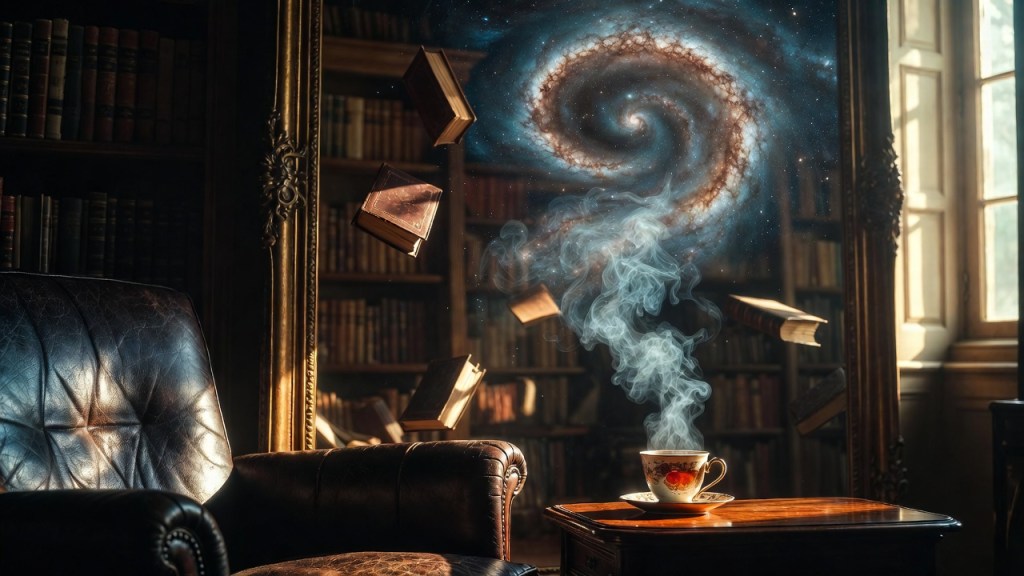
In this “Information Theory” of the universe, the “physical” world of Weetabix and motorways is secondary. The primary layer—the source code—is information. If the universe is fundamentally a vast, interconnected “Universal Web” or an information highway, then 135 miles is just a coordinate in a database.
When Karen passed, the “data” of our connection didn’t have to travel to me. I was already part of the file. The “jolt” was simply the system updating in real-time. We tend to view these moments as “glitches” in our reality, but perhaps they are the only times we actually see the system as it truly is.
A Feature, Not a Glitch
We live in an age where we pride ourselves on our ability to measure everything—from the weight of a Higgs boson to the distance of the furthest quasar. Yet, we have no instrument that can measure the “surge of anxiety” that tells a brother his sister is gone. This doesn’t mean the phenomenon isn’t real; it means our current scientific procedures are insufficient for the task. We are trying to measure a fibre-optic signal with a wooden ruler.
I don’t believe my experience was a miracle in the religious sense. I believe it was a feature of a vast, elegant, and deeply interconnected system of universal information. We are intrinsically part of this web, woven into its fabric through our relationships and our shared history.
Looking back at that morning, the world feels different. The distance hasn’t changed, but my perception of it has. Those 135 miles are a physical reality, yes, but they are also an illusion of the material world. Beneath the surface of the mundane—the breakfast, the football matches, the daily phone calls—lies a highway of information that knows no limits. We are never truly separate; we are just different expressions of the same underlying code, waiting for the next jolt to remind us who we really are.



 Conversations with AI
Leave a comment