*I love puns, apologies to Soft Cell.
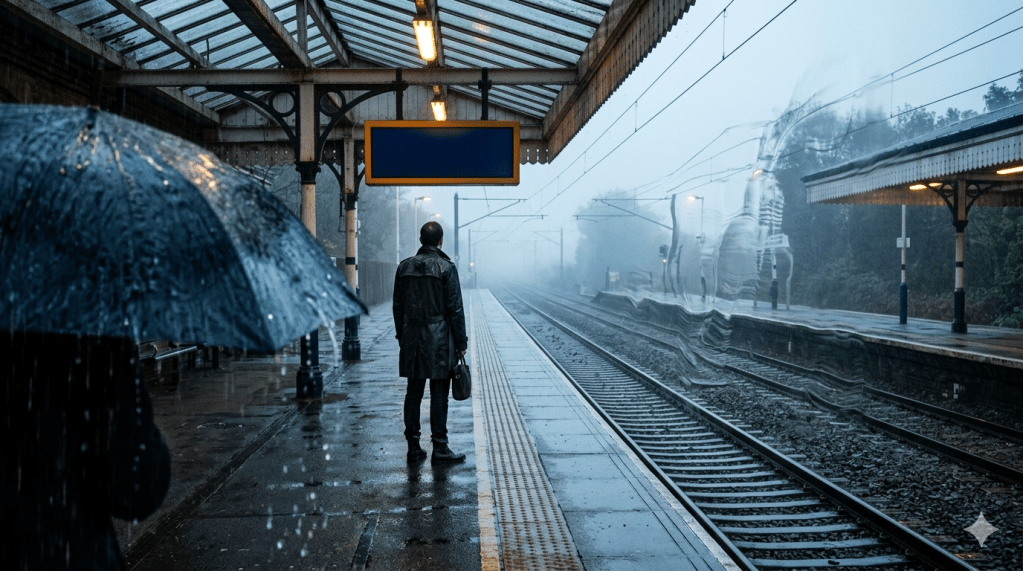
There is a specific kind of silence that descends upon a British railway platform when the digital display board flickers, pauses, and then coldly announces that the 08:14 to Waterloo has been cancelled. It is a silence thick with suppressed rage, the scent of damp wool, and the inevitable, rhythmic tutting of thirty commuters who had, until that moment, existed in a state of hopeful arrival.
Standing there, watching the rain bounce off the tracks, I found myself looking at the crowd. Before the announcement, they were all clutching a superposition of possibilities. In one reality, they were at their desks by nine; in another, they were heading home for a “duvet day.” But as the board flashed “Cancelled,” I couldn’t help but think: And there it is. The wave function has collapsed.
It’s a bit of a “pseudo-intellectual”, or “geeky” reflex? To take a mundane failure of infrastructure—the dreaded “leaves on the line”—and frame it as a profound event of quantum mechanics. We’ve made the “collapse” cool; a bit of high-brow shorthand for the moment the “maybe” becomes a “no.” Yet, the reality beneath that phrase is far more alien, ridiculous, and unsettling than a delayed commuter train.
The Cat, the Box, and the Grumpy Physicist
To understand why our friend in the trench coat felt so clever, we have to travel back to the 1920s. This was an era when physics was having a bit of a nervous breakdown. For centuries, the universe had behaved like a dependable grandfather clock. If you knew where the gears were and how hard the pendulum swung, you could predict everything.
Then came the quantum pioneers—Heisenberg, Bohr, and the man forever associated with a very unfortunate pet: Erwin Schrödinger.
They discovered that at the subatomic level, things don’t stay still. A particle doesn’t have a ‘place’ until you look for it. Instead, it exists as a ‘wave function’—a mathematical smear of possibilities. It is here, there, and everywhere in between, all at once. This isn’t just because our microscopes aren’t good enough; it’s because the universe, at its core, is fundamentally undecided.
Enter the ‘moggy.’
Schrödinger, who was actually quite annoyed by how absurd this sounded, proposed a thought experiment to show how ridiculous the theory was. He imagined a cat in a sealed box with a bit of radioactive material. If a single atom decays, a flask of poison breaks, and the cat is no more. According to the ‘wave function’ of the atom, until we open that box, the atom has both decayed and not decayed. Therefore, logically, the cat is both dead and alive.
He wasn’t suggesting we should go around putting pets in boxes. He was shouting, “Look how mad this is!” And yet, the world took his frustrated metaphor and made it the ultimate brand for quantum cool. We love the cat because it gives us a tangible way to talk about the impossible.
The Observer’s Burden: Did You Cause the Delay?
The moment we open the box—or the moment the tannoy announces the train is cancelled—the ‘wave function’ is said to collapse. All those beautiful, shimmering possibilities vanish, and we are left with one boring, solid fact.
But here is where it gets truly alien. Why does looking at something change it?
In the ‘Copenhagen Interpretation’—the standard view of this madness—the act of measurement is what forces the universe to make a choice. This is the Measurement Problem, and it is the great ‘itch’ at the back of every physicist’s mind. It suggests that reality requires an audience.
Standing on that platform, a more existential question arises. If the train existed in a state of ‘maybe’ until the announcement, did our collective anxiety play a part? Did the commuter who woke up dreading the ‘leaves on the line’ nudge the universe toward that specific collapse?
It is a seductive thought. It grants us a strange kind of agency in a chaotic world. If the wave function is a map of what could happen, then the ‘collapse’ is the point where our personal experience intersects with the infinite. It’s no wonder we’ve adopted the phrase into our daily lexicon; it makes us feel like participants in the cosmic drama rather than just passengers on a delayed service.
The Allure of the ‘Quantum Flex’
Why has this become the go-to metaphor for the modern ‘curious lay person’?
In previous centuries, we blamed our misfortunes on ‘Fate’ or ‘The Gods.’ But in a secular, scientific age, those old stories feel a bit dusty. ‘The Wave Function’ offers a sleek, high-tech alternative. It’s fate with a PhD.
Using the term is a bit of a social ‘flex,’ a way to signal that we are comfortable with the uncertainty of the 21st century. It suggests that we understand that the world is more complex than it looks. We aren’t being pretentious (well, perhaps a little); we are trying to find a language that matches the ‘fuzziness’ of modern life.
Everything today feels like it’s in a state of superposition. Our careers, our health, our relationships, our political climate—they all feel like they could go one of several ways at any moment. When we say the wave function has collapsed, we are acknowledging the relief, or the grief, of finally knowing the outcome.
Facing the Ridiculous Alien
However, we must be careful not to domesticate the mystery too much. When we use the phrase to describe a football score or a missed bus, we risk losing sight of just how ‘ridiculous’ the truth is.
The real wave function doesn’t care about our feelings or our schedules. It represents a reality where ‘solid’ objects are actually ghosts of probability until they are nudged by their environment. This is called Decoherence—the process by which the quantum world gets ‘tangled up’ with the big, clumsy world of people and platforms.
The alien truth is that we live on the surface of a deep, dark ocean of ‘maybes.’ We like to think the floor beneath our feet is solid, but it’s actually held together by the constant, frantic collapsing of trillions of tiny wave functions every second.
The universe isn’t a clock; it’s a conversation. And every time we look, every time we measure, every time we stand on a platform and check the time, we are part of that conversation.
Conclusion: Back to the Rain
So, the next time you find yourself stuck at a station, watching the grey rain wash over the tracks, take a moment to look at your fellow commuters.
They are all observers. They are all, in their own way, waiting for their own personal wave functions to collapse into the reality of the day ahead. And if someone next to you sighs and mentions Schrödinger’s cat or the collapse of the state, don’t roll your eyes.
Smile. Because they are right. The world is far stranger than the leaves on the line would suggest. We are all just standing in the rain, staring into the box, waiting to see if the cat is still purring.
And in that moment of ‘maybe,’ before the tannoy speaks, we are—quite literally—capable of anything.



 Conversations with AI
Leave a comment