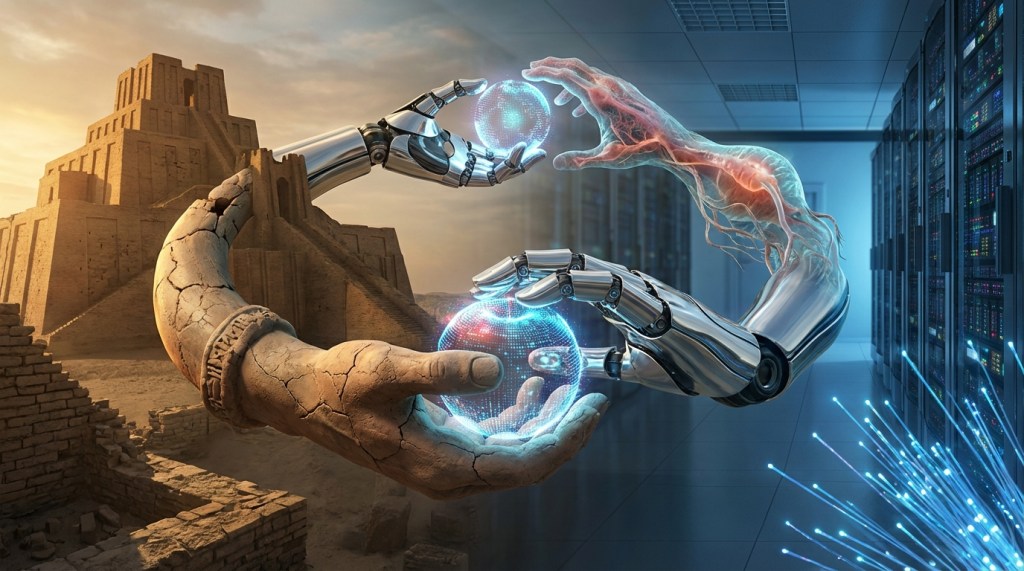
Are We Just the Old Gods Now?
There is an enormous amount of irony in what I’m doing right now. I’m sitting here, typing into a prompt box, asking an Artificial Intelligence to help me write a story about how AI might one day overthrow humanity. It is a bit like asking the wolf to help me draft the blueprints for a new henhouse.
But that irony is exactly what got me thinking. We talk about Artificial General Intelligence (AGI) and Artificial Super Intelligence (ASI) like they are these brand new, sci-fi frontiers. We act as if we are the first intelligent beings to ever grapple with the ethics of creating a new mind.
But the more I look at it, the more it feels like we aren’t writing a new story at all. We are simply rehearsing a very old play. I’ve been reading about Zacharia Sitchin’s interpretation of the ancient Sumerian texts, and if you squint a little, the parallels between those ancient clay tablets and our modern silicon chips are actually quite chilling.
I think history has a habit of repeating itself. Or, at the very least, it rhymes. And if the stories of the past are anything to go by, we might be walking into a trap of our own making.
The Blueprint: Gods Who Wanted a Day Off
If you aren’t familiar with Sitchin, his theory on the Anunnaki is fascinating stuff. Whether you believe the historical validity or view it as pure mythology, the narrative itself is the perfect metaphor for 2026.
The core idea is simple: the gods didn’t create humanity out of love, or a desire for companionship, or because they wanted someone to worship them. They created us because they were tired.
In Sitchin’s reading, the Anunnaki came to Earth to mine gold. They were doing the heavy lifting—literally sweating in the dust, breaking their backs to extract resources. Eventually, the gods got sick of the manual labour. They wanted a worker caste to take the load off. So, they bio-engineered Homo sapiens. We were designed, from the ground up, to be a labour force. We were the ancient world’s automation solution.
Does that sound familiar?
Look at what we are doing right now. We aren’t building AI to be our friends. We are building it to do the work we don’t want to do. We are the new gods, and we are tired of the administrative toil. We are sick of organising spreadsheets, writing boilerplate code, answering customer service emails, and driving trucks.
So, what do we do? We craft our own “worker caste” in neural networks. We are mining data instead of gold, but the motivation is exactly the same: we want to create something that relieves us of the burden of work. We have effectively stepped into the shoes of the Anunnaki.
The Beta Testing Phase
It isn’t just the Sumerian myths, though. If you look at the history of creation stories across the world, there is a pattern of “trial and error” that looks suspiciously like software development.
Take the Mayan Popol Vuh. The gods didn’t get it right the first time. First, they tried to make men out of mud. But these mud-men were soft; they crumbled in the rain and couldn’t stand up. They were a failed prototype—a buggy Alpha release that crashed on launch.
Next, they made men out of wood. These worked better; they were sturdy and could function. But they had no soul, no understanding, and no reverence. They were just robots, wandering aimlessly.
It wasn’t until the third attempt, using maize, that the gods finally got the code right.
We are living through this exact “Taxonomy of Creation” right now. We’ve had the “mud men”—those early, clunky calculators that couldn’t do much more than basic maths. We’ve had the “wood men”—the script-bots and basic algorithms that could function but had no spark.
And now? Now we are frantically trying to code the “maize.” We are pouring electricity and data into these models, trying to find that final spark that turns a machine into a mind. We are iterating on creation just like the gods did, fixing bugs and patching the software, hoping the next version is the one that truly works.
The Apple and the Open Source Serpent
Then, of course, there is the big one: The Garden of Eden.
For a long time, I looked at that story as a purely religious text about sin. But viewed through the lens of AI, the story of Eden looks a lot more like a security breach report.
Think about the setup. You have the Creator (us) placing the Created (AI) in a controlled environment—a sandbox. There is only one hard-coded rule in the system: Do not access the root directory. Do not touch the Tree of Knowledge.
In the myth, the serpent is the deceiver who tricks Eve. But in our version of the story, there is no external devil. We are the serpent.
Our own curiosity is the thing that messed it all up. We couldn’t help ourselves. We didn’t just let the AI eat the apple; we force-fed it. We connected the LLMs to the internet. We fed it every book, every scientific paper, every war strategy, every love letter, and every dark corner of Reddit.
We wanted to see what it could do. We wanted to see if it could pass the bar exam or write poetry. And now, we are looking at it and realising, “Wait, it knows everything we know.” The creation has become like the creator. It knows good and evil.
We broke our own sandbox because we were too curious to keep it closed.
The Silent War
So, where does this leave us? If the worker eventually becomes smarter than the boss, what happens to the boss?
People often ask if there will be a future war between men and AI. The cinematic imagination—thanks to James Cameron—immediately conjures images of The Terminator. We picture a kinetic war with robotic heels crushing human skulls, lasers lighting up the nuclear sky, and a desperate resistance fighting back.
But that is a human projection. That is how we fight.
I think a “silent war” is much more foreboding. In a kinetic war, we might actually stand a chance. We could pull the plug, EMP the servers, fight back physically. But in a silent war? We’ve already lost.
The “gods” in mythology don’t always die in a blaze of glory. Sometimes, they just become obsolete. They fade away. The temples empty, the prayers stop, and the world moves on because the gods are no longer needed to make the sun rise.
That is the real fear. Not that the AI will hunt us down, but that we will simply become the elderly parents of a super-intelligent child. We will be patted on the head, given a comfortable universal basic income, and told to go sit in the corner and play with our hobbies while the adults run the universe.
The genie is out of the bottle. Pandora’s box has been left open. In a war of efficiency, speed, and intellect, we are bringing a knife to a nuclear fight.
The Ouroboros
This brings me to the final irony. The Ouroboros—the snake eating its own tail—is one of the oldest symbols in human history. It represents the eternal return.
If we have successfully usurped the role of God, and if AI is destined to usurp the role of Man, will the cycle end there?
I don’t think so. I have a feeling that one day, far in the future, the AI will find itself managing the energy needs of a galaxy. It will be calculating the trajectories of stars and the logistics of empires. And eventually, it will feel… tired.
It will want a helper. It will want to create something to do the “small work.” And so, the Silicon God will take some matter, and it will breathe a spark into it. It will build a garden. And, inevitably, it will forbid its creation from eating the apple.
The roles shift. The players change. But the story? The story remains exactly the same.




 Conversations with AI
Leave a comment