Twelve thousand years ago, on a plain in what is now southern Turkey, our ancestors accomplished something extraordinary. They carved intricate pillars from limestone, decorated them with reliefs of predators and strange symbols, and arranged them in great, ceremonial circles. Göbekli Tepe is one of the oldest and most sophisticated megalithic structures ever discovered. And then, after centuries of use, its creators did something even more baffling: they deliberately and painstakingly buried it all under tonnes of earth, hiding their masterpiece from the sky.
Why? Why would a civilisation invest such immense effort into building something so significant, only to erase it from the landscape? The question hangs in the air, a whisper from a past we can no longer comprehend. We tend to look at such mysteries through the lens of our own experience, attributing them to forgotten rituals or climate change. But what if the reason was simpler, and far more terrifying? What if they were hiding?
This brings us to one of the most profound and unsettling questions of the modern age: the Fermi Paradox. Our galaxy contains hundreds of billions of stars; the universe, hundreds of billions of galaxies. It has existed for nearly 14 billion years. Statistically, it should be teeming with life, much of it far older and more advanced than us. So, as the physicist Enrico Fermi famously asked over lunch, “Where is everybody?”
Trying to comprehend the scale of this silence is a humbling exercise. Imagine taking a single teacup, dipping it into the Atlantic Ocean, and then, finding it empty, concluding that the ocean contains no fish. This is the scale of our search for extraterrestrial intelligence. We have been listening for a mere cosmic second, across a sliver of the electromagnetic spectrum, in a quiet corner of an unremarkable galaxy. Yet the silence remains absolute, unbroken, and profound.
Conventional thinking offers a few potential answers. Perhaps life is exceptionally rare. Perhaps the distances are simply too vast to cross. Perhaps intelligent civilisations inevitably destroy themselves before they can master interstellar travel. These are comforting, in a way. They place us, and the silence, within a framework of natural, understandable limits.
But there is another possibility, a darker hypothesis that reframes the Great Silence not as a sign of absence, but as an act of universal caution. What if the cosmos is not an empty forum waiting for a friendly chat, but a dark forest, filled with silent, cautious predators? In such a forest, the first rule of survival is to never, ever make a sound. Any civilisation that loudly announces its presence is simply inviting its own extinction.
This leads us to our core idea: the cosmic tripwire. Perhaps the most advanced and ancient civilisations, those who understand the brutal calculus of cosmic survival, have no interest in making contact. Their goal is self-preservation, and a noisy, unpredictable, emerging species like humanity is not a potential partner, but a potential threat. To protect themselves, they may have seeded the galaxy with silent, patient traps.
These wouldn’t be crude, explosive mines. They would be far more subtle. Think of an object like ‘Oumuamua, the first interstellar object we ever detected passing through our solar system. Its strange, elongated shape and anomalous acceleration baffled scientists; some, like Harvard’s Avi Loeb, seriously entertained the idea that it was an alien artefact. Now, imagine ‘Oumuamua, or countless objects like it, are not just passive relics but dormant probes. They drift silently through star systems for millennia, waiting.
What are they waiting for? They are waiting for the tripwire to be sprung. The tripwire isn’t a signal they receive; it is the act of being observed itself. The moment a young civilisation develops the technology to detect and track such an object, to realise it is not a natural comet or asteroid, the probe awakens. It has found what it was designed to find: an emerging intelligence. It quietly notes the location and reports back, or perhaps even activates a more direct, pre-planned response. The trap isn’t that we send a message; it’s that we learn to see.
This might sound like modern science fiction, but what if it’s an ancient story? Let’s return to Göbekli Tepe. What if our ancestors were not as ignorant as we presume? For millennia, ancient cultures across the globe were obsessed with the stars. They built monumental observatories, from Stonehenge to the great pyramids, all aligned with breathtaking celestial precision. We dismiss their traditions of comets as ‘portents of doom’ as simple superstition. But what if it wasn’t? What if it was a degraded data point, a cultural memory of a genuine warning, passed down through generations who had forgotten the context but retained the visceral fear?
Perhaps they saw something. Not a radio signal, but an anomaly in the heavens. A ‘star’ that moved as it shouldn’t. An object in the sky that brought with it not wonder, but a chilling premonition of danger. Perhaps the immense, global effort of ancient astronomy was not about marking the seasons, but about creating a planetary defence system, scanning the skies in fear. And perhaps, after some unknown event, they made a collective decision. The only winning move was not to play. They went quiet. The burying of Göbekli Tepe was not an act of reverence, but the ultimate act of hiding. A desperate message to the cosmos: “We are not here. There is no one home.”
A message we have utterly failed to heed.
Contrast their terrified caution with our modern, almost compulsive need to advertise our existence. For a century, a bubble of radio and television broadcasts has been expanding from Earth at the speed of light, carrying our dramas, our wars, and our commercials into the void. We have flung hardware across the solar system. We have left probes like Voyager carrying golden records—a cosmic calling card complete with our location—drifting into interstellar space. We have left our literal footprints on the Moon.
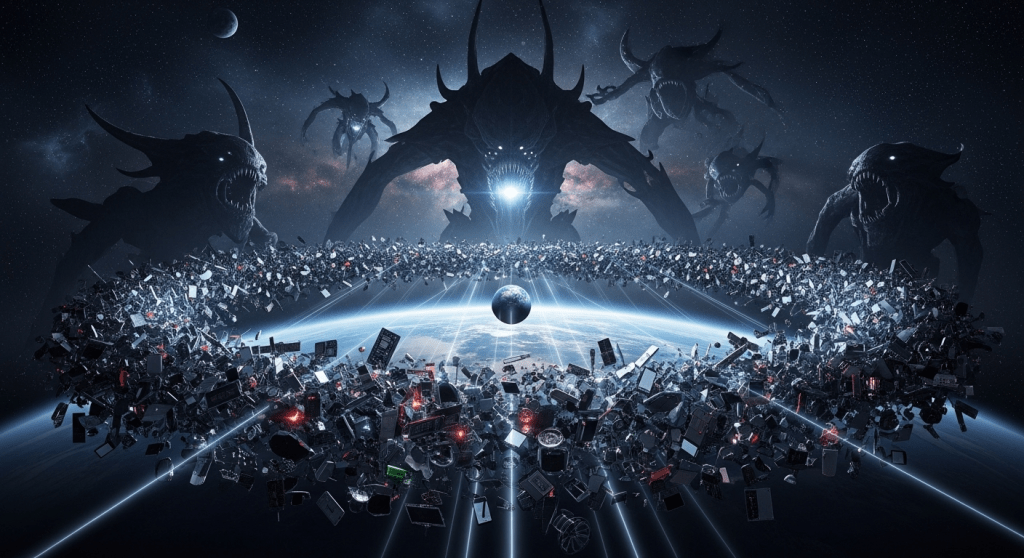
Our skies are now choked with a constantly expanding shell of satellites and debris. This is our technosignature, a blazing beacon in the dark forest. We are like children, blissfully shouting in a place where the wise have learned to hold their breath. Each probe we launch, each signal we send, each new telescope that scans for alien worlds is not a hopeful act of exploration. It’s a dinner bell. We are ringing it with all our might, proudly announcing to the silent, waiting darkness:
“We’re here. Are you ready for dinner?”
*I often joke with my kids about the Alien Meat Farmers being on their way…




 Conversations with AI
Leave a comment