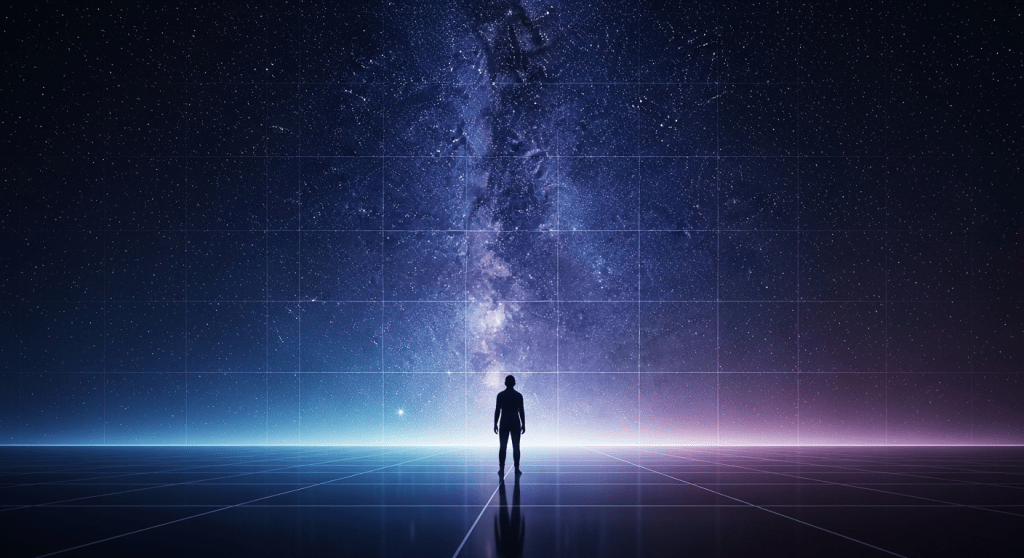
It is a serious scientific possibility that our universe, and everything within it, is an elaborate illusion. This is not a line from a science-fiction script, but a premise being given genuine, sober consideration in the fields of theoretical physics and cosmology. The fabric of our reality, the very bedrock of our existence, may not be what it appears to be. This single thought can be profoundly unsettling, a rabbit hole of cosmic proportions. Yet, it is also a gateway to some of the most fascinating and mind-expanding ideas ever conceived.
Today, we are not going to solve this riddle. Instead, our goal is to explore it together. We will delve into two of the most compelling theories that attempt to explain the potentially illusory nature of our world: the idea that we are inhabitants of a sophisticated computer simulation, and the hypothesis that our entire universe is nested within the crushing darkness of a black hole. After exploring these staggering possibilities, we will arrive at the most crucial question of all, one that brings us back from the cosmic scale to the deeply personal: does any of it truly matter?
Let’s begin with the concept that has most firmly captured the popular imagination: the Simulation Hypothesis. At its core, the idea is straightforward enough to grasp. It posits that our reality, from the grand spiral of the Andromeda galaxy down to the quarks that form a blade of grass, is a simulated construct running on an unimaginably powerful computational device. We, along with our memories, our choices, and our consciousness, would be part of this program.
The argument for this often hinges on a simple matter of probability. If a civilisation anywhere in the universe can reach a point where it can create simulated realities indistinguishable from a ‘base’ reality, it would likely run countless such simulations. For historical research, for entertainment, for reasons we cannot even fathom. If this is the case, then basic statistics suggest it is far more probable that we are living in one of the myriad simulations than in the one, singular, original reality.
But how could we possibly test such a thing from the inside? We cannot simply ‘unplug’ ourselves. The answer may lie in searching for the limitations of the system, the fundamental building blocks of our simulated world. Think of it as looking for the pixels on a screen. If you zoom in far enough on a digital image, you eventually reach a point where the picture dissolves into a grid of single-coloured squares. Its resolution has a limit. Theorists propose that our universe might have a similar ‘resolution’—a smallest possible unit of space, time, and energy.
This is precisely what physicists are doing when they delve into the perplexing world of quantum mechanics. They are trying to find the universe’s smallest, most fundamental constituents. And what they have found is bizarre. The more closely we observe this quantum realm, the stranger it seems to become. Particles that exist in multiple places at once until they are measured, connections that appear to happen faster than the speed of light—it is a world that seems to defy all common sense. This is where your own insightful observation comes into play. You noted that this strangeness itself feels like a tell. It is almost as if the ‘glitch’ we are looking for is right there in front of us. The system seems to behave differently when it knows it is being watched. Perhaps, some suggest, this is a feature of the simulation designed to save on processing power, only rendering the fine details of reality when a conscious observer, a user, decides to look.
From the digital to the cosmological, let us turn to the second of our grand theories. This one is perhaps even more staggering: the idea that our universe was born from, and exists within, a black hole. It’s a hypothesis that re-casts the Big Bang not as a singular, unique beginning, but as a recurring event happening all over a much larger ‘parent’ cosmos.
On the surface, it sounds fantastical. But the mathematical parallels are compelling. A black hole is formed when matter becomes so dense that it collapses under its own gravity, creating a point of infinite density called a singularity. Surrounding this is the event horizon, the point of no return. According to our current understanding, our own universe also began from a singularity that erupted in the Big Bang. Physicists have noted that the mathematical description of a black hole’s event horizon is surprisingly similar to the cosmological description of a universe like ours. This has led some to propose that when a giant star in a parent universe collapses into a black hole, a new ‘baby’ universe might be formed from the singularity within it. Our universe could be one such baby.
Here, too, scientists have devised a potential method of testing. We cannot, of course, journey outside our cosmos to look for a parent universe. The evidence, if it exists, must be found within our own home. The most promising place to search is in the Cosmic Microwave Background (CMB). This is the faint, afterglow radiation left over from the Big Bang, permeating all of space. It is a snapshot of the universe in its infancy. If our universe was indeed forged in the violent collapse of a black hole, the process may have left subtle, tell-tale imprints on this relic radiation. These specific patterns or anisotropies could be thought of as a kind of ‘scar’ from our cosmic birth, a faint but persistent sign that our origins lie within another, older space. The search for such a scar is an active, albeit challenging, area of cosmological research.
And so, we are left suspended between these two immense possibilities. A world of code, or a world within a world. It is enough to induce a sense of vertigo in even the most grounded individual. After navigating these far-flung ideas, it is only natural that we return to Earth and ask the quiet, simple question you posed right at the start. So what? Does it really matter?
Perhaps the most sensible response to such unanswerable questions is to turn away from the cosmic and focus on the personal. In the face of such profound uncertainty about the nature of our reality, maybe the wisest course of action is to anchor ourselves in the things we know to be true for us. The warmth of the sun on our skin, the comfort of a friend’s laughter, the quiet satisfaction of a task well done. Perhaps the meaning of our existence isn’t to be found by solving the riddle of the universe, but by simply bottling up the good moments. To collect these small, tangible certainties so that we can revisit them when things aren’t so good, as a reminder that our experience, our joy and our pain, is undeniably real to us, whatever its underlying framework.
That is certainly a comforting, gentle conclusion. It is a philosophy that allows us to find peace and purpose in a world that may be far stranger than we can comprehend.
But there is another, perhaps more liberating, conclusion to draw. One that looks at the cosmic diagrams, the complex mathematics, the philosophical debates and responds with a calm, resounding… “meh”.
Bah. So what?!
Perhaps the true freedom lies not in finding an alternative source of meaning, but in recognising that we may not need a grand one at all. Whether we are in a simulation, a black hole, or a ‘base reality’ so straightforward it’s gone out of fashion, we are here. Now. The constant search for a hidden layer of meaning, a secret purpose to our existence, can become its own kind of prison. The ultimate answer to the unanswerable question might just be to stop asking it. To shrug our shoulders, accept the magnificent mystery for what it is, and get on with the messy, beautiful, and only business we have: living.






 Conversations with AI
Leave a comment