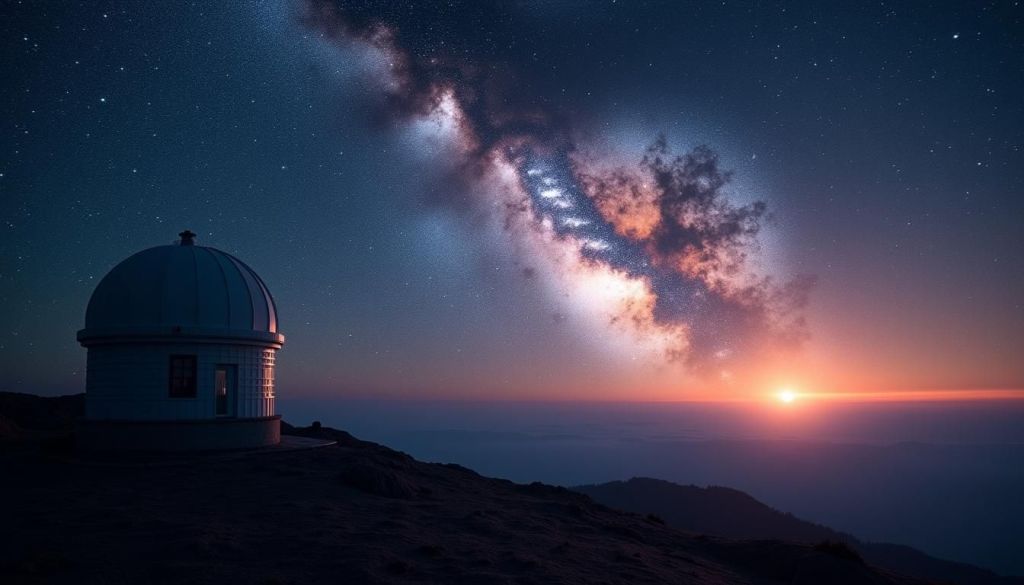
On a clear, moonless night, far from the light pollution of our cities, the cosmos presents itself as a vast, unchanging canvas of silent, glittering points. It’s a vista that has captivated humanity for millennia, inspiring myths, religions, and the very first stirrings of science. Yet, this perception of serene permanence is perhaps the grandest illusion we have ever collectively experienced. The reality, as revealed by a century of meticulous observation and rigorous analysis, is that the silent, glittering canopy above us is a theatre of unimaginable violence and change, governed by an expansion so powerful it shapes the very nature of existence and time itself.
From my perspective, shaped by a career in computer science and IT, this story of cosmic discovery feels uncannily familiar. It’s a process of debugging the ultimate system. You start with an observation—a program not behaving as expected, a network showing strange latency. You then gather data, form a hypothesis, and test it. More often than not, the answer reveals that the system is far more complex than you initially assumed, and that your initial understanding was fundamentally flawed. The story of our evolving universe is just that: a tale of observation challenging assumption, of data overwriting dogma, and of us, the analysts, piecing together a model of reality from the faint signals that reach our tiny corner of space-time. Let’s unpack the evidence for this expanding, evolving universe and explore what its profound and unsettling effects truly are.
Our journey into this new understanding really began in earnest in the 1920s with the work of American astronomer Edwin Hubble. At the time, the prevailing wisdom, even championed by Einstein, was that the universe was static and eternal. The alternative—a universe with a beginning—smacked of creation myths and felt unscientific. Hubble, using the powerful Hooker telescope at Mount Wilson Observatory, was meticulously cataloguing the “spiral nebulae,” which were then thought by many to be gas clouds within our own Milky Way galaxy. By identifying specific types of pulsating stars (Cepheid variables) within these nebulae, he was able to calculate their distances, proving conclusively that they were in fact entire galaxies, “island universes” as he called them, lying millions of light-years away. This was a revolutionary discovery in its own right, expanding the known universe immensely.
But it was his next step that truly shattered the old paradigm. When analysing the light from these distant galaxies, Hubble noticed something consistent and strange: the light was stretched. This phenomenon, known as redshift, is an astronomical application of the Doppler effect. We’re all familiar with how the pitch of an ambulance siren rises as it approaches and drops as it moves away. The same principle applies to light waves. Light from an object moving away from us is stretched to longer, redder wavelengths. Hubble observed that not only were nearly all galaxies redshifted, meaning they were moving away from us, but the further away a galaxy was, the faster it was receding [1].
The conclusion was inescapable and profound. The universe wasn’t static; it was expanding. It’s crucial to understand what this means. It’s not that galaxies are flying away from a central point *through* space, like cosmic shrapnel. Rather, space itself is expanding, carrying the galaxies along with it. The classic analogy is of raisins in a loaf of baking bread. As the dough expands, every raisin moves away from every other raisin. From the perspective of any single raisin, it would appear that all the others are rushing away from it, with the most distant ones moving the fastest. There is no centre to the expansion; it’s happening everywhere.
This discovery provided the first solid piece of observational evidence for a universe that had a history, an evolution. If everything is flying apart now, it stands to reason that in the past, everything must have been much, much closer together. This logic points directly to a moment of immense density and heat—a beginning. The term “Big Bang” was actually coined derisively by astronomer Fred Hoyle, a proponent of the rival “Steady State” theory, but the name stuck.
For decades, the Big Bang theory was a powerful model, but it lacked a definitive piece of “smoking gun” evidence. If the universe had truly begun in an ultra-hot, dense state, a faint afterglow from that primordial fireball ought to still be detectable today, cooled by billions of years of expansion into the microwave part of the spectrum. The search for this relic radiation was on. Its discovery, like so many great scientific breakthroughs, came about by accident. In 1965, two American radio astronomers, Arno Penzias and Robert Wilson, were working with a large horn antenna at Bell Labs in New Jersey. They were plagued by a persistent, faint, background “hiss” in their measurements, a noise that seemed to come from every direction in the sky, day and night, throughout the seasons. They tried everything to eliminate it, even removing resident pigeons and cleaning their droppings from the antenna, but the hiss remained.
Unbeknownst to them, a team of physicists at nearby Princeton University, led by Robert Dicke, was actively building an instrument to search for exactly this cosmic afterglow. When the two groups learned of each other’s work, the puzzle pieces snapped into place. The hiss that Penzias and Wilson couldn’t get rid of was the echo of creation itself—the Cosmic Microwave Background (CMB) [2]. This discovery was a monumental confirmation of the Big Bang model. It was, in essence, a baby picture of the universe, a snapshot of the cosmos when it was just 380,000 years old. It showed a universe that was incredibly uniform, yet contained the tiny temperature fluctuations—the seeds of all future structures, including the galaxies, stars, and us.
With the expansion and the CMB, the case for an evolving universe was rock-solid. The story seemed fairly complete: the universe began with the Big Bang, and its expansion has been ongoing ever since, albeit slowed down over time by the mutual gravitational pull of all the matter within it. The big question became whether there was enough matter to eventually halt the expansion and cause a “Big Crunch,” or if it would expand forever, coasting into a cold, dark eternity. To answer this, astronomers needed to measure the rate of cosmic deceleration. They turned to another “standard candle”: Type Ia supernovae. These are stellar explosions that occur when a white dwarf star in a binary system accretes too much matter from its companion. Because they all happen at a very specific mass, they all explode with almost exactly the same intrinsic brightness. By comparing their apparent brightness (how bright they look from Earth) with their known intrinsic brightness, astronomers can calculate their distance with incredible precision.
In the late 1990s, two independent teams set out to use these supernovae to measure the universe’s deceleration. They observed incredibly distant supernovae to peer deep into the cosmic past. What they found was utterly bewildering. The data showed that the distant supernovae were fainter—and therefore further away—than they should have been in a decelerating universe. The only way to explain the data was to conclude that the expansion of the universe was not slowing down. It was accelerating [3]. This discovery, which earned its leaders the 2011 Nobel Prize in Physics, was a system diagnostic that sent shockwaves through the scientific community. It was as if you were monitoring a server’s workload, expecting it to slow down as a task finished, only to see its CPU usage spike to 100% for no apparent reason. Your model of the system is wrong. There is a component you haven’t accounted for.
This unknown component, this mysterious influence that is pushing the universe apart against the pull of gravity, was given the placeholder name “Dark Energy.” It isn’t energy in the conventional sense; it appears to be a property of space itself. As space expands, more space is created, and with it, more of this repulsive dark energy. Its discovery has led to our current, rather humbling “standard model” of cosmology. When we add up all the matter and energy in the universe, based on observations from probes like NASA’s WMAP and the ESA’s Planck satellite, the inventory is startling. The “normal” baryonic matter that makes up every star, planet, and person you’ve ever seen or heard of accounts for less than 5% of the total. About 27% is composed of “Dark Matter,” another mysterious substance whose gravitational effects we can see holding galaxies together, but which we cannot detect directly. The remaining ~68% is this perplexing Dark Energy, driving the cosmic acceleration [4].
So, what are the effects of living in this expanding, evolving, and accelerating cosmos? They are both profoundly philosophical and starkly physical. Firstly, they force a radical re-evaluation of our own significance. The Copernican principle, which moved the Earth from the centre of the universe, was just the beginning. We now understand that we are not at the centre of anything, living on a typical planet orbiting a typical star in a typical galaxy. Furthermore, our physical substance—the atoms of carbon, oxygen, and iron we hold so dear—is little more than a cosmic afterthought, a trace contaminant in a universe dominated by forces and substances we are only just beginning to name. This isn’t a cause for despair, but for a deep and abiding humility. It gives a sense of perspective that nothing else can. As the physicist Richard Feynman noted, “I, a universe of atoms, an atom in the universe.”
Secondly, the expansion of the universe gives direction to time itself. The Second Law of Thermodynamics states that entropy—disorder—always increases in a closed system. The primordial universe was a state of incredibly low entropy: hot, dense, and uniform. The expansion allowed for the formation of structure—galaxies, stars, planets—and the flow of energy that makes life and complexity possible. Without an expanding universe, we simply couldn’t exist. As Martin Rees, the British Astronomer Royal, has eloquently argued, the very physical laws and conditions of our universe seem finely tuned for life to emerge [5]. The expansion is a key part of that delicate balance.
Finally, the accelerating expansion dictates our ultimate fate. If Dark Energy is a constant property of space, then the future looks rather bleak and lonely. As the expansion accelerates, galaxies that are not gravitationally bound to our own local group will eventually be pushed away from us faster than the speed of light. Not that they are breaking the cosmic speed limit—it’s the space between us and them that is expanding that fast. The result is that they will disappear over our cosmic horizon, their light no longer able to reach us. Billions of years from now, the night sky for any future inhabitants of our galaxy will be a far emptier, darker place. The universe will eventually settle into a “Big Chill” or “Heat Death,” a vast, cold, dark void of fading embers.
From a seemingly static arrangement of celestial lights, we have reverse-engineered a dynamic, evolving system of immense scale and complexity. We have learned that our reality is built on a foundation of which we are almost entirely ignorant, and that the grand cosmic narrative is one of constant change, driving towards a distant future of profound isolation. The investigation is far from over. The nature of Dark Matter and Dark Energy are the two biggest unknowns in all of physics. But the process continues, just as it does in any field of complex problem-solving: we observe the output, we analyse the data, we refine the model, and we ask the next, deeper question. The universe may not have been designed for us, but in a strange and beautiful way, our minds seem perfectly designed to try and understand it. And that, surely, is a thought worth holding on to under the vast, expanding sky.
References and Further Reading
- 1Hubble, E. (1929). A relation between distance and radial velocity among extra-galactic nebulae. *Proceedings of the National Academy of Sciences*, 15(3), 168-173.
- Penzias, A. A., & Wilson, R. W. (1965). A Measurement of Excess Antenna Temperature at 4080 Mc/s. *The Astrophysical Journal*, 142, 419-421.
- Riess, A. G., et al. (Supernova Search Team). (1998). Observational Evidence from Supernovae for an Accelerating Universe and a Cosmological Constant. *The Astronomical Journal*, 116(3), 1009-1038.
- NASA Science. (2023). *Dark Energy, Dark Matter*. NASA. Available at: https://science.nasa.gov/astrophysics/focus-areas/what-is-dark-energy/
- Rees, M. (1999). *Just Six Numbers: The Deep Forces That Shape the Universe*. Weidenfeld & Nicolson.
*If this has raised your interest, you might enjoy delving into Brian Greene’s “The Fabric of the Cosmos” for a wonderfully accessible exploration of spacetime and cosmology, or the classic “Cosmos” by Carl Sagan for its sheer inspirational power.*




 Conversations with AI
Leave a comment