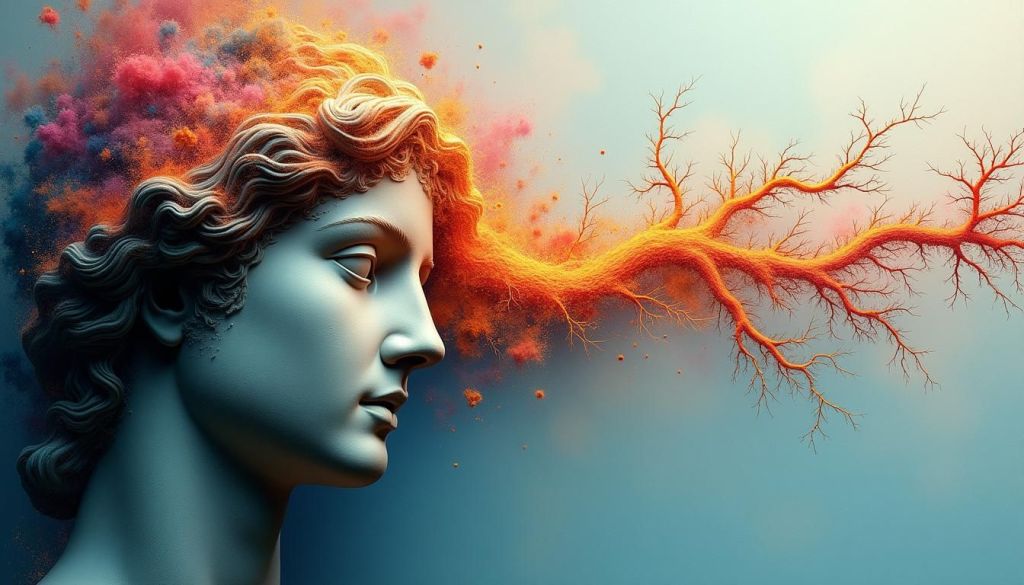
*What is beauty? My wife and kids – obvs!
It’s a question that has quietly, persistently buzzed in the background of human thought for millennia, like a subtle network process running in the background of a vast system: what makes something beautiful? Or, for that matter, what transforms an object, a sound, a movement, into ‘art’? We intuitively recognise beauty, we’re moved by art, yet pinning down a universal definition feels rather like trying to perfectly map a perpetually shifting cloud formation. It’s an elusive, yet utterly compelling, query that touches upon our very nature as perceiving, feeling, and thinking beings.
For a long time, the pursuit of beauty was central to aesthetic philosophy. The ancient Greeks, for instance, spoke of kalokagathia, the ideal of noble and good beauty, associating it with proportion, harmony, and an almost divine order. Plato, in his profound explorations, considered beauty to be an echo of perfect Forms, suggesting an objective, ideal standard that exists beyond our fleeting perceptions. In his view, a beautiful sculpture was beautiful because it participated in the universal Form of Beauty. Fast forward to the Enlightenment, and thinkers like David Hume offered a contrasting perspective, positing that beauty resides not in the object itself, but entirely in the eye of the beholder. For Hume, “Beauty is no quality in things themselves: it exists merely in the mind which contemplates them; and each mind perceives a different beauty.” This rather neatly encapsulates the long-standing tug-of-war between objective and subjective interpretations of aesthetics. Immanuel Kant, in turn, tried to bridge this divide, suggesting that while the judgment of beauty is subjective, it nonetheless carries a peculiar “universal validity,” a feeling that others ought to agree with our assessment, arising from a “disinterested” pleasure. It’s a fascinating, complex set of initial parameters for our inquiry.
However, the late 19th and early 20th centuries saw a seismic shift, particularly in the realm of art. The question evolved from “what makes something beautiful?” to “what makes something art?” This wasn’t merely a semantic distinction; it reflected a fundamental questioning of traditional aesthetic values. Consider Marcel Duchamp’s Fountain of 1917 – a porcelain urinal, signed “R. Mutt,” and presented as art. It wasn’t beautiful in any conventional sense, yet it provoked, challenged, and ultimately reshaped the very definition of art. This piece, among others, demonstrated that art could exist quite independently of traditional notions of aesthetic beauty or craftsmanship. The focus began to shift from the intrinsic qualities of an object to its context, its creator’s intent, and its reception within the ‘art world’. From a systems perspective, this was a radical re-configuration of the entire artistic protocol.
Let’s approach this from a systems-thinking vantage point, much as one might dissect a complex computational problem. At its most fundamental, perhaps biological, level, our perception of beauty might be hard-wired, a form of evolutionary “default setting” in our operating system. Certain patterns, for instance, seem to hold a near-universal appeal. Symmetry, for one, is often perceived as beautiful across cultures. From the perfectly mirrored wings of a butterfly to the balanced features of a human face, symmetry frequently correlates with health, genetic fitness, and developmental stability. As evolutionary psychologists like David Buss have argued, our brains may have evolved to register these markers of health and vitality as aesthetically pleasing because they signal desirable traits in a mate or a healthy environment. This isn’t a conscious decision; it’s a recognition embedded deep within our cognitive architecture, a pattern-matching function perhaps, that helps us navigate the world effectively. It’s an elegant, almost algorithmic, solution to a survival problem.
Beyond basic biological imperatives, our cognitive machinery is also deeply implicated in how we perceive and assign value. Neuroaesthetics, a relatively nascent field, explores the neurological underpinnings of aesthetic experience. Brain scans show that when we perceive something beautiful, whether it’s a piece of art or a natural landscape, specific areas of the brain associated with reward, pleasure, and emotion, such as the orbitofrontal cortex and the ventral striatum, become active. Semir Zeki, a pioneering neuroscientist, has suggested that art acts as a kind of “super-stimulus,” tapping into fundamental visual processing mechanisms in the brain. Similarly, Vilayanur S. Ramachandran has proposed “laws” of aesthetic experience, suggesting that beauty might be linked to the brain’s ability to extract and amplify key patterns, much like data compression, leading to a pleasurable “aha!” moment when a complex set of inputs is elegantly resolved. The unexpected resolution of perceptual tension, or the elegant synthesis of disparate elements, can trigger a release of neurochemicals, making us feel beauty. This feels very much like an efficient computational process delivering a positive feedback loop.
Yet, this biological and cognitive foundation, whilst compelling, still doesn’t fully account for the vast panorama of what we deem art, especially that which challenges conventional beauty. This brings us to the system of art itself – a complex adaptive system involving artists, institutions, critics, and the public. Arthur Danto, a renowned philosopher of art, argued that art couldn’t be distinguished from non-art by purely visual criteria alone, especially after pop art blurred the lines between everyday objects and artistic creations. For Danto, an object became art not by virtue of its intrinsic qualities, but by its “art status,” conferred within an “artworld” – a theoretical construct of art historians, critics, dealers, and collectors. George Dickie further elaborated this with his “institutional theory of art,” positing that art is essentially “any artifact which has had conferred upon it the status of candidate for appreciation by some person or persons acting on behalf of a certain social institution (the artworld).” Here, the ‘system’ – the social context and its arbiters – plays a pivotal role in the definition. It’s almost as if the art world functions like a distributed ledger, validating and assigning value to creative output.
This ‘artworld’ system, however, is not static; it evolves, influenced by culture, history, and shifts in societal values. The values we attach to art, and indeed to beauty, are profoundly shaped by what the sociologist Pierre Bourdieu termed habitus – our ingrained habits, skills, and dispositions, acquired through experience and upbringing. Our aesthetic sensibilities are not merely individual quirks; they are deeply entangled with our social class, education, and cultural milieu. A work considered groundbreaking in one era might be dismissed as kitsch in another; what is deemed ‘beautiful’ by one culture might be considered alien or even repellent by another. This demonstrates that the ‘algorithm’ for identifying beauty or art is not universal or fixed; it’s dynamically recalibrated by a complex interplay of personal and collective data points, adapting and mutating over time. It’s a continuous, often unpredictable, update cycle for cultural preferences.
Moreover, a significant aspect of what we call art isn’t necessarily about beauty at all; it’s about expression, provocation, challenge, and dialogue. Conceptual art, performance art, and much of modern art aims not to please the eye but to engage the mind, to force re-evaluation of assumptions, or to critique societal norms. Consider the impactful street art of Banksy; much of it isn’t ‘beautiful’ in a classical sense, but its artfulness lies in its biting social commentary, its placement, and the subversive message it delivers. The ‘art’ in these cases resides not in the physical object or its visual appeal, but in the conceptual space it opens up, the conversation it initiates, or the perspective it forces upon the viewer. It’s less about the static ‘data’ of the object and more about the dynamic ‘process’ it instigates in the viewer’s mind. The value lies in the ‘compute cycle’ it triggers.
This brings us to the active role of the viewer. While there might be some universal parameters or culturally learned preferences, the individual’s subjective experience remains paramount. Our personal history, our mood, our current context, and even our momentary preoccupations can all influence how we react to a piece of art or an aesthetic experience. The ‘aha!’ moment, that feeling of profound connection or insight when encountering a piece of art, is often highly personal. It’s when our internal processing algorithms find a compelling match, or an intriguing mismatch, with the external stimulus. Perhaps what makes something beautiful or art isn’t merely what it is, but what it does to us; how it stimulates our senses, challenges our intellect, stirs our emotions, or connects us to something larger than ourselves. It’s less about the objective output and more about the individual’s system state after processing.
In pondering what makes something beautiful or art, we realise there is no single, simple algorithm. Instead, we are looking at a highly complex, interconnected system. At one level, there are deep evolutionary and neurological predispositions – a kind of foundational layer for aesthetic appreciation, where patterns of harmony, symmetry, and perhaps novelty are ‘hardwired’ into our brains. Upon this, layers of cultural conditioning, historical context, and institutional frameworks are built, shaping and refining what we collectively deem to be artistic or beautiful. Finally, the individual observer’s unique internal state and personal history act as the ultimate filter, leading to an incredibly varied and dynamic spectrum of aesthetic experience. Art, in this view, becomes an emergent property of these interacting systems – biological, cognitive, cultural, and individual.
The democratisation of art through digital platforms and the emergence of AI-generated art further complicate this already intricate landscape. If an AI can create a visually pleasing image or a compelling musical score, does that qualify as art? It looks the part, it may even feel beautiful to a human observer, but does the lack of human intent or consciousness behind its creation diminish its status as art? This isn’t just a technical question; it directly challenges our core assumptions about creativity, authorship, and the very nature of aesthetic value. It prompts us to reflect: if the output is indistinguishable from human work, does the process matter less than the perception? This is, in a way, a sophisticated Turing Test for aesthetics.
Ultimately, the persistent inquiry into what makes something beautiful or art is itself a testament to our profound human curiosity and our quest for meaning. It’s a journey that takes us from the earliest vestiges of our evolutionary history to the cutting edge of neurobiology, from the lofty halls of philosophy to the bustling galleries of the contemporary art world. There’s no fixed endpoint to this exploration, no definitive ‘solution’ that can be coded and universally applied. And perhaps that’s precisely where its beauty lies: in its irreducible complexity, in its constant shifting, and in the enduring invitation to perpetually observe, analyse, and reflect upon the subtle and profound ways in which we engage with the world, seeking pattern, meaning, and transcendence in the seemingly mundane, or indeed, the exquisitely designed. The true art, perhaps, is in the conversation itself.
References and Further Reading:
1. Buss, David M. (1994). *The Evolution of Desire: Strategies of Human Mating*. Basic Books.
2. Kant, Immanuel. (1790). *Critique of Judgment*.
3. Zeki, Semir. (1999). *Inner Vision: An Exploration of Art and the Brain*. Oxford University Press.
4. Danto, Arthur C. (1964). “The Artworld.” *The Journal of Philosophy*, 61(19), 571-584.
5. Dickie, George. (1974). *Art and the Aesthetic: An Institutional Analysis*. Cornell University Press.
6. Ramachandran, V.S., & Hirstein, W. (1999). “The Science of Art: A Neurological Theory of Aesthetic Experience.” *Journal of Consciousness Studies*, 6(6-7), 15-51.
7. Bourdieu, Pierre. (1984). *Distinction: A Social Critique of the Judgement of Taste*. Harvard University Press.
8. Hume, David. (1757). “Of the Standard of Taste.” In *Four Dissertations*.
9. Plato. (c. 380 BCE). *Symposium*.





 Conversations with AI
Leave a comment