*Triggers broom is a reference to a really popular British sitcom
Have you ever stopped to think if you’re truly the same person you were five years ago, or even last year? You’ve changed, haven’t you? Your cells have replenished, your thoughts have evolved, and your experiences have shaped you. This very question, about what makes something (or someone) retain its identity over time despite constant change, is at the heart of a fascinating philosophical puzzle known as the Ship of Theseus paradox. This isn’t just some dusty old thought experiment; it’s a concept that challenges our understanding of identity in everything from everyday objects to our very selves, and it’s more relevant than ever in our rapidly changing world. Our purpose here is to delve into this ancient riddle, explore its various twists and turns, and see how it continues to provoke questions about who we are and what it means to be “the same.”
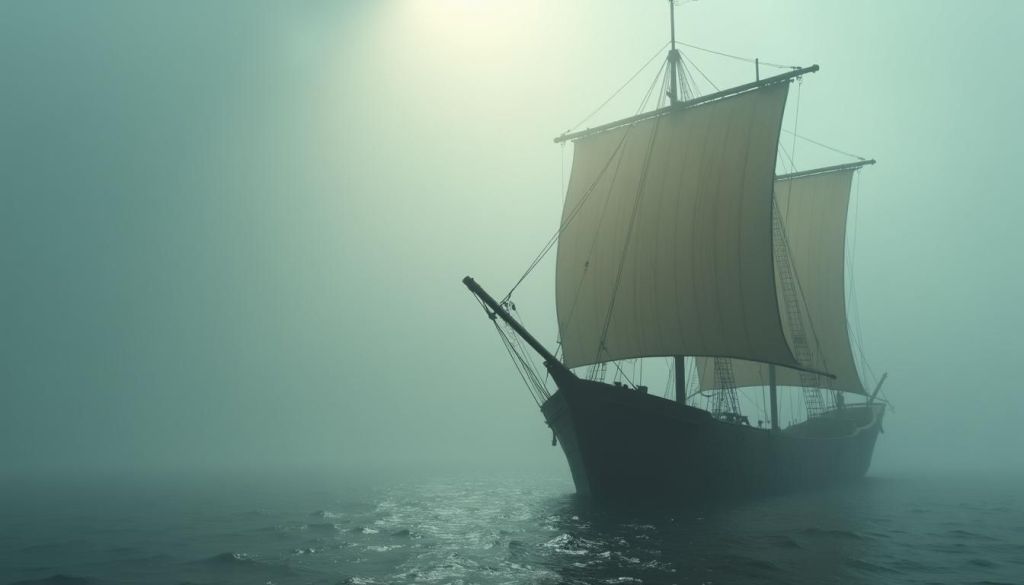
The story of the Ship of Theseus was first notably recorded by the ancient Greek historian and biographer Plutarch, in his “Life of Theseus.” Theseus, the mythical founder-king of Athens, had a ship that was so treasured by the Athenians that they preserved it for centuries in their harbour. As the wooden planks began to decay, they were meticulously replaced with new, strong timber. Plutarch writes, “The ship wherein Theseus and the youth of Athens returned from Crete had thirty oars, and was preserved by the Athenians down even to the time of Demetrius Phalereus, for they took away the old planks as they decayed, putting in new and strong timber in their places, insomuch that this ship became a standing example among the philosophers, for the logical question of things that grow; one side holding that the ship remained the same, and the other contending that it was not the same.” This became a classic philosophical conundrum: after all the original parts have been replaced, is the ship still the Ship of Theseus? If it’s not the same ship, at what exact moment did it cease to be the original?
Centuries later, the English philosopher Thomas Hobbes added another layer to this puzzle. He wondered: what if someone gathered all the old, discarded planks and used them to build a second ship? Which of these two ships, the one continually repaired with new planks or the one reconstructed from all the original old planks, would be the actual Ship of Theseus? Hobbes highlighted the absurdity of having two ships being numerically the same as the original. This extension sharpened the debate, forcing an even closer look at what defines an object’s identity.
This thought experiment immediately forces us to ask: what actually makes an object itself? One perspective is that an object’s identity is tied to its material composition — what it’s made of. This view, in philosophical circles, touches on ideas like “mereological essentialism,” which suggests that an object has its parts essentially. If you change the parts, you change the object. So, from this viewpoint, as soon as the first plank was replaced, the ship began to lose its original identity, and once all planks were new, it would definitively be a different ship. The ship reconstructed from the old planks would, for a mereological essentialist, have a stronger claim to being the original.
However, this doesn’t always sit right with our intuition. Think about a favourite childhood teddy bear, lovingly patched up over years until perhaps very little of its original fabric remains. Many would still consider it the same teddy, imbued with the same sentimental value. This points to other ways of understanding identity. Another strong contender is the idea of “spatiotemporal continuity.” This argument posits that an object remains the same as long as it exists continuously through space and time, irrespective of gradual changes to its parts. So, the ship in the harbour, having an unbroken history of existence and repair, would remain the Ship of Theseus because it traces a continuous path through time, always being that ship, the one everyone points to and calls the Ship of Theseus. The philosopher Aristotle offers another angle, suggesting that the “what-it-is” or the “formal cause” — the design, structure, or function — is key to an object’s identity. As long as the design and purpose of the ship remain the same, it’s the same ship, even if the matter changes. So, for Aristotle, the continuously repaired ship, maintaining its form and function as Theseus’s ship, would likely be considered the same. However, some argue that if two ships are built to the same design, they are not the same ship, suggesting form alone isn’t enough to define identity.
This is where the paradox truly comes alive, particularly when we turn the lens from inanimate objects to ourselves. Are you the same person you were as a child? Your body has undergone almost a complete replacement of its cells over the years. Your thoughts, beliefs, and personality may have also changed dramatically. So, what makes you you across time? This is the core question of personal identity. The 17th-century philosopher John Locke argued that personal identity is founded on consciousness, specifically memory. Locke famously stated that “as far as this consciousness can be extended backwards to any past action or thought, so far reaches the identity of that person; it is the same self now it was then; and ’tis by the same self with this present one that now reflects on it, that that action was done.” For Locke, if you can remember your past experiences, you are the same person who had those experiences. This view suggests that your identity is a matter of psychological continuity, not physical substance.
However, Locke’s theory faces challenges. What about forgotten memories or significant changes in personality due to amnesia or trauma? Does a person cease to be themselves if their memory is severely impaired? Scottish philosopher David Hume, taking a more radical stance, proposed what’s known as the “bundle theory” of the self. Hume argued that there is no permanent, enduring “self” that exists separately from our perceptions and experiences. He suggested that when we introspect, we only find a collection of different perceptions — thoughts, feelings, sensations — that are in constant flux. He famously wrote in A Treatise of Human Nature, “For my part, when I enter most intimately into what I call myself, I always stumble on some particular perception or other, of heat or cold, light or shade, love or hatred, pain or pleasure. I never can catch myself at any time without a perception, and never can observe any thing but the perception.” He concluded that the “self” is “nothing but a bundle or collection of different perceptions, which succeed each other with an inconceivable rapidity, and are in a perpetual flux and movement.”. This view suggests that perhaps our sense of continuous identity is more of an illusion or a useful fiction.
The Ship of Theseus paradox doesn’t just apply to ancient ships or philosophical debates about the self; its tendrils reach into many aspects of modern life. Consider a favourite football club. Over decades, players retire and are replaced, the manager changes, the stadium might be rebuilt, even the club’s crest might be redesigned. Is it still the same club that fans supported generations ago? For many, the answer is a resounding yes, suggesting that identity here is tied to a continuous history, a name, a community of fans, and an ongoing story, rather than just its constituent parts at any one time. We see a similar idea in the popular British sitcom Only Fools and Horses, with the character Trigger proudly proclaiming he’s had the “same broom” for 20 years, despite it having had 17 new heads and 14 new handles. It’s a humorous take, but it neatly illustrates the Ship of Theseus problem in an everyday context.
This line of questioning extends to organisations and institutions. If a company replaces all its employees, moves its headquarters, and changes its product line, is it still the “same” company? Legally, it might be, due to continuous registration. But philosophically? What about nations, whose borders shift, populations change, and governing ideologies evolve over centuries? Is modern Greece the same entity as ancient Greece, where these philosophical discussions began? Even our digital identities present a version of this paradox. If you change your avatar, your username, and all your online content, is your online persona still “you”? In an age of artificial intelligence, where an AI’s code is constantly updated and its hardware potentially replaced, at what point, if any, does an AI become a new AI, or does its identity persist through these changes?
The beauty of the Ship of Theseus paradox is that there isn’t one single, universally accepted answer. Its power lies in its ability to make us question and examine our assumptions about identity. Philosophers have proposed various solutions or ways of thinking about it. Some suggest identity is relative: the repaired ship is the same ship in one sense (e.g., functionally, historically) but a different ship in another (e.g., materially). Others argue that the very notion of “sameness” over time for complex objects is a linguistic convenience rather than a deep metaphysical truth. Perhaps identity isn’t about a fixed, unchanging essence but about a continuous process, a narrative we construct, or a pattern that persists. The “four-dimensionalist” view, for example, suggests objects are spread out through time, like a snake, with different “temporal parts” at different moments. So, the ship-at-time-one and the ship-at-time-two are different temporal parts of a larger, four-dimensional “ship-worm.”
Ultimately, the implications are wide-ranging. Our concepts of identity underpin legal responsibility (is the person who committed a crime years ago the “same” person today for purposes of justice?), ownership (if an artwork is continuously restored, who owns the “original”?), and even our personal sense of self and continuity. The paradox forces us to consider what criteria we prioritise: original material, form and function, continuous history, consciousness and memory, or something else entirely. Different contexts might lead us to different answers.
In summary, the Ship of Theseus begins with a seemingly simple question about a wooden boat but rapidly sails into the deep and often turbulent waters of metaphysics and personal identity. We’ve seen how the initial problem posed by Plutarch — whether a ship remains the same after all its parts are replaced — was complicated by Hobbes’s query about a second ship built from the old parts. We’ve explored how this applies not just to inanimate objects, by considering ideas like material composition, spatiotemporal continuity, and Aristotelian form, but also profoundly to ourselves, through the lens of Locke’s memory-based consciousness and Hume’s bundle theory of self. The paradox isn’t just an abstract puzzle; it resonates in our understanding of everything from sports teams and cultural artefacts to the very nature of our evolving selves in a world of constant flux. Perhaps the enduring lesson of the Ship of Theseus is that identity, whether of ships or of people, is far more complex and fluid than we might initially assume. It challenges us to think critically about what truly defines something — or someone — over time. So, as you continue to change and grow, collecting new “planks” and discarding old ones, what makes you undeniably, enduringly you?
References and Further Reading:
1. Plutarch. *Life of Theseus*. (Specifically, section 23.1 is the primary source for the paradox). Available in numerous translations. A good online version can be found via The Internet Classics Archive or the Perseus Digital Library.
2. Hobbes, Thomas. *De Corpore* (Concerning Body). (Chapter 11 discusses Hobbes’s extension of the paradox). Look for editions of Hobbes’s philosophical works.
3. Locke, John. *An Essay Concerning Human Understanding*. (Book II, Chapter XXVII, “Of Identity and Diversity” is where Locke discusses personal identity).
4. Hume, David. *A Treatise of Human Nature*. (Book 1, Part IV, Section VI, “Of personal identity” discusses the bundle theory of self).
5. Stanford Encyclopedia of Philosophy. (Online). Articles on “Identity Over Time”, “Personal Identity”, and “The Ship of Theseus”. (A highly reliable and detailed resource for philosophical topics).
6. Cohen, S. Marc. “Identity, Persistence, and the Ship of Theseus.” (Various publications and lecture notes by philosophy professors like Cohen often provide in-depth analysis. Searching for academic papers on the topic will yield many results).
7. Wiggins, David. *Sameness and Substance Renewed*. Cambridge University Press, 2001. (A more advanced philosophical text exploring identity).
8. Olson, Eric T. *The Human Animal: Personal Identity Without Psychology*. Oxford University Press, 1997. (Presents a biological view of personal identity).
9. Gallagher, Shaun. *How the Body Shapes the Mind*. Oxford University Press, 2005. (Explores the role of the body in self-consciousness and identity).
10. Noonan, Harold W. *Personal Identity*. Routledge, 2nd Edition, 2003. (A comprehensive overview of theories of personal identity).
11. Rea, Michael Cannon (editor). *Material Constitution: A Reader*. Rowman & Littlefield Publishers, 1997. (Contains several key essays on the metaphysics of objects and their parts, relevant to the Ship of Theseus).
12. The Collector. “The Ship of Theseus Thought Experiment: An Ancient Paradox.” (Provides a good overview and discusses some modern applications).
13. Britannica. “Ship of Theseus”. (Offers a concise explanation and its philosophical importance).
14. Philosophy Now. “A Philosophical Identity Crisis”. (Discusses theories of personal identity in an accessible way).




 Conversations with AI
Leave a comment