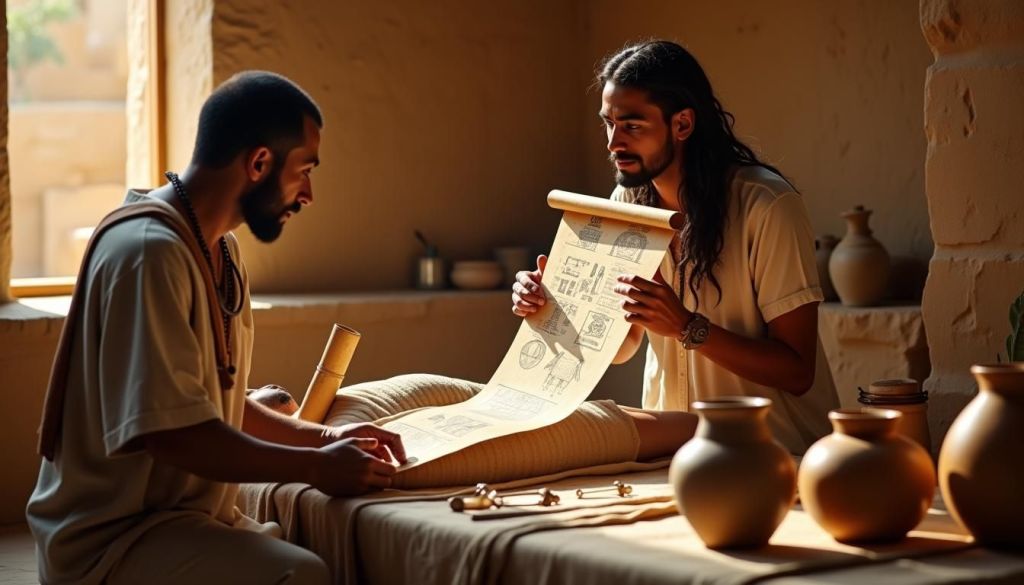
Imagine a world thousands of years before the advent of antibiotics, X-rays, or even a basic understanding of germs. In this ancient landscape, along the fertile banks of the River Nile, a civilisation blossomed, not only building colossal pyramids and intricate temples but also pioneering some of the earliest systematic approaches to medicine and health. The ancient Egyptians, often famed for their elaborate mummification rituals and preoccupation with the afterlife, were equally dedicated to preserving life and alleviating suffering in the here and now. This exploration aims to unveil the remarkable, and often surprisingly sophisticated, contributions of ancient Egypt to the medical arts, demonstrating how their practices laid foundational stones upon which later medical traditions, including our own, were built. Understanding their journey into the complexities of the human body and disease is not just a historical curiosity; it reveals the timeless human endeavour to combat illness and enhance wellbeing.
The story of Egyptian medicine spans millennia, intertwined with the very fabric of their civilisation. From the Early Dynastic Period, around 3100 BCE, when Egypt was unified, laying the groundwork for a stable society conducive to specialised learning, to the New Kingdom (circa 1550-1070 BCE), often considered the zenith of Egyptian power and cultural achievement, medical knowledge was accumulated and refined. Significant figures, though sometimes shrouded in legend, emerge from this period. Imhotep, a chancellor to the pharaoh Djoser during the Old Kingdom (circa 2650-2600 BCE), was a polymath revered for his wisdom, later deified and worshipped as a god of medicine, a testament to the high regard in which medical skill was held. The development of hieroglyphic writing was crucial, allowing for the recording of medical observations, treatments, and prescriptions on papyrus scrolls. These texts, painstakingly copied by scribes in institutions known as ‘Houses of Life’ (Per Ankh), which were often attached to temples, served as both repositories of knowledge and teaching manuals. The stability of the Egyptian state, punctuated by periods of intense cultural and intellectual activity, allowed for this continuous, albeit slow, development of medical understanding over an astonishing length of time. The later Ptolemaic period (332-30 BCE) saw Alexandria become a beacon of learning, where Egyptian medical traditions began to meld with emerging Greek thought, creating a rich cross-cultural exchange.
The ancient Egyptians perceived illness through a lens that combined empirical observation with strong magico-religious beliefs. Diseases were often attributed to the wrath of gods or goddesses, the malevolent actions of spirits or demons, or the presence of supernatural entities sent by enemies. Deities played a significant role in healing; Sekhmet, the lioness-headed goddess, could bring plague but also cure it, while Thoth, the ibis-headed god of wisdom and writing, was a patron of physicians and possessed knowledge of healing spells. Isis, the mother goddess, was also invoked for her healing powers, particularly for women and children. However, alongside these supernatural explanations, Egyptians also believed that illness could arise from natural causes, such as the ingestion of harmful substances or disturbances within the body’s internal ‘channels’ or metu. These metu, thought to carry air, water, blood, and other bodily fluids, could become blocked or corrupted, leading to disease. This concept, while not anatomically precise by modern standards, represented an early attempt to understand the body as an interconnected system.
This dual understanding of disease was reflected in the practitioners themselves. There were the swnw (pronounced ‘soo-noo’), who we might consider general physicians, focusing on observable symptoms and physical treatments. Then there were priest-physicians, such as the priests of Sekhmet, who employed incantations, amulets, and rituals alongside, or sometimes instead of, physical remedies. The famed Greek historian Herodotus, writing in the 5th century BCE, noted the high degree of specialisation among Egyptian doctors: “Medicine is practised among them on a plan of separation; each physician treats a single disorder, and no more… some undertaking to cure diseases of the eye, others of the head, others again of the teeth, others of the intestines, and some those which are not local.” [1] This suggests a sophisticated medical community with individuals focusing on specific areas like ophthalmology, dentistry (with figures like Hesy-Ra from the Old Kingdom being described as “Chief of Dentists and Physicians”), and even proctology, humorously referred to as “shepherd of the anus.” Training for these roles was likely apprenticeship-based, often within the temple precincts or the ‘Houses of Life’, where medical texts were studied and knowledge passed down.
Central to Egyptian medical practice were their methods of diagnosis. Physicians relied heavily on careful observation, examining a patient’s complexion, posture, and the appearance of bodily excretions like urine, faeces, and sputum. They would palpate the body to detect swellings, assess the temperature, and check the pulse, which they understood as a “speaker of the heart.” The Edwin Smith Papyrus, for instance, describes taking the pulse, linking it to the heart’s function. Questioning the patient about their symptoms and the history of their ailment was also a key component. Based on this examination, the physician would make a prognosis, often categorised into three types, as clearly outlined in several papyri: “An ailment which I will treat,” indicating a favourable outcome; “An ailment with which I will contend,” suggesting a more uncertain prognosis where the physician would attempt treatment; and “An ailment not to be treated,” a frank admission of the limits of their ability to cure, demonstrating a pragmatic and ethical approach. [2]
Our most profound insights into ancient Egyptian medicine come from a series of remarkable medical papyri that have survived the ravages of time. The most famous of these is the Edwin Smith Papyrus, dating to around 1600 BCE but believed to be a copy of a much older text, possibly from the Old Kingdom. It is an extraordinary document, primarily a surgical treatise dealing with 48 cases of trauma, systematically arranged from the head down to the spine. As James P. Allen, an Egyptologist, notes, “Although Egyptian medicine always retained a strong element of magic, the surviving papyri also document a long tradition of empirical observation and reasoning.” [3] The Edwin Smith Papyrus is particularly striking for its largely rational and scientific approach, with minimal recourse to magic. Each case describes the injury, lists the examination findings, provides a diagnosis and prognosis, and then details the treatment. It includes descriptions of skull fractures, brain injuries (with an awareness that damage to one side of the brain could affect the opposite side of the body), fractured clavicles, dislocated jaws, and spinal injuries. Treatments included reducing dislocations, setting fractures with splints, stitching wounds with needle and thread, and using bandages.
Another cornerstone text is the Ebers Papyrus, dating to around 1550 BCE. It is far more comprehensive than the Edwin Smith, resembling a medical encyclopaedia. It contains over 700 magical spells and folk remedies for a wide array of ailments, including internal diseases, eye and skin complaints, gynaecological problems, digestive disorders, and even what we might now interpret as depressive conditions. While the Ebers Papyrus incorporates more incantations and magical formulae than the Edwin Smith, it also details numerous pharmacological prescriptions and offers insights into Egyptian understanding of anatomy and physiology, such as the role of the heart as the centre of blood supply. Other important texts include the Kahun Gynaecological Papyrus (circa 1825 BCE), the oldest known medical text, focusing on women’s health, fertility, and contraception, and the Hearst Papyrus, which covers topics like urinary tract issues, snake bites, and digestive problems. These documents collectively paint a picture of a medical system that, while not always correct by modern standards, was based on accumulated experience and a genuine desire to heal.
Surgical interventions, though limited by the lack of anaesthesia and antisepsis as we know them, were certainly practised. The Edwin Smith Papyrus describes suturing wounds using linen thread and bronze needles, applying fresh meat to wounds to promote healing (possibly an early form of haemostasis), and using honey, known for its antibacterial properties, as a wound dressing. [2] Fractures were immobilised with wooden splints padded with linen. Evidence of circumcision, performed for religious or ritualistic reasons as much as for hygiene, is depicted in tomb reliefs from the Old Kingdom onwards. The question of more invasive procedures like trepanation (drilling holes in the skull) is debated; while some skulls show evidence of such openings with signs of healing, it’s unclear if these were always for medical purposes (like relieving pressure on the brain) or had ritualistic significance. The Egyptians possessed a range of surgical instruments, including knives (often made of flint or later bronze), forceps, probes, catheters, and saws, some of which have been found in tombs or depicted in reliefs.
The ancient Egyptian pharmacopoeia was extensive, drawing from plant, animal, and mineral sources. The Ebers Papyrus alone lists hundreds of prescriptions. Plant-based remedies were common: willow bark (a source of salicylic acid, the precursor to aspirin) was used for pain and inflammation; senna pods for their laxative effect; garlic and onions, valued for their general health benefits; pomegranates for expelling intestinal worms; and castor oil as a purgative. Honey, as mentioned, was widely used for its healing and preservative qualities. Animal products such as milk, animal fats, and even parts of organs were incorporated into remedies. Mineral substances included malachite (a copper ore) for eye infections, antimony (as kohl) for eye makeup and protection, and natron (a natural soda ash) for cleaning and in mummification. These ingredients were prepared in various forms – decoctions, infusions, ointments, poultices, pills, and suppositories. While the effectiveness of many of these remedies varied, and some were undoubtedly based on superstition, others contained active ingredients that are still recognised today. John F. Nunn, in his comprehensive study Ancient Egyptian Medicine, highlights that “many of the prescriptions in the papyri are seen to be soundly based, and even if others are purely magical, all treatments must have carried a powerful placebo effect.” [2]
Public health and hygiene also received attention, albeit rudimentary by modern standards. The Egyptians valued cleanliness, with frequent washing and shaving of body hair being common practices, partly due to the hot climate but also for ritual purity. Priests, in particular, maintained high standards of hygiene. While sophisticated sanitation systems were lacking, leading to contamination of water sources in densely populated areas and contributing to parasitic infections, there was an awareness of the environment. The importance of a balanced diet, consisting mainly of bread, beer, vegetables, fruit, and fish, was implicitly understood, though the concept of vitamins or specific nutritional deficiencies was unknown. The reverence for cats, often depicted in art and even mummified, may have had a practical side effect in controlling rodent populations, which could carry disease.
Dental health appears to have been a significant concern, with many mummies showing evidence of severe dental attrition (wear from stone particles in ground flour), abscesses, and periodontal disease. Hesy-Ra, an official from the Third Dynasty (circa 2600 BCE), bore titles that have been translated as “Chief of Dentists” or “Great one of the ivory cutters,” suggesting an early specialisation in dental care. [4] Treatments included draining abscesses, applying medicinal compounds to relieve pain (perhaps containing opium or honey), and possibly rudimentary extractions. There is some, though contested, evidence of attempts at dental prosthetics, such as teeth bound together with gold wire, but these may have been primarily for cosmetic purposes or even added post-mortem.
The legacy of ancient Egyptian medicine extended far beyond its borders. Greek scholars and physicians, including figures like Homer and Herodotus, acknowledged the medical prowess of the Egyptians. Later, the foundational figures of Greek medicine, Hippocrates and Galen, are thought to have been influenced by Egyptian medical knowledge, either directly or indirectly through the transmission of texts and practices. The city of Alexandria in Egypt, under Ptolemaic rule, became a pre-eminent centre for medical study and research, boasting a great library and attracting scholars from across the Hellenistic world. Greek physicians adopted and adapted Egyptian remedies and diagnostic approaches, integrating them into their own evolving medical systems. Thus, the empirical observations and practical skills honed over millennia along the Nile contributed to the broader stream of medical history that eventually flowed into Europe and shaped Western medicine.
In analysing ancient Egyptian medicine, it’s crucial to appreciate the unique blend of empirical observation and magical belief that characterised their approach. They did not necessarily see a contradiction between a rational treatment for a wound and a magical incantation to ward off malevolent spirits that might cause infection. Magic provided psychological support and a framework for understanding the inexplicable. Their primary limitations lay in their incomplete understanding of anatomy (despite mummification, extensive human dissection for purely scientific purposes was not systematically practised due to religious beliefs), physiology (their theories about the metu system, for instance, were not anatomically accurate), and, crucially, the absence of germ theory. Yet, their strengths were considerable: a capacity for keen observation, a systematic approach to diagnosis and prognosis evident in texts like the Edwin Smith Papyrus, the development of a wide range of practical treatments for common ailments and injuries, and the beginnings of medical specialisation. Their pharmacopoeia, though mixed, contained genuinely effective remedies.
The ancient Egyptians embarked on a remarkable journey of medical discovery, driven by the universal human desire to understand the body, alleviate suffering, and preserve life. Their physicians, scribes, and priests meticulously recorded their observations and treatments, creating a body of knowledge that was highly advanced for its time. From their surprisingly rational approach to trauma care to their extensive list of medicinal remedies, their contributions provided a vital, if often unrecognised, foundation for future medical advancements. While their world of gods, magic, and metu channels may seem distant from our modern, scientifically-driven medical landscape, the echoes of their pioneering spirit remain. Their mummies speak eloquently of a sophisticated culture preoccupied with eternity, but their medical papyri reveal an equally profound and strikingly practical concern for the health and wellbeing of the living. As we continue to push the boundaries of medical science, one might ponder: how much of the fundamental human quest for healing, evident in our own sophisticated systems, still resonates with the ancient wisdom first cultivated along the fertile banks of the Nile?
References and Further Reading:
- Herodotus. The Histories. (Specifically Book II, paragraph 84 for medical specialisation). Penguin Classics, 2003.
- Nunn, John F. Ancient Egyptian Medicine. University of Oklahoma Press, 1996.
- Allen, James P. The Art of Medicine in Ancient Egypt. The Metropolitan Museum of Art Bulletin, Fall 2005. Yale University Press, 2005.
- Ghalioungui, Paul. The Physicians of Pharaonic Egypt. Al-Ahram Center for Scientific Translations, 1983. (For Hesy-Ra and other physician details).
- David, Rosalie. The Experience of Ancient Egypt. Routledge, 2000.
- Estes, J. Worth. The Medical Skills of Ancient Egypt. Science History Publications, 1989.
- Strouhal, Eugen. Life in Ancient Egypt. University of Oklahoma Press, 1992.
- Breasted, James Henry. The Edwin Smith Surgical Papyrus: Hieroglyphic Transliteration, Translation, and Commentary. University of Chicago Press, 1930. (The original major translation and analysis).
- Riggs, Christina. The Oxford Handbook of Roman Egypt. Oxford University Press, 2012. (For context on Alexandria and later periods).
- Reeves, Nicholas. Ancient Egypt: The Great Discoveries: A Year-by-Year Chronicle. Thames & Hudson, 2000.





 Conversations with AI
Leave a comment