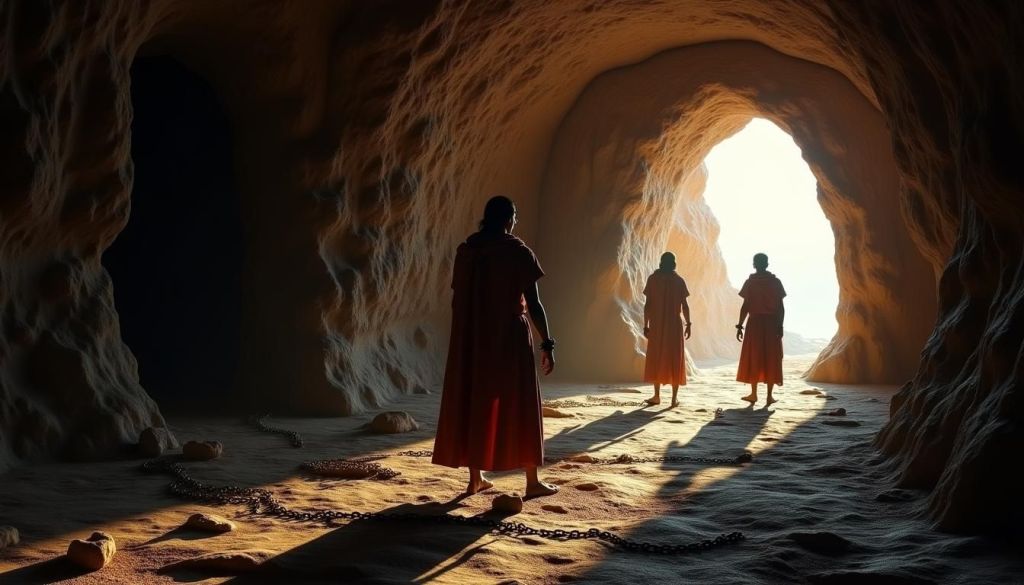
*I threatened it, now trying to figure out how to get out of the cave
**I also discovered this on youtube – Top Physicist: “Reality Is Not Physical”
Imagine scrolling through your social media feed, watching a mind-bending film, or even just looking out of the window. How much of what you perceive is actually ‘real’? It sounds like a question straight out of science fiction, maybe something like The Matrix, but it’s a puzzle humans have been wrestling with for millennia. Over two thousand years ago, an ancient Greek thinker named Plato dreamed up a powerful story to explore this very idea – the Allegory of the Cave. It’s a tale about prisoners mistaking shadows for reality, and it’s surprisingly relevant today. This post will delve into Plato’s famous allegory, unpacking its meaning and exploring its fascinating, and sometimes unsettling, connections to modern science and the futuristic worlds often imagined in science fiction. Why bother with such an old story? Because understanding the Cave might just change how you see everything around you.
To really grasp the Allegory of the Cave, we need to hop back in time to Ancient Athens, around the 4th century BC. This was a vibrant, sometimes chaotic, city-state, a cradle of democracy, drama, and philosophy. It was the home of Socrates, a philosopher famous for questioning everything, and his student, Plato (born around 428/427 BC). Plato was deeply affected by Socrates’s trial and execution, events which fuelled his search for true knowledge and justice, away from the shifting opinions of the masses. He founded the Academy in Athens, arguably the first institution of higher learning in the Western world, where he taught another philosophical giant, Aristotle. Plato wrote extensively, often using dialogues featuring Socrates as the main character. His most famous work is The Republic, written around 380 BC. It’s not just about politics; it’s a sprawling exploration of justice, the ideal society, the nature of reality, and how we gain knowledge. The Allegory of the Cave appears in Book VII of The Republic, not just as a standalone story, but as a way to illustrate Plato’s complex Theory of Forms. This theory suggests that the physical world we perceive through our senses is not the real world, but only a shadow or imperfect copy of a higher, eternal, unchanging world of Forms or Ideas. The ultimate Form, the source of all truth and reality, is the Form of the Good, often symbolised by the sun. The cave allegory is the key that unlocks this challenging idea.
So, what actually happens in this allegory? Picture a dark underground cave. Inside, a group of people have been prisoners since childhood. They are chained in such a way that they can only face forward, towards a flat wall at the back of the cave. They cannot turn their heads, let alone get up and walk around. Behind these prisoners, there’s a low wall, and behind that wall, puppeteers walk back and forth, holding up various objects – statues of people, animals, tools, all sorts of things. Further back still, a large fire burns, casting light over the low wall and onto the back wall that the prisoners face. The prisoners see the shadows of these objects projected onto the wall in front of them. Because these shadows are all they have ever known, they believe the shadows are reality. They hear echoes of the puppeteers’ voices bouncing off the cave walls and assume the sounds come from the shadows themselves. They spend their lives watching, naming, and discussing these flickering shapes, thinking they are engaging with true existence.
Now, Plato asks us to imagine what happens if one prisoner is suddenly freed. The chains fall away, and someone forces him to stand up and turn around. His eyes, accustomed only to the dim wall, would be painfully dazzled by the firelight. He would be confused, unable to clearly see the puppets whose shadows he thought were real. If someone told him that the objects he now sees are closer to reality than the shadows he watched before, he would likely disbelieve them, wanting to turn back to the familiar comfort of the wall. Plato suggests the prisoner would have to be dragged, forcibly, up the steep, rough passage leading out of the cave and into the world above.
Emerging into the sunlight would be even more overwhelming. He would be blinded, unable to see anything at first. Gradually, his eyes would adjust. First, he might be able to look at shadows on the ground, then reflections in water, then perhaps the objects themselves. Later, he might look at the stars and the moon at night, finding the dim celestial light easier to bear than the sun. Finally, Plato says, he would be able to look directly at the sun itself, not just its reflection. He would understand that the sun is the source of light, the seasons, and ultimately, the source of life and visibility for everything in the upper world – just as the Form of the Good is the source of all reality and truth in Plato’s philosophy. He would realise that his entire former life in the cave was spent observing mere illusions. He would pity his fellow prisoners still trapped below, valuing their shadow-based honours and knowledge as meaningless.
But the journey isn’t over. Plato argues that this enlightened individual would feel a duty to return to the cave, to try and free the others. However, descending back into the darkness, his eyes, now accustomed to the sunlit world, would struggle to see. He would seem clumsy and foolish to the remaining prisoners. If he tried to tell them about the world outside, explaining that their cherished shadows were not real, they wouldn’t understand. They would likely mock him, think his journey had ruined his eyesight and his mind. If he tried to release them and lead them upwards, Plato grimly suggests, the prisoners might become hostile and even try to kill him – a clear reference to the fate of his mentor, Socrates, who was executed for challenging Athenian beliefs. The allegory, therefore, is a powerful metaphor for the journey from ignorance to knowledge, the challenges of education, the nature of reality versus illusion, and the potential hostility faced by those who try to enlighten others.
Centuries after Plato, does this ancient story hold any water when examined through the lens of modern science? Surprisingly, yes, in several fascinating ways. Firstly, consider neuroscience and the science of perception. We often assume our senses give us a direct pipeline to reality. But scientists like Anil Seth, Professor of Cognitive and Computational Neuroscience at the University of Sussex, argue that what we perceive isn’t reality itself, but rather our brain’s best guess or prediction about the causes of sensory signals. Seth describes perception as a kind of “controlled hallucination” [1]. Our brains construct our conscious world based on ambiguous sensory data and prior expectations. We don’t just passively receive reality; we actively generate it. Our senses are also incredibly limited. We only see a tiny fraction of the electromagnetic spectrum (visible light), hear a narrow range of sound frequencies, and are oblivious to countless phenomena happening around us, like cosmic rays or neutrinos passing through our bodies. Like the prisoners, we perceive only a sliver of what might constitute total reality, filtered and interpreted by our biological apparatus. Optical illusions vividly demonstrate how our brains can be tricked, constructing perceptions that don’t match the physical world. We are, in a very real sense, living within the ‘cave’ of our own sensory and cognitive limitations.
Then there’s the explosion of virtual reality (VR) and augmented reality (AR). These technologies are explicitly designed to create convincing illusions, overlaying digital information onto our view of the world or immersing us entirely in simulated environments. As VR becomes more sophisticated, offering higher resolution, wider fields of view, haptic feedback, and spatial audio, the line between the ‘real’ world and the virtual one blurs. Are users experiencing a highly advanced form of the shadows on Plato’s cave wall? These technologies offer incredible potential – for training surgeons, designing buildings, connecting people across distances, and experiencing impossible worlds. But they also raise Platonic questions: What happens when simulated realities become indistinguishable from, or even preferable to, physical reality? Could people become trapped in digital ‘caves’, mistaking sophisticated simulations for genuine experience? Philosopher David Chalmers explored related ideas in his book Reality+: Virtual Worlds and the Problems of Philosophy, arguing that virtual realities can be genuinely real, just a different kind [2]. Yet, the potential for deception and detachment, akin to the prisoners’ ignorance, remains a valid concern.
Even fundamental physics hints at realities beyond our everyday grasp, echoing the allegory’s layers of understanding. Concepts like dark matter and dark energy, believed to make up about 95% of the universe, are inferred from their gravitational effects but remain invisible and mysterious [3]. We know they exist, shaping the cosmos, yet we cannot directly perceive them – they are outside our observational ‘cave’. String theory proposes extra spatial dimensions curled up too small for us to experience, while quantum mechanics reveals a bizarre subatomic world where particles exist in superpositions of states until measured (the observer effect), challenging classical notions of an objective, observer-independent reality. As physicist Carlo Rovelli suggests, reality might be best understood not as solid ‘things’ but as relationships and interactions [4]. While these scientific theories are vastly different from Plato’s Forms, they share the implication that the reality we perceive is not the whole story, and perhaps not even the most fundamental layer of existence. Like the freed prisoner discovering the sun, scientists strive to uncover these deeper truths, often facing incomprehension or resistance when presenting ideas that challenge common sense.
Furthermore, the cave resonates with psychological phenomena like confirmation bias and the echo chambers fostered by social media algorithms. We naturally seek out information that confirms our existing beliefs and avoid challenging viewpoints, effectively constructing our own informational caves. Social media platforms often amplify this tendency, feeding us content similar to what we’ve already liked or engaged with, creating personalised realities where opposing views are invisible or caricatured [5]. Like Plato’s prisoners fiercely defending their shadows, people within these echo chambers can become resistant to evidence or perspectives from ‘outside’, mistaking their limited, curated view for the whole picture.
It’s perhaps unsurprising, then, that Plato’s Cave has become a cornerstone trope in science fiction. Sci-fi thrives on exploring ‘what if’ scenarios, pushing the boundaries of reality, technology, and human understanding. The allegory provides a perfect template for stories questioning perception, control, and the very definition of being human. The most direct and famous cinematic adaptation is arguably The Matrix (1999). Here, humanity is unknowingly trapped in a vast, sophisticated computer simulation (the Matrix), while their bodies are harvested for energy by intelligent machines. The world they perceive – late 20th-century Earth – is Plato’s cave wall. The protagonist, Neo, is the prisoner offered the chance of freedom by Morpheus, who explicitly asks, “What is real? How do you define ‘real’?” [6]. The choice between the red pill (painful truth, the world outside the cave) and the blue pill (blissful ignorance, returning to the simulation) is a direct dramatisation of the prisoner’s dilemma. The film vividly portrays the difficulty of accepting a radically different reality and the hostility faced by those who try to liberate others.
Christopher Nolan’s Inception (2010) explores similar themes through the concept of shared dreaming and implanting ideas. While not a direct allegory, it delves into layers of constructed reality, the seductive power of illusions (Mal’s entrapment in limbo), and the uncertainty of distinguishing dreams from waking life, echoing the prisoner’s disorientation. David Cronenberg’s Existenz (1999) uses immersive virtual reality gaming to blur the lines between the game world and the ‘real’ world, leaving characters and the audience questioning where one ends and the other begins – a technological take on the cave’s deceptive shadows. Even earlier, Peter Weir’s The Truman Show (1998) presents a gentler but equally profound version: Truman Burbank lives his entire life inside a giant television studio, unaware that his friends, family, and town are all actors and sets in a 24/7 reality show. His eventual discovery and escape from this artificial world mirrors the prisoner’s journey towards truth.
Beyond direct reality-simulation plots, the cave’s shadow casts itself over much dystopian fiction. Works like George Orwell’s Nineteen Eighty-Four or Aldous Huxley’s Brave New World depict societies where the ruling powers maintain control by manipulating information, language, and perception, keeping the populace in a state of metaphorical ignorance – a socially engineered cave designed to prevent dissent or the pursuit of uncomfortable truths. Science fiction uses the allegory because it powerfully dramatises fundamental anxieties and hopes: the fear of being deceived or controlled, the desire for authentic experience, the struggle for knowledge, and the courage required to face reality, however harsh it might be.
So, what are we to make of this ancient allegory in our hyper-connected, technologically saturated world? The enduring power of Plato’s Cave lies in its exploration of timeless human questions. It forces us to confront the possibility that our understanding of reality is incomplete, perhaps even fundamentally flawed. The allegory highlights the inherent difficulty and often painful nature of learning and enlightenment. Challenging deeply ingrained beliefs – whether personal assumptions, cultural norms, or scientific paradigms – can be deeply uncomfortable, triggering cognitive dissonance, that mental stress we feel when holding conflicting ideas. It’s often easier, like the prisoners, to cling to the familiar shadows than to undertake the arduous journey towards the light.
The story also raises questions about responsibility. Does the individual who gains knowledge – the scientist discovering a breakthrough, the journalist uncovering corruption, the artist revealing a hidden perspective – have a duty to share that knowledge, even if it’s unwelcome? Plato clearly thought so, casting the philosopher as the reluctant but obligated leader who must return to the cave. However, the allegory also warns of the potential consequences: misunderstanding, ridicule, and even violence. This tension remains relevant today as experts in fields like climate science or public health struggle to communicate urgent but inconvenient truths to a sometimes sceptical or hostile public.
Perhaps most importantly, the allegory invites introspection. What are the ‘caves’ we inhabit today? Are we confined by the echo chambers of our social media feeds? Trapped by unquestioned political ideologies or consumerist desires? Limited by cultural biases or nationalistic narratives? Are we mistaking the flickering shadows of curated online personas, partisan news cycles, or reality television for genuine human connection and understanding? The forms of deception might have changed from literal puppets to sophisticated algorithms and digital deepfakes, but the fundamental challenge remains the same: distinguishing illusion from reality. Of course, the allegory isn’t perfect. Its sharp distinction between the ‘unreal’ cave and the ‘real’ world outside might be too simplistic for a reality that, as quantum physics and VR suggest, could be multi-layered and observer-dependent. Perhaps reality isn’t a single destination but an ongoing process of questioning and discovery.
In conclusion, Plato’s Allegory of the Cave, born from the philosophical ferment of ancient Athens, resonates across the centuries with remarkable clarity. It offers a profound framework for understanding the journey from ignorance to knowledge, the constructed nature of our perceived reality, and the challenges inherent in seeking and sharing truth. Its echoes are loud in modern neuroscience, which reveals the brain as an active interpreter rather than a passive receiver of reality; in the burgeoning technologies of VR and AR that craft artificial worlds; in the cosmological quest to understand the unseen universe; and, most vividly, in the compelling narratives of science fiction that repeatedly dramatise the struggle between illusion and authenticity. The allegory serves as a timeless reminder of the importance of critical thinking, intellectual humility, and the courage to question our own perceptions. It pushes us to consider: what comfortable shadows might we be mistaking for reality right now, and are we brave enough to turn around and face the potentially dazzling, perhaps even frightening, light?
References and Further Reading:
- Seth, Anil K. (2021). Being You: A New Science of Consciousness. Faber & Faber. (Also see his popular TED Talk: “Your brain hallucinates your conscious reality”).
- Chalmers, David J. (2022). Reality+: Virtual Worlds and the Problems of Philosophy. W. W. Norton & Company.
- NASA Science Universe. (n.d.). Dark Energy, Dark Matter. https://science.nasa.gov/universe/dark-energy-dark-matter/ (Accessed [Current Date])
- Rovelli, Carlo. (2018). Reality Is Not What It Seems: The Journey to Quantum Gravity. Penguin Books. (Specifically discusses relational quantum mechanics).
- Pariser, Eli. (2011). The Filter Bubble: What the Internet Is Hiding from You. Penguin UK.
- Wachowski, Lana., & Wachowski, Lilly. (Directors). (1999). The Matrix [Film]. Warner Bros. Pictures. (Quote widely attributed to the character Morpheus).
- Plato. The Republic. (Numerous translations exist. Benjamin Jowett’s translation is classic, though sometimes considered dated. More modern translations include those by G.M.A. Grube, revised by C.D.C. Reeve, or Allan Bloom). Check specific editions for Book VII, sections 514a–520a for the allegory.
- Annas, Julia. (1981). An Introduction to Plato’s Republic. Oxford University Press. (Provides scholarly analysis of the text and its context).
- Bostrom, Nick. (2003). “Are You Living in a Computer Simulation?” Philosophical Quarterly, 53(211), pp. 243-255. https://www.simulation-argument.com/simulation.html (Explores the simulation hypothesis, a modern philosophical parallel).
- Snowden, James., & Halsall, Alison. (Eds.). (2023). The Routledge Companion to Cyberpunk Culture. Routledge. (Explores themes relevant to The Matrix, Existenz etc. in science fiction).



 Conversations with AI
Leave a comment