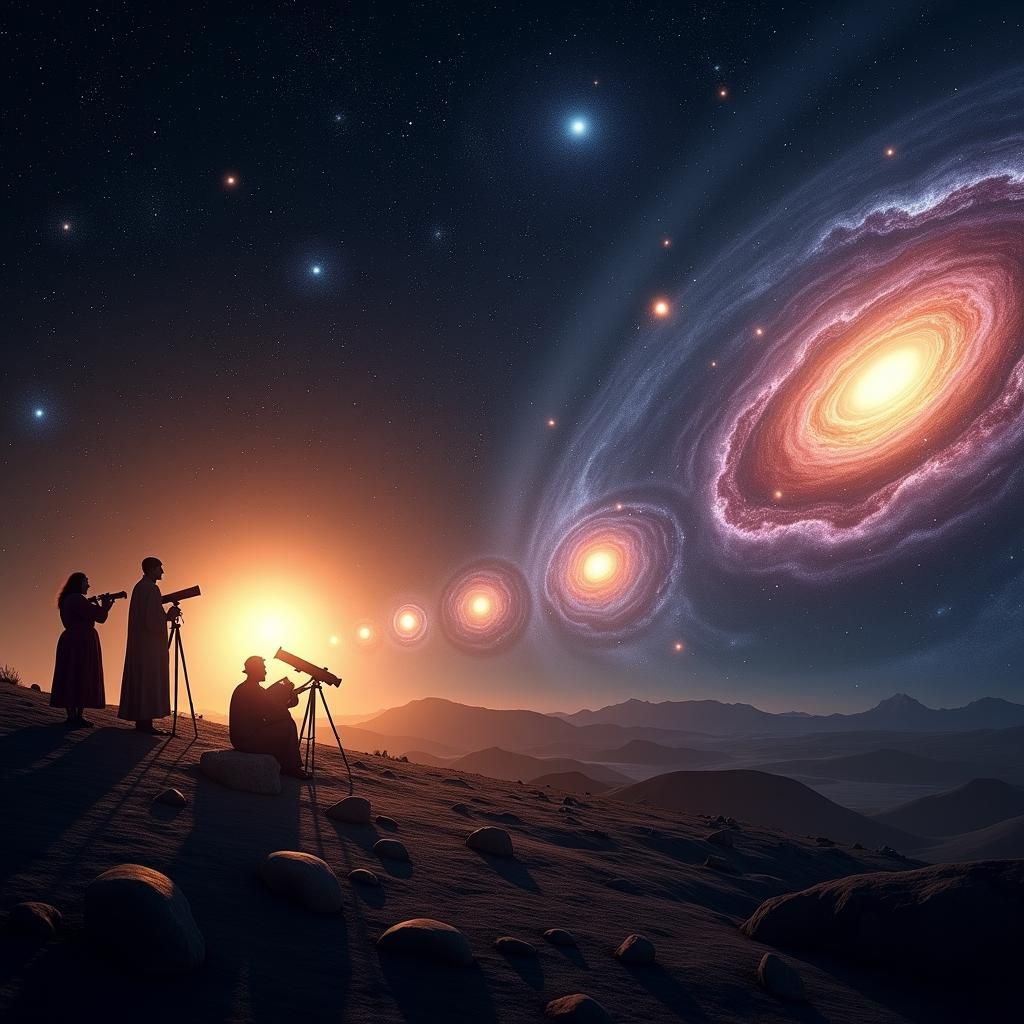
how did all this begin? For thousands of years, humans have tried to answer this question, weaving stories and constructing models to explain the universe’s origins, structure, and ultimate fate. Today, we’re not just relying on myths or philosophy—science has given us tools to test these ideas rigorously. This article dives into the most influential theoretical models of the universe, from ancient geocentric concepts to cutting-edge multiverse hypotheses. Whether you’re a space enthusiast or just curious about cosmology, understanding these frameworks helps us grasp humanity’s place in the cosmos—and why the answers matter more than ever in an age of rapid discovery.
The quest to model the universe isn’t new. Ancient civilisations, like the Babylonians and Greeks, mapped the heavens with remarkable precision, often tying celestial movements to divine will. Aristotle’s geocentric model, which placed Earth at the universe’s centre, dominated Western thought for over a millennium. But in 1543, Nicolaus Copernicus revolutionised cosmology by proposing a heliocentric system, shifting Earth to just another planet orbiting the Sun. This wasn’t merely a scientific correction—it was a philosophical earthquake, challenging humanity’s perceived centrality in creation.
The 20th century brought even more radical shifts. Albert Einstein’s general relativity (1915) redefined gravity as the curvature of spacetime, providing a mathematical backbone for cosmological models. Edwin Hubble’s 1929 discovery that galaxies are moving away from us—evidence of an expanding universe—shattered the earlier assumption of a static cosmos. Suddenly, scientists had to confront the idea that the universe had a beginning. This led to the Big Bang theory, first proposed by Georges Lemaître in 1927 and later supported by the discovery of cosmic microwave background radiation in 1964[1].
But the Big Bang wasn’t the only game in town. In 1948, Fred Hoyle, Hermann Bondi, and Thomas Gold proposed the Steady State model, arguing that the universe had no beginning or end—it simply expanded while new matter formed to maintain a constant density. Though eventually sidelined by observational evidence, this theory highlighted how scientific debates hinge on empirical testing. As astrophysicist Carl Sagan once quipped, “Extraordinary claims require extraordinary evidence”[2].
Fast-forward to the 1980s, and another paradigm shift emerged: cosmic inflation. Proposed by Alan Guth, inflation suggests that the universe underwent exponential expansion in the first fraction of a second after the Big Bang, smoothing out irregularities and explaining why the cosmos appears so uniform on large scales[3]. This theory also predicts “multiverse” scenarios, where our universe is one of countless bubbles in a vast cosmic foam. While controversial, inflation remains the leading explanation for the universe’s large-scale structure, supported by detailed measurements of the cosmic microwave background[4].
Yet mysteries abound. Observations in the late 1990s revealed that the universe’s expansion is accelerating, driven by an unknown force dubbed dark energy. This discovery, which earned Saul Perlmutter, Brian Schmidt, and Adam Riess the 2011 Nobel Prize in Physics, upended earlier assumptions that gravity would eventually slow cosmic expansion[5]. Today, dark energy and dark matter—an invisible substance making up 27% of the universe’s mass-energy—dominate cosmological research, yet their true nature remains elusive. As physicist Vera Rubin, whose work confirmed dark matter’s existence, noted: “We’re out of practice at saying, ‘We don’t know’”[6].
Theoretical models also grapple with the universe’s ultimate fate. Will it expand forever, growing colder and darker (the “Big Freeze”)? Collapse back into a singularity (the “Big Crunch”)? Or tear itself apart in a “Big Rip” due to dark energy’s influence? Each scenario depends on factors like dark energy’s strength and the universe’s overall curvature. Current data favour the Big Freeze, but as cosmologist Katie Mack warns, “The universe is under no obligation to make sense to us”[7].
Critics argue that some models, like the multiverse, veer into untestable speculation. Philosopher Karl Popper famously asserted that a theory must be falsifiable to qualify as scientific[8]. Inflation’s flexibility—its ability to accommodate almost any observation—has led some to question its validity. Others counter that cosmology, by its nature, deals with singularities (like the Big Bang) that defy conventional experimentation. The debate underscores a tension in modern physics: balancing mathematical elegance with empirical accountability.
Looking ahead, new telescopes and experiments aim to resolve these uncertainties. The European Space Agency’s Euclid mission, launched in 2023, seeks to map dark matter’s distribution by observing its gravitational lensing effects[9]. Meanwhile, quantum gravity theories like string theory and loop quantum gravity attempt to reconcile general relativity with quantum mechanics—a prerequisite for understanding the universe’s earliest moments. As theoretical physicist Brian Greene puts it, “The universe is a puzzle whose pieces we’re still learning how to fit together”[10].
So, what have we learned? Our universe is dynamic, expanding, and dominated by invisible components. Its history is written in light from distant galaxies, subtle temperature fluctuations in the cosmic microwave background, and the gravitational whispers of dark matter. Yet each discovery peels back a layer to reveal deeper questions. Perhaps that’s the most profound insight: the universe isn’t just a static backdrop but an evolving story, one we’re only beginning to read.
If the universe began with a Big Bang, what—or who—was there before? And if we’re part of a multiverse, does that make our existence a statistical inevitability or a cosmic fluke? These questions might seem abstract, but they shape how we perceive reality itself. As you gaze at the stars tonight, remember: you’re not just looking into space—you’re looking back in time, witnessing the universe’s grand narrative unfold. What chapter will we write next?
References and Further Reading
- Penzias, A. A., & Wilson, R. W. (1965). A Measurement of Excess Antenna Temperature at 4080 Mc/s. The Astrophysical Journal, 142, 419–421.
- Sagan, C. (1980). Cosmos. Random House.
- Guth, A. H. (1981). Inflationary universe: A possible solution to the horizon and flatness problems. Physical Review D, 23(2), 347.
- Planck Collaboration. (2018). Planck 2018 results. VI. Cosmological parameters. Astronomy & Astrophysics, 641, A6.
- Perlmutter, S., et al. (1999). Measurements of Ω and Λ from 42 high-redshift supernovae. The Astrophysical Journal, 517(2), 565.
- Rubin, V. (1983). Dark matter in spiral galaxies. Scientific American, 248(6), 96–113.
- Mack, K. (2020). The End of Everything (Astrophysically Speaking). Scribner.
- Popper, K. (1959). The Logic of Scientific Discovery. Hutchinson & Co.
- Euclid Consortium. (2023). Euclid Mission Overview. European Space Agency.
- Greene, B. (2004). The Fabric of the Cosmos. Alfred A. Knopf.




 Conversations with AI
Leave a comment