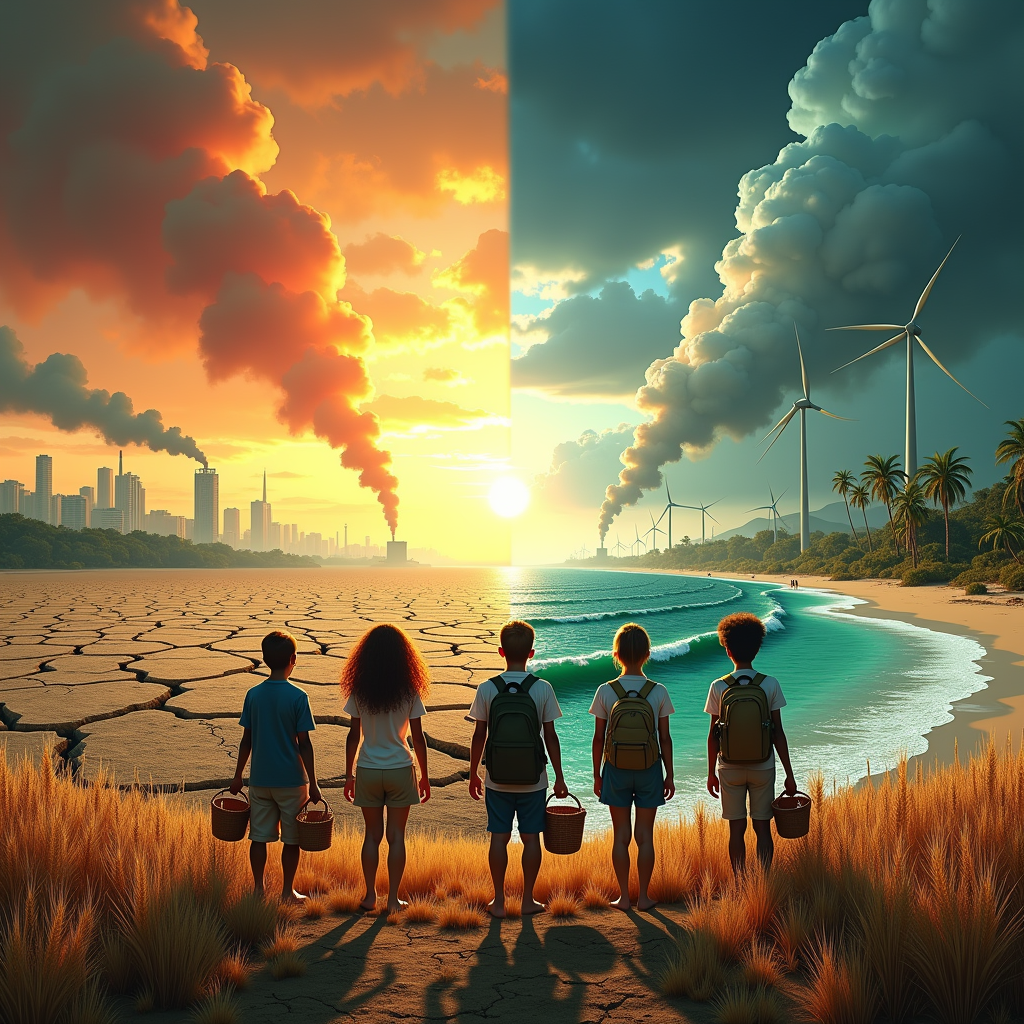
Imagine a world where your favourite foods—chocolate, coffee, even pizza—become luxuries few can afford. Picture farmers in India battling record-breaking heatwaves to grow rice, while fishermen in Senegal haul empty nets as ocean temperatures rise. This isn’t a dystopian novel; it’s the reality climate change is carving into our global food systems. From shifting growing seasons to collapsing fisheries, the interconnected web of how we produce, distribute, and consume food is unravelling. For anyone who eats (which is everyone), this crisis isn’t abstract—it’s personal. Let’s explore how rising temperatures, extreme weather, and ecological disruptions are reshaping what’s on our plates, and why teenagers today will face decisions about food that no previous generation has confronted.
The relationship between climate and agriculture is as old as farming itself. For 12,000 years, humans have relied on relatively stable climatic conditions to cultivate crops and raise livestock [1]. The Green Revolution of the 1960s turbocharged food production through synthetic fertilisers and irrigation, but it also made farming increasingly vulnerable to climate shocks by promoting monocropping and heavy water use [2]. Fast forward to 2023: the UN’s Food and Agriculture Organisation (FAO) reports that extreme weather events have tripled since the 1960s, with agricultural losses exceeding $200 billion globally in the last decade alone [3]. What makes this moment different isn’t just the scale of disruption, but the collision of multiple crises—soil degradation, water scarcity, and biodiversity loss—all amplified by a warming planet.
Crop yields are the most visible casualty. Wheat, rice, and maize—which provide 60% of humanity’s calories—all have strict temperature tolerances. For every 1°C of warming, global wheat production drops by 6%, while maize could see 7.4% declines under current emission trajectories [4]. But it’s not just about heat. Unpredictable rainfall patterns are playing havoc with planting cycles: in 2022, Pakistan lost 80% of its rice crop to biblical floods, while drought-stricken Kenya saw maize harvests halved [5]. Even crops we consider resilient, like coffee and cocoa, are struggling. By 2050, over 50% of global coffee-growing land could become unsuitable, threatening both your morning latte and the livelihoods of 25 million farmers [6].
The oceans aren’t faring better. Marine heatwaves have bleached coral reefs that nurture 25% of marine species, while acidifying waters dissolve shellfish shells [7]. Small-scale fisheries, which feed 3 billion people, face a double blow: warming shifts fish populations poleward, and cyclones destroy boats and gear. In the Pacific Islands, where seafood provides 70% of dietary protein, tuna stocks are projected to decline by 20% by 2050 [8]. “We’re not just losing fish,” says marine biologist Dr. Jane Lubchenco, “we’re losing entire food cultures that have sustained coastal communities for millennia” [9].
Behind these stark numbers lies a web of ecological connections we’re only beginning to understand. Take soil—the overlooked hero of food security. Healthy soil stores carbon, filters water, and supports crops. But intensive farming has degraded 33% of the world’s topsoil, and climate change accelerates this through erosion from extreme rains and decreased organic matter in hotter conditions [10]. Then there are pollinators: 75% of food crops rely on bees and butterflies, yet warming temperatures are desynchronising flowering periods and insect life cycles [11]. Even the rise in CO2—often touted as a ‘plant fertiliser’—has a dark side. Studies show that elevated CO2 reduces protein and nutrient content in staples like rice and wheat, potentially leaving millions deficient in zinc and iron [12].
The human toll of these disruptions is profoundly unequal. While the Global North grapples with supermarket price hikes—UK food inflation hit 19.2% in 2023—low-income countries face existential threats [13]. In Somalia, where 90% of wheat imports came from Ukraine and Russia, the climate-driven war disrupted supplies, leaving 8 million people food insecure [14]. Women and girls bear the brunt: during droughts, they walk farther for water, missing school and facing greater risks of violence [15]. “Climate change isn’t just an environmental issue; it’s a multiplier of hunger and inequality,” warns FAO Director-General Qu Dongyu [16].
Technology offers partial solutions, but no silver bullets. Drought-resistant GM crops like Water Efficient Maize for Africa (WEMA) show promise, yet many smallholders can’t afford the seeds [17]. Vertical farming and lab-grown meat could reduce land use, but their energy demands raise questions about scalability [18]. Meanwhile, traditional knowledge is gaining recognition: in Peru, Andean farmers are reviving ancient terraces and crop diversity to buffer against erratic weather [19]. Policy changes matter too—the European Union’s Farm to Fork strategy aims to slash pesticide use by 50% and boost organic farming to 25% by 2030 [20]. But as youth activist Mitzi Jonelle Tan argues, “We need systemic change, not just tech fixes. That means rethinking how we value food, farmers, and nature” [21].
What’s certain is that today’s teenagers will inherit a food system in flux. Some changes are unavoidable—certain regions may abandon staple crops, while others adopt new ones (think quinoa in Norway or bananas in Wales). But the extent of crisis depends on choices made now. Diets will play a role: shifting from meat-centric meals could free up land equivalent to the US, China, and Australia combined [22]. Food waste, which accounts for 8-10% of global emissions, is another front for action [23]. Ultimately, the question isn’t just whether we can feed 10 billion people by 2050, but whether we can do so without destroying the ecosystems that make life possible.
As you bite into your next meal, consider this: will your grandchildren inherit a world where food is a battleground, or a testament to human ingenuity and resilience? The answer depends on what we sow today.
References and Further Reading
- IPCC. (2021). Climate Change 2021: The Physical Science Basis. Cambridge University Press.
- FAO. (2017). The Future of Food and Agriculture: Trends and Challenges.
- UNDRR. (2022). Global Assessment Report on Disaster Risk Reduction.
- Zhao, C. et al. (2017). Temperature increase reduces global yields of major crops. Proceedings of the National Academy of Sciences.
- World Food Programme. (2023). Climate Impacts on Food Security: 2022 Case Studies.
- Bunn, C. et al. (2015). A bitter cup: climate change profile of global coffee production. Climatic Change.
- IPCC. (2019). Special Report on the Ocean and Cryosphere in a Changing Climate.
- Bell, J. et al. (2021). Climate change and Pacific Island fisheries. Nature Sustainability.
- Lubchenco, J. (2022). Interview in The Guardian.
- FAO. (2015). Status of the World’s Soil Resources.
- IPBES. (2016). Assessment Report on Pollinators, Pollination, and Food Production.
- Smith, M.R. et al. (2017). Global expanded nutrient supply (GENuS) model. The Lancet Planetary Health.
- Office for National Statistics. (2023). UK Consumer Price Inflation Report.
- FAO. (2023). The State of Food Security and Nutrition in the World.
- CARE International. (2021). Gender Implications of Climate-Induced Food Insecurity.
- Qu Dongyu. (2022). Speech at COP27.
- African Agricultural Technology Foundation. (2020). WEMA Project Annual Report.
- Poore, J. & Nemecek, T. (2018). Reducing food’s environmental impacts through producers and consumers. Science.
- UNESCO. (2022). Andean Agricultural Heritage Systems.
- European Commission. (2020). Farm to Fork Strategy Document.
- Jonelle Tan, M. (2023). Youth Climate Summit keynote.
- Springmann, M. et al. (2018). Options for keeping the food system within environmental limits. Nature.
- UNEP. (2021). Food Waste Index Report.




 Conversations with AI
Leave a comment