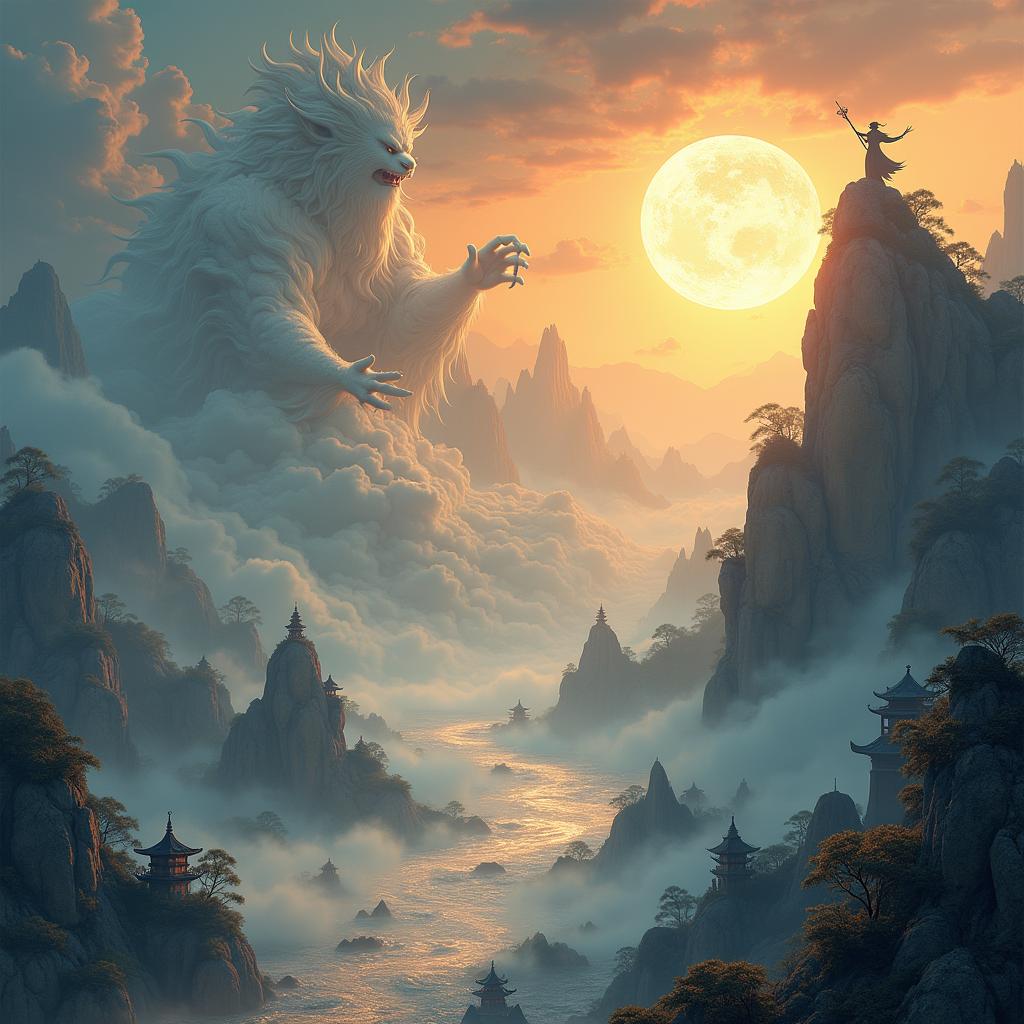
Imagine a world where dragons soar through stormy skies, where a goddess mends the heavens with melted stones, and where a monkey king defies the gods themselves. These are not scenes from a fantasy novel but fragments of ancient Chinese mythology—stories that have shaped one of the world’s oldest civilisations. For over 3,000 years, these myths have been more than just tales; they’ve served as moral guides, explanations for the natural world, and foundations for cultural identity. Today, they continue to resonate, influencing everything from Lunar New Year celebrations to blockbuster films. This article delves into the rich tapestry of ancient Chinese mythology, exploring its origins, key themes, and enduring significance. Whether you’re a mythology enthusiast or simply curious about how ancient stories shape modern minds, prepare to journey through a realm where chaos transforms into order, heroes grapple with destiny, and the divine walks alongside the mortal.
Chinese mythology’s roots stretch back to the Shang Dynasty (c. 1600–1046 BCE), a time when oracle bones—etched with early script—recorded divinations to ancestral spirits [1]. Unlike the codified pantheons of Greece or Rome, Chinese myths evolved fluidly, blending local folklore, shamanistic practices, and later philosophical ideas from Confucianism, Daoism, and Buddhism. Early myths were oral traditions, passed down by storytellers and ritualists, only becoming systematised during the Han Dynasty (206 BCE–220 CE) when scholars like Sima Qian compiled historical records [2]. This lack of a single canonical text, such as the Greek Theogony, means Chinese mythology is inherently pluralistic, reflecting regional diversity and shifting political landscapes. For instance, the cosmic creator Pangu—now a central figure—only emerged in written records during the Three Kingdoms period (220–280 CE), likely synthesised from older southern Chinese legends [3].
At the heart of Chinese mythology lies the concept of Tian (Heaven), a force both immanent and transcendent. Unlike the personalised gods of Western traditions, Tian represents an impersonal cosmic order, a principle mirrored in myths about the separation of chaos into yin and yang. The story of Pangu illustrates this: emerging from a cosmic egg, he spends 18,000 years pushing apart heaven and earth, his body transforming into mountains, rivers, and stars upon death [4]. This narrative encodes a Daoist worldview, where creation arises from balance rather than divine fiat. Similarly, the goddess Nüwa, often depicted with a serpent’s tail, repairs the collapsing sky using five-coloured stones and reeds, establishing herself as a protector of humanity [5]. These myths weren’t mere entertainment; they explained natural phenomena (like floods or eclipses) and reinforced social hierarchies. The Mandate of Heaven (天命), used to legitimise rulers, directly stems from this mythic framework, positing that virtuous leaders maintain cosmic harmony [6].
Hero myths, meanwhile, blend moral instruction with historical memory. The tale of Yu the Great, who tamed China’s floods by dredging rivers instead of building dams, underscores values of perseverance and ingenuity. Yu’s success earns him the throne, founding the Xia Dynasty—a narrative that merges myth with semi-historical accounts [7]. Similarly, the Journey to the West (16th century CE), though a later literary work, draws on older folk traditions. Its protagonist, the Monkey King Sun Wukong, embodies rebellion against authority, yet his eventual enlightenment under Buddha reflects Confucian ideals of self-cultivation [8]. These stories served as ethical primers, teaching filial piety, loyalty, and resilience. Even fantastical elements had didactic purposes: the Classic of Mountains and Seas (山海经), a compilation of mythical geography, likely functioned as both a bestiary and a moral allegory, warning against greed and hubris [9].
The interplay between myth and philosophy is particularly striking. Confucius, though sceptical of supernatural tales, repurposed mythic figures like the Yellow Emperor (Huangdi) as paragons of virtuous rule [10]. Daoists, conversely, embraced myth’s mystical dimensions, with Laozi himself later deified as a cosmic deity. By the Tang Dynasty (618–907 CE), Buddhism’s arrival introduced new motifs—karmic rebirth, bodhisattvas—which syncretised with existing myths. The goddess Guanyin, originally the Buddhist Avalokiteśvara, became a maternal figure in Chinese folklore, illustrating this cultural blending [11]. This adaptability ensured mythology’s survival even as China underwent seismic shifts, from imperial collapses to communist revolutions.
Modern China’s relationship with its mythic heritage is complex. On one hand, the Communist Party initially suppressed “feudal superstitions,” yet today, myths are rebranded as cultural heritage. Festivals like the Dragon Boat Festival, linked to the poet Qu Yuan’s suicide, attract millions, while films like Ne Zha (2019) reimagine myths for Gen Z audiences [12]. Scholars argue this revival reflects a search for identity in a globalised world [13]. Yet controversies persist: some see state-sponsored myth-making as a tool for nationalism, while others champion grassroots efforts to preserve regional tales. Comparatively, Chinese myths differ from Western counterparts in their emphasis on collective harmony over individual heroism—a distinction rooted in Confucian values [14].
What can these ancient stories teach us today? They remind us that myths are never static; they evolve, reflecting the fears and aspirations of each generation. As you watch the next lunar eclipse, consider Nüwa’s patched sky. Or when facing a dilemma, recall Sun Wukong’s journey from mischief to wisdom. In a world grappling with environmental crises, Yu the Great’s ecological pragmatism feels strikingly relevant. Chinese mythology, with its blend of cosmic wonder and humanistic ethics, offers not just a window into the past but a mirror for our present—and perhaps a compass for the future.
References and Further Reading
- Keightley, D. N. (1978). Sources of Shang History: The Oracle-Bone Inscriptions of Bronze Age China. University of California Press.
- Sima Qian. (c. 94 BCE). Records of the Grand Historian (Shiji).
- Birrell, A. (1993). Chinese Mythology: An Introduction. Johns Hopkins University Press.
- Yang, L., & An, D. (2005). Handbook of Chinese Mythology. Oxford University Press.
- Christie, A. (1968). Chinese Mythology. Hamlyn.
- Puett, M. (2002). To Become a God: Cosmology, Sacrifice, and Self-Divinization in Early China. Harvard University Asia Center.
- Lewis, M. E. (2006). The Flood Myths of Early China. SUNY Press.
- Wu Cheng’en. (1592). Journey to the West (Xiyouji).
- Strassberg, R. E. (2002). A Chinese Bestiary: Strange Creatures from the Guideways Through Mountains and Seas. University of California Press.
- Confucius. (c. 5th century BCE). Analects (Lunyu).
- Yu, C. (2001). Kuan-yin: The Chinese Transformation of Avalokiteśvara. Columbia University Press.
- Zhong, X. (2020). Ne Zha and the Reinvention of Chinese Mythology in Contemporary Cinema. Journal of Chinese Cinemas, 14(3), 234–249.
- Wang, D. D. (2014). Mythmaking in the New China: National Identity and the Role of Mythology. Asian Studies Review, 38(2), 179–196.
- Loewe, M. (1994). Divination, Mythology and Monarchy in Han China. Cambridge University Press.
Further Reading
- For primary texts: The Classic of Mountains and Seas (trans. Anne Birrell).
- For comparative analysis: Mythology: Chinese Myths by Xueting C. Ni.
- For cultural impact: The Penguin Book of Myths and Legends of Ancient China by Xiaobing Wang.
What stories from your own culture shape how you see the world—and what might they reveal about the values we share or challenge?





 Conversations with AI
Leave a comment