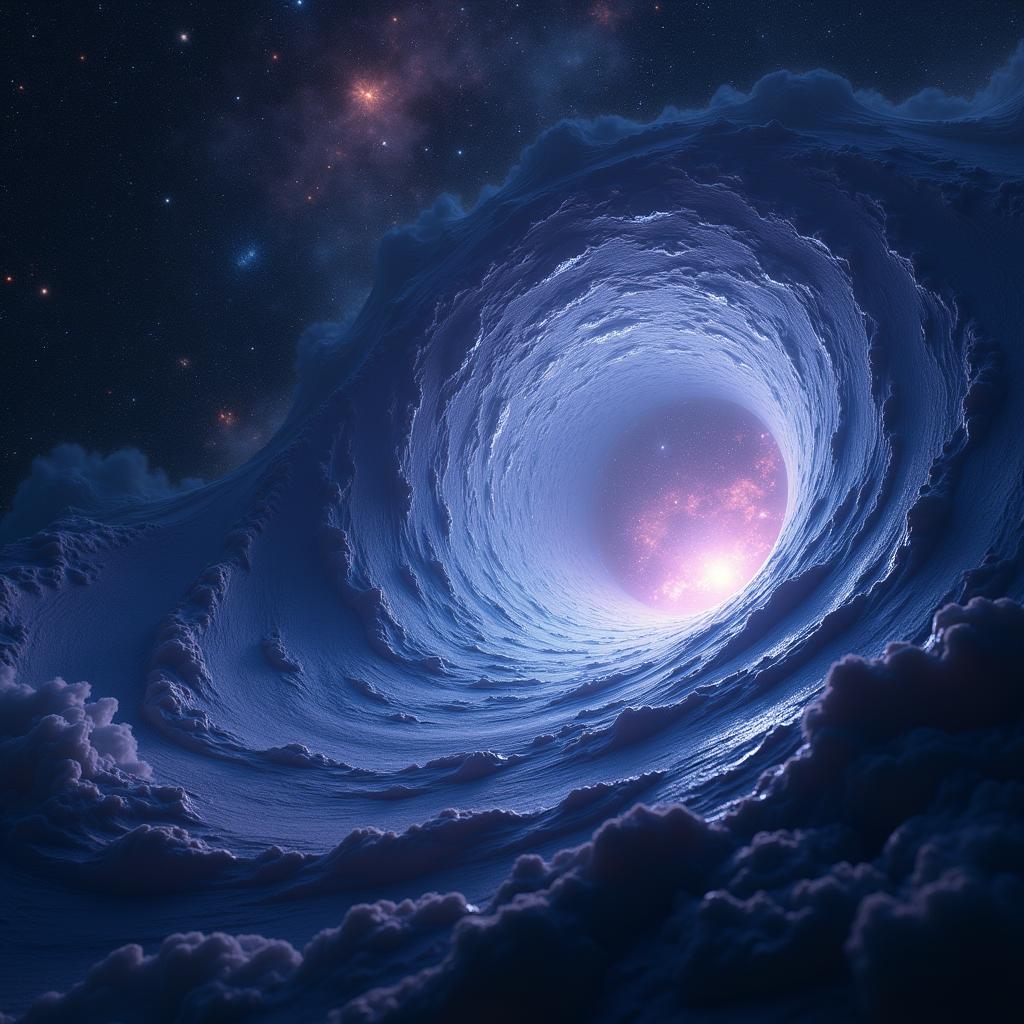
Imagine a shortcut through the fabric of space and time—a cosmic tunnel connecting distant galaxies, ancient stars, or even different universes. This isn’t just science fiction. Films like Interstellar and Contact have brought wormholes to life on screen, but the real science behind these hypothetical structures is even wilder. For over a century, theoretical physicists have grappled with the idea that our universe might be threaded with invisible bridges forged by gravity itself. These wormholes, as they’re called, could rewrite our understanding of reality—if they exist. This article dives into the mind-bending physics of wormholes, exploring how they emerged from Einstein’s equations, why they remain tantalisingly out of reach, and what they might mean for the future of humanity’s cosmic ambitions.
The story begins in 1916, just a year after Albert Einstein published his general theory of relativity. German physicist Ludwig Flamm stumbled upon a peculiar solution to Einstein’s equations, which describe how mass and energy warp spacetime. Flamm’s work hinted at the possibility of a “white hole”—a theoretical reversal of a black hole—connected to a black hole via a spacetime conduit [1]. Though Flamm didn’t name it, this was the first mathematical glimmer of a wormhole. Fast-forward to 1935, when Einstein and physicist Nathan Rosen expanded the idea, proposing that black holes could be linked by bridges through spacetime [2]. These “Einstein-Rosen bridges” captured imaginations but were initially dismissed as mathematical oddities, unstable and useless for travel.
The concept lay dormant until the 1950s, when physicist John Wheeler coined the term “wormhole” and popularised the idea of spacetime foam—a quantum mechanical sea of tiny, flickering wormholes at the smallest scales [3]. But it wasn’t until the 1980s that wormholes entered mainstream physics debates. Kip Thorne, a leading gravitational theorist, sparked renewed interest by exploring whether traversable wormholes—ones that humans could theoretically pass through—might be possible [4]. His work was partly inspired by Carl Sagan’s request for a plausible faster-than-light travel method for his novel Contact [5]. Thorne’s calculations revealed that keeping a wormhole stable would require something bizarre: exotic matter with negative energy density, a substance that defies everyday physics.
So, what exactly is a wormhole? Picture spacetime as a vast, stretchy sheet. A massive object like a star dimples the sheet, creating a gravity well. Now imagine punching a hole through the sheet and connecting two distant dimples with a tunnel. That’s the basic idea—a shortcut through the folded geometry of spacetime. Mathematically, wormholes are solutions to Einstein’s field equations, but they come with caveats. The entrance, or “mouth,” of a wormhole would resemble a black hole, but instead of a singularity at its core, it would funnel into a throat-like structure (the “Einstein-Rosen bridge”) leading to another region of spacetime [6].
The catch? Traditional wormholes described by Einstein and Rosen collapse instantly. To make them traversable, you’d need to line the throat with exotic matter that repels gravity. This material would have negative energy density, something theorised in quantum fields like the Casimir effect, where two uncharged metal plates in a vacuum attract each other due to quantum fluctuations [7]. While the Casimir effect produces tiny amounts of negative energy, scaling it up to stabilise a wormhole remains science fiction. As physicist Stephen Hawking quipped, “If time travel is possible, where are the tourists from the future?” [8].
Recent advances have kept the wormhole dream alive. In 2013, Juan Maldacena and Leonard Susskind proposed that entangled black holes—a key part of quantum gravity theories—might be connected by wormholes [9]. This “ER = EPR” conjecture (linking Einstein-Rosen bridges to quantum entanglement) suggests that spacetime itself could emerge from quantum interactions. Meanwhile, experiments with quantum computers have simulated holographic wormholes, offering clues about how information might traverse these structures [10]. In 2022, researchers even created a tiny magnetic wormhole in a lab, though it only manipulated magnetic fields rather than spacetime [11].
But let’s step back. Why pursue such speculative ideas? Wormholes aren’t just about interstellar travel. They force us to confront fundamental questions: Is spacetime smooth or granular at the smallest scales? Can quantum mechanics and gravity coexist in a unified theory? And could the universe itself be a network of entangled wormholes? For physicists, these questions are bridges to deeper truths. As Nobel laureate Roger Penrose argues, understanding extreme spacetime geometries might reveal “the missing link between quantum theory and general relativity” [12].
Of course, controversies abound. Critics like Sabine Hossenfelder dismiss traversable wormholes as “fantasy physics,” arguing that exotic matter is too speculative and that quantum gravity effects would inevitably destroy them [13]. Others worry about paradoxes: if you could travel through a wormhole to the past, could you alter history? Hawking’s “chronology protection conjecture” suggests nature abhors time loops, preventing such scenarios through unknown physical laws [14]. Yet optimists counter that undiscovered quantum principles might resolve these issues.
The implications are staggering. If stable wormholes exist, they could enable interstellar travel without breaking the light-speed barrier—a boon for a civilisation confined to one pale blue dot. They might also serve as time machines, though the ethics of temporal tourism are murky at best. On a cosmic scale, wormholes could explain dark energy or the universe’s accelerating expansion. Some theories even propose that our universe is part of a multiverse connected by wormholes [15].
But for now, wormholes remain firmly in the realm of theory. Detecting one would require spotting gravitational anomalies—perhaps unusual starlight distortions or unexpected particle accelerations near black holes. The Event Horizon Telescope, which captured the first black hole image in 2019, might one day find hints of wormhole shadows [16]. Until then, physicists will keep wrestling with equations, searching for that elusive thread that could stitch the cosmos together.
So, are wormholes just mathematical curiosities, or could they be real? The answer lies in the unknown—a reminder that the universe is stranger and more wonderful than we imagine. As Carl Sagan wrote, “Somewhere, something incredible is waiting to be known” [17]. Whether that something is a wormhole… well, that’s a journey for future scientists.
References and Further Reading
- Flamm, L. (1916). Physikalische Zeitschrift, 17, 448.
- Einstein, A., & Rosen, N. (1935). Physical Review, 48(1), 73.
- Wheeler, J. A. (1955). Physical Review, 97(2), 511.
- Thorne, K. S. (1994). Black Holes and Time Warps: Einstein’s Outrageous Legacy. W. W. Norton & Company.
- Sagan, C. (1985). Contact. Simon & Schuster.
- Visser, M. (1995). Lorentzian Wormholes: From Einstein to Hawking. AIP Press.
- Casimir, H. B. G. (1948). Proceedings of the Royal Netherlands Academy of Arts and Sciences, 51, 793.
- Hawking, S. W. (1992). Physical Review D, 46(2), 603.
- Maldacena, J., & Susskind, L. (2013). Fortschritte der Physik, 61(9), 781.
- Jafferis, D. et al. (2022). Nature, 612(7938), 51.
- Prat-Camps, J. et al. (2022). Scientific Reports, 12, 14630.
- Penrose, R. (2004). The Road to Reality: A Complete Guide to the Laws of the Universe. Jonathan Cape.
- Hossenfelder, S. (2018). Lost in Math: How Beauty Leads Physics Astray. Basic Books.
- Hawking, S. W. (1992). Physical Review D, 46(2), 603.
- Ellis, G. F. R., & Rothman, T. (1993). American Journal of Physics, 61(10), 883.
- Akiyama, K. et al. (2019). The Astrophysical Journal Letters, 875(1), L1.
- Sagan, C. (1979). Broca’s Brain: Reflections on the Romance of Science. Random House.




 Conversations with AI
Leave a comment