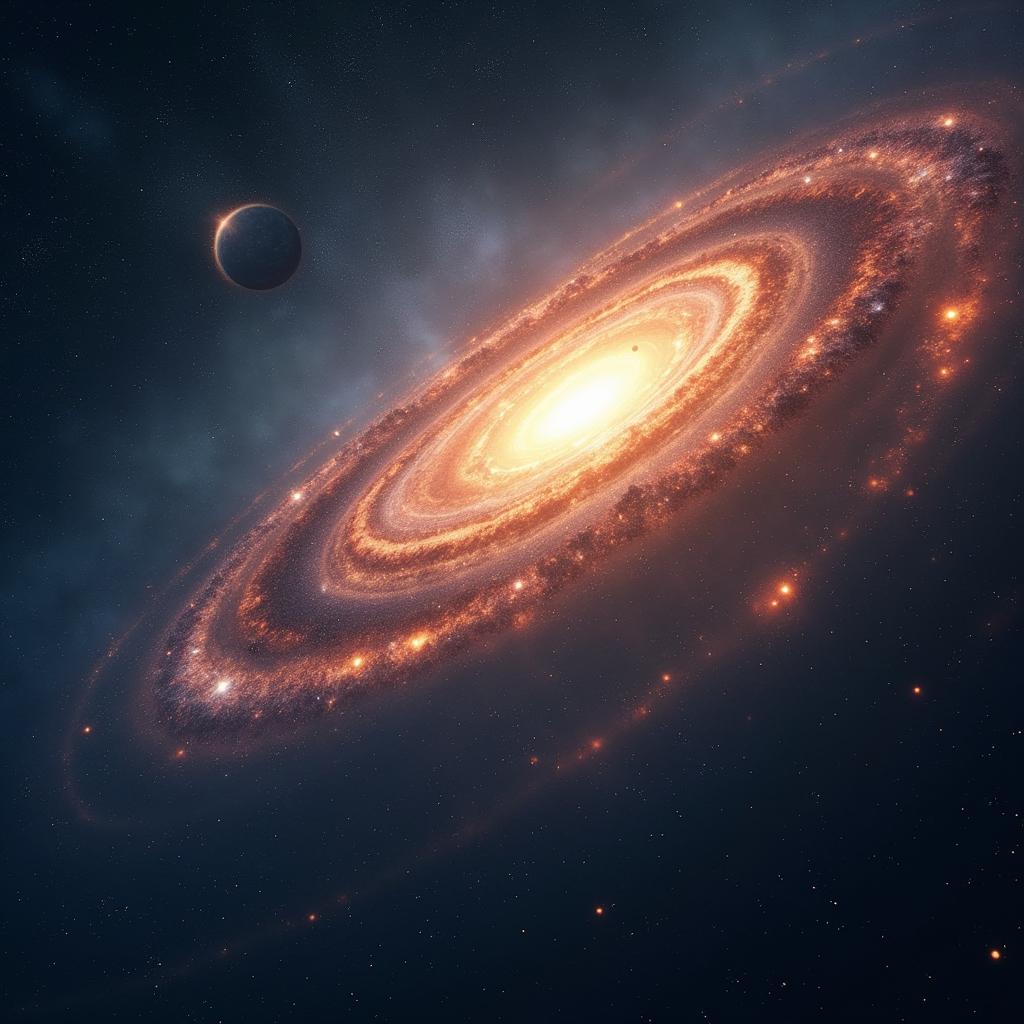
*We can’t even predict the next days weather with certainty, yet here we are trying to predict how something will end that we don’t even know how it fully started.
The universe has always been a subject of fascination for humans, with its vast expanse and mysterious nature sparking countless questions and theories about its origins, evolution, and ultimate fate. One of the most intriguing aspects of cosmology, the study of the universe, is the exploration of its potential endings, which has led to the development of various theoretical models. In this article, we will delve into the historical background and context of these models, discuss the main areas of exploration, and analyze the implications and controversies surrounding them. The purpose of this article is to provide an in-depth understanding of the theoretical models of the universe’s fate, highlighting their significance and relevance to our understanding of the cosmos.
The concept of the universe’s fate has been debated for centuries, with ancient Greek philosophers such as Aristotle and Epicurus proposing various ideas about the universe’s origins and destiny. However, it wasn’t until the 20th century that the development of modern cosmology led to the formulation of more sophisticated theoretical models. The discovery of dark energy in the late 1990s revolutionized our understanding of the universe’s evolution, and since then, scientists have been working tirelessly to refine and expand our knowledge of the cosmos. As stated by Professor Brian Cox, a renowned physicist and cosmologist, “The universe is a big place, and we’re still trying to understand the rules that govern its behaviour” [1].
One of the earliest and most influential models of the universe’s fate is the Big Crunch theory, which suggests that the expansion of the universe will eventually slow down and then reverse, causing the universe to collapse back in on itself. This theory is based on the idea that the density of matter in the universe is sufficient to halt the expansion and cause a collapse. However, the discovery of dark energy, a mysterious form of energy that is thought to be responsible for the accelerating expansion of the universe, has led to the development of alternative models. The Big Rip theory, for example, proposes that the expansion of the universe will continue to accelerate, causing the fabric of space itself to tear apart, resulting in the destruction of all matter and energy.
Another model, known as the Heat Death theory, suggests that the universe will eventually reach a state of maximum entropy, or disorder, in which all energy has been evenly distributed and there are no longer any gradients or differences in temperature. This theory is based on the second law of thermodynamics, which states that the total entropy of a closed system will always increase over time. As explained by Professor Stephen Hawking, “The second law of thermodynamics is a fundamental principle that governs the behaviour of the universe, and it has important implications for our understanding of the universe’s fate” [2].
In addition to these models, there are several other theories that attempt to explain the ultimate fate of the universe. The Multiverse theory, for example, proposes that our universe is just one of many universes that exist in a vast multidimensional space, and that the fate of our universe is inextricably linked to the fate of the multiverse as a whole. The Cyclic Model theory, on the other hand, suggests that the universe undergoes cycles of expansion and contraction, with each cycle lasting for billions of years.
The development of these theoretical models has been influenced by a range of scientific and technological advancements, including the discovery of dark energy, the observation of supernovae, and the development of sophisticated computer simulations. As noted by Professor Lisa Randall, a leading cosmologist, “The discovery of dark energy has revolutionized our understanding of the universe, and it has opened up new avenues of research and exploration” [3]. The use of advanced telescopes and observational techniques has also enabled scientists to study the universe in greater detail, providing valuable insights into its evolution and fate.
The implications of these theoretical models are far-reaching and profound, with significant consequences for our understanding of the universe and our place within it. If the Big Crunch theory is correct, for example, it would suggest that the universe is finite and has a clear beginning and end. On the other hand, if the Heat Death theory is correct, it would imply that the universe is ultimately destined for a state of maximum entropy, in which all life and energy have been extinguished. As stated by Professor Neil deGrasse Tyson, “The universe is a complex and mysterious place, and our understanding of its fate is still evolving” [4].
Despite the significance of these models, there are still many controversies and uncertainties surrounding them. The existence of dark energy, for example, is still not well understood, and its role in the universe’s evolution is still the subject of much debate. Additionally, the development of new theories and models, such as the theory of eternal inflation, has raised new questions and challenges for our understanding of the universe’s fate. As noted by Professor Alan Guth, a leading cosmologist, “The theory of eternal inflation is a highly speculative idea, but it has the potential to revolutionize our understanding of the universe” [5].
In conclusion, the theoretical models of the universe’s fate are a fascinating and complex area of study, with significant implications for our understanding of the cosmos. From the Big Crunch to the Heat Death theory, each model provides a unique perspective on the ultimate fate of the universe, and highlights the complexities and uncertainties of the cosmos. As we continue to explore and refine our understanding of the universe, we may uncover new insights and challenges that will shape our understanding of the universe’s fate. As Professor Brian Cox so eloquently puts it, “The universe is a mystery that we are still trying to unravel, and its fate is a question that may remain forever shrouded in uncertainty” [6]. Will we ever be able to uncover the ultimate fate of the universe, or will it remain a mystery forever?
References and Further Reading:
- Cox, B. (2011). The Quantum Universe. Allen Lane.
- Hawking, S. (2005). A Briefer History of Time. Bantam Books.
- Randall, L. (2011). Knocking on Heaven’s Door. Ecco.
- Tyson, N. deG. (2012). Space Chronicles. W.W. Norton & Company.
- Guth, A. (1997). The Inflationary Universe. Addison-Wesley.
- Cox, B. (2014). Human Universe. William Collins.
- Peebles, P.J.E. (1993). Principles of Physical Cosmology. Princeton University Press.
- Weinberg, S. (2008). Cosmology. Oxford University Press.
- Linde, A. (2004). Inflation, Quantum Cosmology and the Anthropic Principle. Springer.
- Rees, M. (2001). Our Cosmic Habitat. Princeton University Press.





 Conversations with AI
Leave a comment