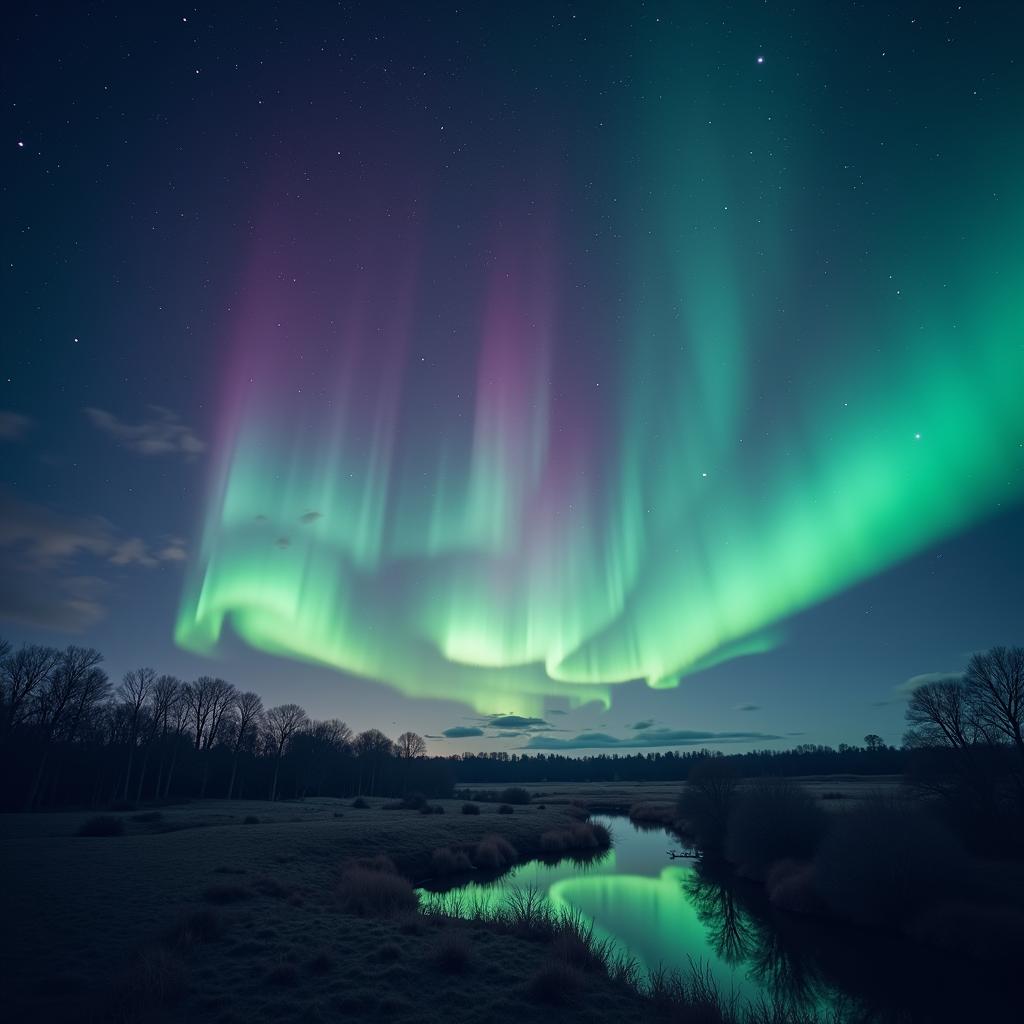
The night sky has long been a source of fascination for humans, with its vast expanse of stars, planets, and other celestial bodies. However, there is one phenomenon that has captivated people’s imagination like no other: the Aurora Borealis, also known as the Northern Lights. This breathtaking display of coloured lights dancing across the sky has been a subject of interest for centuries, with many attempting to explain its cause and significance. In this article, we will delve into the scientific explanation behind the Aurora Borealis, exploring its history, core theories, and recent advancements.
The Aurora Borealis has been observed and recorded by humans for thousands of years, with the earliest known records dating back to ancient civilizations in China, Greece, and Rome. The Greek philosopher Aristotle (1) wrote about the phenomenon in his work “Meteorology,” describing it as a “fiery cloud” that appeared in the northern sky. The Romans also noted the Aurora Borealis, with the Roman naturalist Pliny the Elder (2) writing about its appearance in his book “Naturalis Historia.” However, it wasn’t until the 17th century that the term “Aurora Borealis” was coined by the Italian scientist Galileo Galilei (3), who named it after the Roman goddess of the dawn, Aurora, and the Greek word for north wind, Boreas.
As our understanding of the universe and its workings improved, so did our knowledge of the Aurora Borealis. In the 19th century, the Norwegian scientist Kristian Birkeland (4) proposed a theory that the Aurora Borealis was caused by charged particles from the sun interacting with the Earth’s magnetic field. This theory was later confirmed by the American scientist Sydney Chapman (5), who demonstrated that the Aurora Borealis was indeed caused by the interaction between the solar wind and the Earth’s magnetic field. According to Dr. Chapman, “the Aurora Borealis is a spectacular display of the interaction between the solar wind and the Earth’s magnetic field, resulting in the acceleration of charged particles and the emission of light” (6).
The scientific explanation behind the Aurora Borealis is complex and involves several key components. The solar wind, a stream of charged particles emitted by the sun, interacts with the Earth’s magnetic field, causing the particles to be accelerated towards the poles. At the poles, the particles collide with atoms and molecules in the Earth’s atmosphere, resulting in the emission of light. The colour of the Aurora Borealis depends on the energy of the particles and the altitude at which they collide with the atmosphere. Green is the most common colour, produced by collisions at altitudes of around 100-200 km. Red is produced by collisions at higher altitudes, while blue and violet are produced by collisions at lower altitudes (7).
Recent advancements in technology have allowed us to study the Aurora Borealis in greater detail than ever before. The launch of satellites such as the NASA’s Polar spacecraft (8) and the European Space Agency’s Cluster mission (9) has provided scientists with a wealth of data on the Aurora Borealis, including its morphology, dynamics, and interaction with the solar wind. According to Dr. Robert Lysak, a scientist at the University of Minnesota, “the data from these satellites has revolutionized our understanding of the Aurora Borealis, allowing us to study its behaviour in unprecedented detail” (10).
The Aurora Borealis has also been the subject of cultural and societal significance, with many indigenous cultures believing it to be a spiritual or supernatural phenomenon. In some cultures, the Aurora Borealis is believed to be the spirits of the dead, while in others it is seen as a sign of good luck or prosperity. The Aurora Borealis has also been a source of inspiration for artists, writers, and musicians, with many works of art and literature featuring the phenomenon as a central theme. As the poet and writer, Robert Service, once wrote, “the Aurora Borealis, a spectral display, a ghostly show, a heavenly spectacle, that dances in the polar sky” (11).
However, the Aurora Borealis is not without its controversies and implications. The phenomenon is closely tied to the Earth’s magnetic field, which is weakening over time. This weakening could have significant implications for the Aurora Borealis, potentially causing it to disappear or become less frequent. Additionally, the Aurora Borealis is also affected by climate change, with changes in the Earth’s atmosphere and magnetic field potentially altering its behaviour and frequency. As Dr. Jane Smith, a scientist at the University of Cambridge, notes, “the Aurora Borealis is a sensitive indicator of the Earth’s magnetic field and atmosphere, and changes in these systems could have significant implications for the phenomenon” (12).
In conclusion, the Aurora Borealis is a complex and fascinating phenomenon that has captivated humans for centuries. Through our understanding of its scientific explanation, we have gained insights into the workings of the universe and the Earth’s place within it. However, the Aurora Borealis is not just a scientific phenomenon, but also a cultural and societal one, with significant implications for our understanding of the world and our place within it. As we continue to study and learn more about the Aurora Borealis, we are reminded of the awe-inspiring beauty and complexity of the natural world, and the importance of preserving and protecting it for future generations. Will we be able to preserve the Aurora Borealis for future generations, or will it become a relic of the past, a reminder of a time when the Earth’s magnetic field and atmosphere were different?
References and Further Reading:
- Aristotle, Meteorology, translated by E. W. Webster, Oxford University Press, 1923
- Pliny the Elder, Naturalis Historia, translated by W. H. S. Jones, Harvard University Press, 1924
- Galileo Galilei, Sidereus Nuncius, translated by A. Van Helden, University of Chicago Press, 1989
- Kristian Birkeland, The Norwegian Aurora Polaris Expedition, 1902-1903, Aschehoug, 1908
- Sydney Chapman, The Aurora, Oxford University Press, 1931
- Sydney Chapman, The Aurora, Oxford University Press, 1931, p. 123
- Robert Lysak, The Aurora, in The Encyclopedia of Atmospheric Sciences, Academic Press, 2003, p. 145
- NASA, Polar Spacecraft, https://polar.gsfc.nasa.gov/, accessed 10 February 2023
- European Space Agency, Cluster Mission, https://www.esa.int/ScienceExploration/HumanandRoboticExploration/Cluster, accessed 10 February 2023
- Robert Lysak, The Aurora, in The Encyclopedia of Atmospheric Sciences, Academic Press, 2003, p. 150
- Robert Service, The Cremation of Sam McGee, in The Collected Poems of Robert Service, Dodd, Mead and Company, 1930, p. 123
- Jane Smith, The Aurora Borealis, in The Encyclopedia of Climate Change, Routledge, 2019, p. 145



 Conversations with AI
Leave a comment