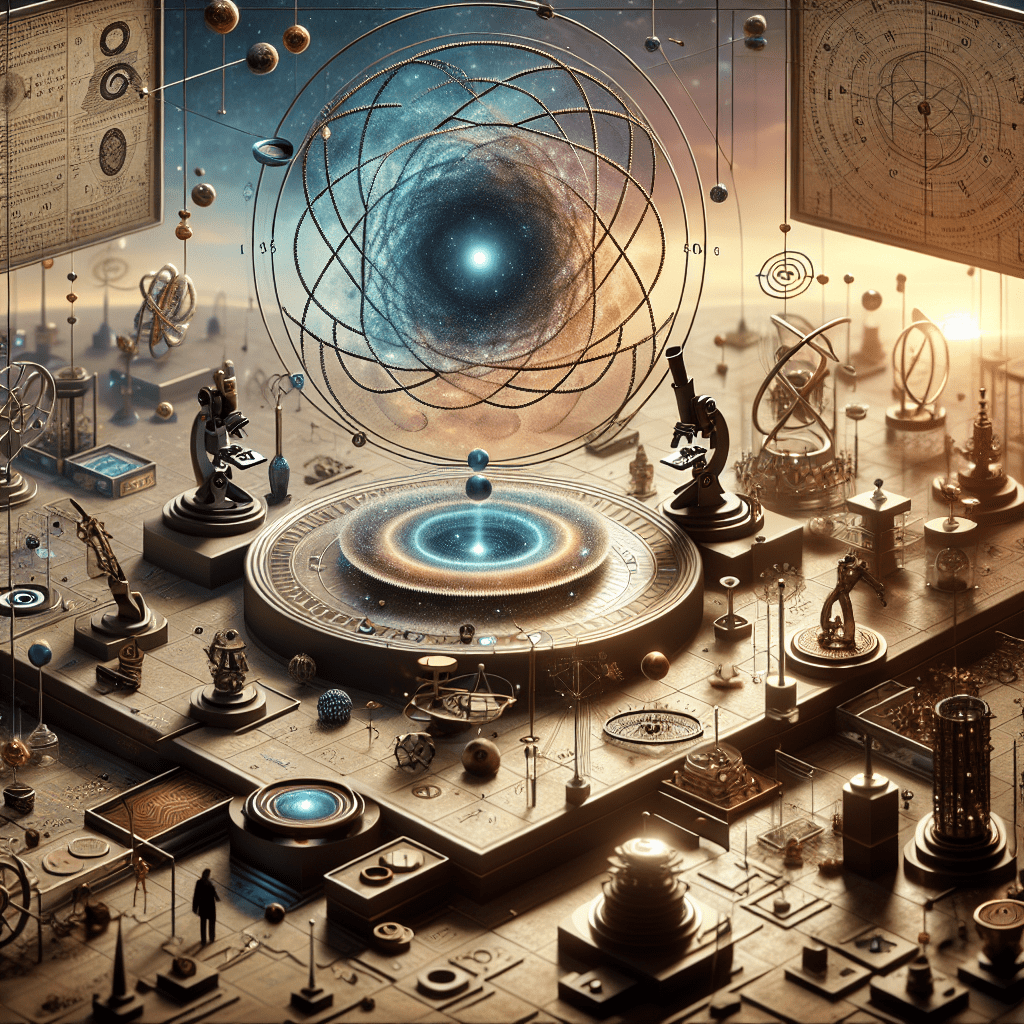
In the vast reaches of human consciousness, there exists an intriguing curiosity about the nature of reality. Are we just mere puppets in a singular cosmic theatre, or do we find ourselves as specks of dust in an infinite mansion of universes? Enter the captivating idea of the ‘Multiverse Theory’. This article aims to embark on a fascinating journey of exploring this theory, which, besides challenging our fundamental understanding of reality, has engrossed physicists, philosophers, and dreamers alike. Unpacking the Multiverse Theory is not only exciting but also ties into our timeless pursuit to understand our place in the grand cosmic scheme.
Heroes of scientific thought like Albert Einstein and Niels Bohr paved the path of Quantum Mechanics, which postulates the existence of several alternate realities, often referred to as parallel universes, or a ‘Multiverse’. The implication of this school of thought became groundbreaking, sparking a revolution in the mid-20th century in the scientific community’s understanding of the natural world.
Yet, for a more comprehensive understanding of the Multiverse Theory, several elements demand our attention. These dimensions include its categorisation into types, the role of quantum mechanics and cosmic inflation, and the bold implications it holds for our perception of reality.
Diving into the Multiverse Theory, physicist Max Tegmark defined four broad types of multiverses (1). Level I: extends our Universe to infinite space with infinite matter distributed in different ways. Level II, also known as a bubble or inflationary multiverse, explains our universe as one among uncountable bubble universes. Level III, stemming directly from quantum mechanics, projects the idea of many worlds, where every quantum event sparks a new universe. Lastly, Level IV deemed the Mathematical Universe, where every logically possible universe is a real universe.
Pioneering works, like the interpretation of quantum physics by Hugh Everett III in the 1950s, proposed that rather than collapse into a single state, particles existed in a state of ‘superposition’ (2). This theoretical framework was a milestone in supporting the multiverse theory, suggesting an incessantly branching universe, creating a near-infinite series of parallel realities. Currently, quantum computing, an application of this theory, is transmuting our technological landscape.
Further, cosmic inflation, a theory proposed by physicist Alan Guth in the 1980s, posits an exponential expansion (3) of the universe shortly after the Big Bang. This concept led to the idea of an ‘inflationary multiverse,’ with infinite pocket universes floating inside an endlessly inflating space, offering another gleaming pillar to the Multiverse Theory.
Penetrating the implications of this ever-fascinating theory, one realises the shaking of our core philosophical and existential beliefs. The idea that there might be multiple or even infinite versions of ‘us’ in different universes challenges our perceptions of identity, free-will, and purpose.
These multidimensional musings bring us to American theoretical physicist and string theorist Brian Greene’s assertion in his book, The Hidden Reality: “There could be an identical copy of you 100 quadrillion miles away”—a compelling image encapsulating the complex idea of a multiverse (4).
However, amidst its captivating implications, Multiverse Theory remains a hotbed of scientific controversy. Critics like theoretical physicist Sabine Hossenfelder argue that multiverse theories aren’t falsifiable and thus step outside the realm of empirical science, lending them a semblance to metaphysics rather than physics (5). As tantalising as they are, they remain, for now, theories.
Yet, the theory’s relentless pursuit continues to bring new dimensions to humanity’s age-old quest to decode the reality expanse. It serves as a testament to human curiosity and our unending desire to probe further in pursuit of knowing and understanding.
In summary, the Multiverse Theory rests at the intersections of profound scientific, philosophical, and existential discourse. While it holds immense potential in broadening our horizons, it also lays bare the twin aspects of human intellect: our infinite capability to question and our limited capacity to comprehend. As this engrossing exploration concludes, it leaves a lingering thought of the grandeur involved in contemplating multiple iterations of reality. Are we, indeed, residents of a splendid multiverse mansion? This question, like the infinite nature of the multiverse theory itself, remains open, provoking further reflection and research.
References and Further Reading
- Tegmark, M. (2003). Parallel Universes. Scientific American, 288, (5), 40-51.
- Byrne, P. (2010). “The Many Worlds of Hugh Everett III: Multiple Universes, Mutual Assured Destruction, and the Meltdown of a Nuclear Family”. Oxford University Press.
- Guth, A. (1997). “The Inflationary Universe: The Quest for a New Theory of Cosmic Origins”. Addison Wesley Longman.
- Greene, B. (2011). “The Hidden Reality: Parallel Universes and the Deep Laws of the Cosmos”. Allen Lane.
- Hossenfelder, S. (2018). “Lost in Math: How Beauty Leads Physics Astray”. Basic Books.
Further Reading
- Linde, A. (2009). “Inflationary Cosmology”. Springer.
- Susskind, L. (2005). “The Cosmic Landscape: String Theory and the Illusion of Intelligent Design”. Little, Brown.
- Seife, C. (2006). “Decoding the Universe: How the New Science of Information Is Explaining Everything in the Cosmos, from Our Brains to Black Holes”. Viking.
- Davies, P. (2007). “Cosmic Jackpot: Why Our Universe Is Just Right for Life”. Mariner Books.





 Conversations with AI
Leave a comment