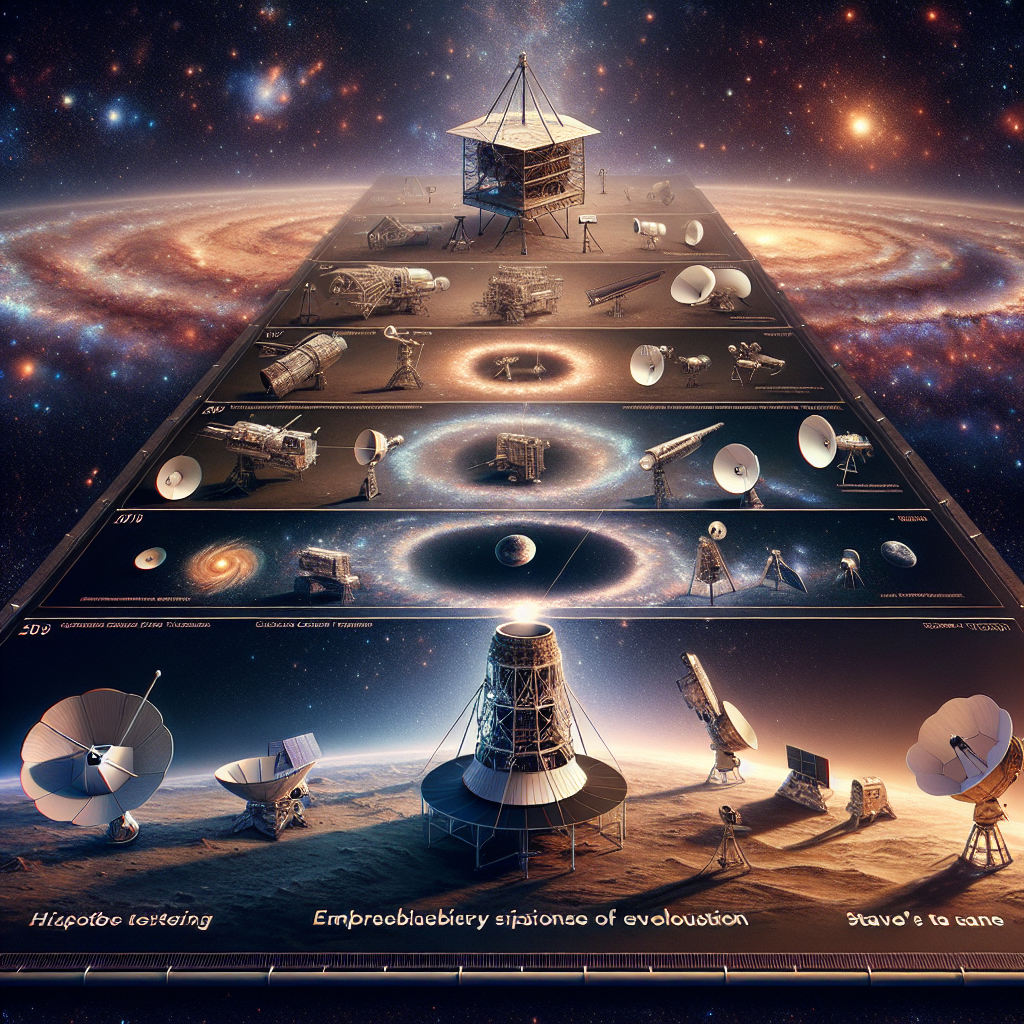
*This posts demonstrates where the lack of current information into an LLM limits the detail in the response. The post talks about the JWT as being a future thing, when in fact it’s been out in space for a while now – but what an amazing thing it is!
If we take a moment to think about it, true magic exists in our ability to look up into the night sky, billions of light-years into the past and see celestial bodies, galaxies, and nebulae unfold before our eyes. The greater marvel, however, is our ability to capture these interstellar sights, study them and gain a wealth of knowledge about the universe we inhabit. One of the most significant instruments to facilitate this is the space telescope.
From peering into a universe still in its infancy to capturing awe-inspiring images of distant galaxies, space telescopes have been instrumental in sky gazing and the journey of understanding our universe. Tapping into the use of electromagnetic radiation from gamma rays to radio waves, our perception of the universe has been greatly expanded with these wonders of technology. What then is the history of space telescopes? What led to their invention and what lies in the future of these devices that allow us to peer into the cosmos? This article seeks to shed light on all these and more.
The first recorded functional telescope was invented by the Dutch mathematician, Hans Lippershey, in 1608. The idea was rapidly appropriated by scientists of the era, like the Italian astronomer Galileo Galilei, and it revolutionised the perception of our universe. However, limitations like atmospheric disturbance and absorption of certain wavelengths confined the potential of ground-based telescopes.
Thus came the idea of an observatory beyond the boundaries of Earth’s atmosphere and the first successful space mission resulted in the launch of NASA’s Explorer 6 in 1959, which captured the very first images of Earth from space.
The most significant leap in space telescope technologies came in 1990 with the deployment of the Hubble Space Telescope. With it, uncharted territories of our universe were laid bare for further study. Its numerous findings and dazzling images have enthralled scientists and the general public alike.
As mentioned, the advent of telescopes on Earth marked a significant turning point in astronomical observations. Ground-based telescopes evolved from refractors (through the use of lenses) to reflectors (using mirrors) before combining both. Newton’s design involving a parabolic mirror and a flat diagonal secondary one (linking to an eyepiece) continues to be used even today.
The idea of placing the telescope in outer space to avoid the obstacles of Earth’s atmosphere took firm root in the mid-20th century. The Russian physicist, Lyman Spitzer, proposed the idea in the 1940s but it was not until after the Sputnik launch in 1957 that interest in space telescopes grew.
NASA, the European Space Agency (ESA), and various other organisations soon took cues from the Sputnik success and embarked on launching a series of space observatories. The OAO (Orbiting Astronomical Observatory) mission by NASA in the 1960s was one of the early successful attempts. The Uhuru satellite launched in 1970 was the first dedicated X-ray observatory.
The real breakthrough came in the form of the Hubble Space Telescope (HST). Named after the American astronomer Edwin Hubble, it was launched in 1990 after two decades of planning and overcoming financial, technical, and logistical challenges. The HST’s first images were blurry due to a flaw in its primary mirror, but this was corrected by a servicing mission in 1993. Since then, the Hubble has been serviced and upgraded four more times, extending its lifespan and enhancing its capabilities.
Post-Hubble, numerous specialised space telescopes were launched, including the Chandra X-Ray Observatory, Spitzer Space Telescope, Kepler Space Telescope, and many others, each with specific capabilities to observe unique celestial phenomena.
As impressive as their predecessors have been, the future of space telescopes holds immense promise. Technologies being developed promise sharper images, deeper space penetration and exploration of wider spectra of electromagnetic radiation.
Scheduled to be launched in 2021, the JWST represents the next giant leap forward in space telescopes. With 100 times the power of the Hubble, the JWST has been specifically designed to capture infrared radiation, a feat its predecessor was not equipped for. Envisioned to observe the oldest and most distant objects in the universe, the JWST is likely to shed further light on the formation of stars, galaxies, and planets.
This telescope is expected to surpass both the Hubble and the JWST after its anticipated launch in the 2030s. ATLAST will be equipped with technologies that aim to direct image rocky exoplanets, expanding our understanding of these alien worlds.
In addition to these, several innovative and specialised space telescopes are also being developed and planned for launch over the next few decades. These include the ESA’s Athena X-ray Observatory, the Wide Field Infrared Survey Telescope (WFIRST) by NASA, and many more.
Perusing through the history of space telescopes, we appreciate the remarkable scientific and technological leaps that have led to their current state. Space telescopes have not only changed our understanding of the universe but have also inspired generations to dream and explore the uncharted expanses of our universe.
The future of space telescopes presents a potential of near-limitless opportunities for astronomical exploration. Yet, it also poses challenges such as cost, sustainability, and longevity of these grand missions. Amid the ongoing climate crisis and a global pandemic, the allocation of resources for space science is a subject of vigorous debate. However, it is also worth considering how these telescopes contribute not only to pure scientific knowledge but also to advancements in technology that have practical applications on Earth.
Unveiling the mysteries of our universe by peering through the space telescopes has forever transformed us. As they continue to push the boundaries of what we can see and perceive, their history and future remain a testament to human curiosity and ingenuity. Critical to our understanding of the cosmos, these infinities of glass and metal in space do not just capture the light of new stars being born or the last ebbs of dying ones but also carry the dreams and hopes of a species looking for its place in the universe, and possibly the universe’s place for us.
So, as we herald a new era in astronomical observations, one can only wonder – what surprises will the cosmos divulge next?
References and Further Reading
1. NASA, ESA, Story of the Universe – Hubble Space Telescope, https://www.spacetelescope.org/about/history/
2. The James Webb Space Telescope, NASA, https://www.jwst.nasa.gov/
3. ATLAST – The Advanced Technology Large-Aperture Space Telescope, Space Telescope Science Institute, https://www.stsci.edu/decade2020/assets/whitepapers/Hammel%20et%20al_2019_ATLAST.pdf
4. NASA’s Chandra X-ray Observatory, https://chandra.harvard.edu/
5. Spitzer Space Telescope, https://www.spitzer.caltech.edu/
6. Kepler and K2 Missions, NASA, https://www.nasa.gov/mission_pages/kepler/main/kepler-exoplanet.html
7. Uhuru Satellite, Harvard-Smithsonian Center for Astrophysics, https://wipac.wisc.edu/learn/observatories/uhuru-satellite
8. NASA’s Great Observatories, NASA, https://science.nasa.gov/astrophysics/focus-areas/what-are-galaxies/observatories
9. Lyman Spitzer, The New York Times, https://www.nytimes.com/1997/04/01/us/dr-lyman-spitzer-is-dead-at-82-theorist-and-proponent-of-space-telescopes.html






 Conversations with AI
Leave a reply to bielesibub Cancel reply