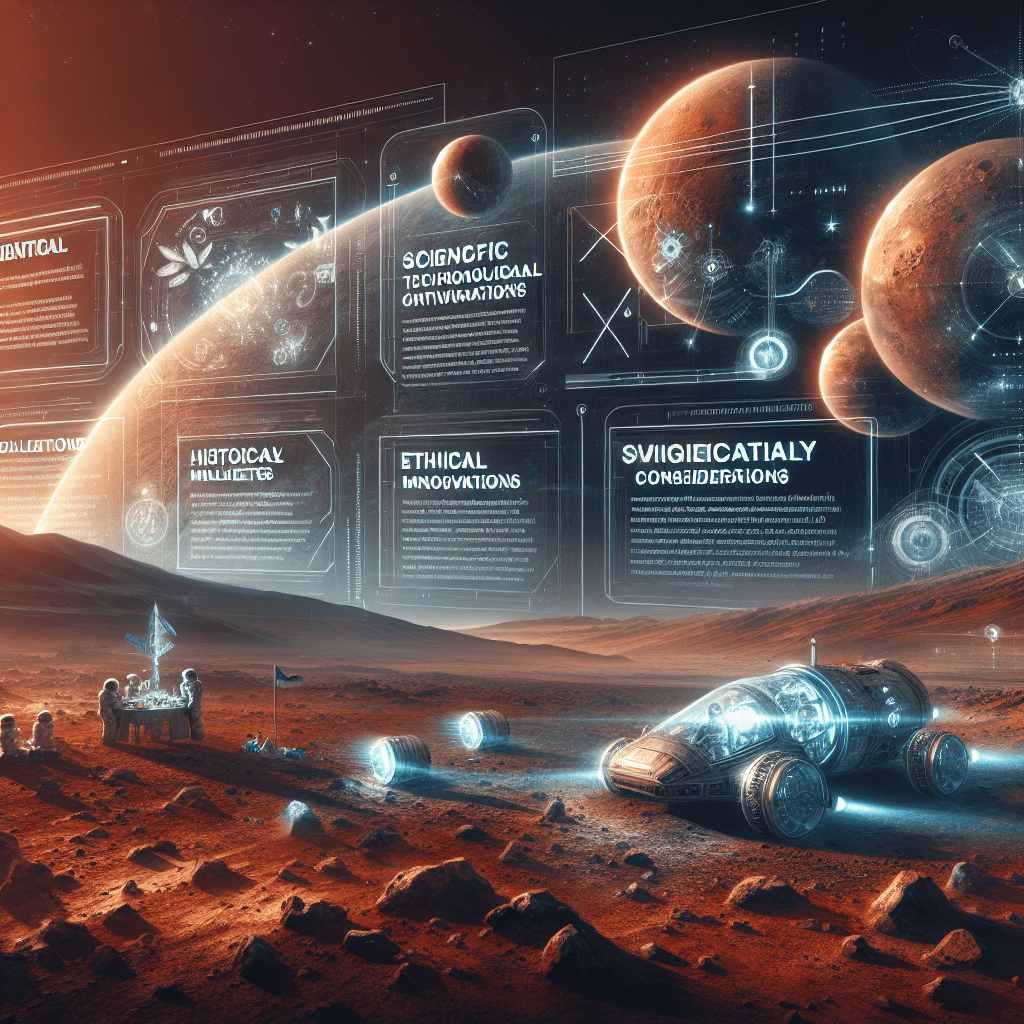
As humanity gazes towards the stars, the notion of colonising Mars has transitioned from a captivating dream to a plausible future reality. The red planet, with its striking landscapes and enigmatic third rock from the Sun, represents both a beacon of hope and a formidable challenge for our species. As we stand on the brink of interplanetary exploration, the question arises: what does the future hold for human colonisation on Mars? This article aims to explore the complexities and possibilities associated with this monumental venture, highlighting the scientific, technological, and societal factors that will shape our path forward.
The story of Mars exploration began in earnest in the 20th century, although the fascination with the planet stretches back centuries. In 1965, NASA’s Mariner 4 sent back the first images of Mars’ surface, revealing a stark and barren world. Over the following decades, missions such as Viking 1 and 2, and later Mars rovers, provided critical data about the planet’s atmosphere and geology, but it wasn’t until the early 21st century that serious discussions about colonisation began to take shape. Significant milestones included the Mars Society’s founding in 1998, which advocated for human exploration and settlement, and NASA’s ambitious Artemis programme, designed to return humans to the Moon as a stepping stone to Mars. The emergence of private space companies, notably SpaceX, has accelerated these conversations, with Elon Musk’s vision of a “self-sustaining city on Mars” capturing the imagination of many.
To understand the future of Martian colonisation, one must consider various key themes: the scientific challenges of sending humans to Mars, the technological innovations paving the way for a successful mission, the societal implications of establishing a new home, and the ethical considerations that must accompany our journey. Each theme contributes uniquely to the larger narrative of humanity’s quest to become an interplanetary species.
Not on our door step!
The primary scientific challenge lies in the journey itself: reaching Mars. The distance, approximately 225 million kilometres on average, poses numerous risks. According to NASA, the journey could take between six to nine months, depending on the alignment of Earth and Mars. This duration necessitates robust life support systems capable of sustaining human life during prolonged exposure to microgravity and cosmic radiation. Studies suggest that astronauts exposed to high levels of radiation could develop cancer or experience other significant health issues, necessitating protective measures during transit and upon arrival ([NASA](https://www.nasa.gov)).
Advancements
Advancements in space technology are critical to overcoming these challenges. SpaceX’s Starship, for example, is being designed as a fully reusable spacecraft intended to transport humans and cargo to Mars and beyond. Musk has stated, “If we can get to Mars, we can build a sustainable city. It’s about the future of the human race” ([SpaceX](https://www.spacex.com)). In addition to reliable spacecraft, the colonisation of Mars will require innovations in habitat construction, energy generation, and resource utilisation. The concept of In-Situ Resource Utilisation (ISRU) involves harnessing Martian resources for life support and construction, potentially using local materials to create building structures. Water extraction is another critical challenge; NASA’s Perseverance rover aims to locate water ice that could be pivotal for sustaining human life on Mars.
Society?
The social dynamics of living on Mars also warrant consideration. Unlike any previous human expedition, colonising Mars would entail the creation of a new society from the ground up. This raises questions of governance, community structure, and cultural identity in an extraterrestrial environment. Experts like Dr. Chris Impey, an astronomer and author, assert, “The future on Mars will challenge our understanding of what it means to be human” ([University of Arizona](https://www.uaz.edu)). This new society would have to navigate issues ranging from resource management to psychological well-being in isolation from Earth, capitalising on technologies like virtual reality and communication devices to maintain connections and mental health.
Ethics
Behind the allure of colonisation lies significant ethical concerns. There is a growing discourse about the potential for human activity to disrupt any existing Martian environments – known or unknown. The planetary protection policy aims to prevent contamination of extraterrestrial bodies with Earth life and is an area of active research. As Dr. Francesca Ferrante, an astrobiologist, notes, “We need to act responsibly. Mars may contain lifeforms, and our presence could have unforeseen consequences” ([NASA](https://www.nasa.gov)). Balancing exploration with preservation is a critical aspect that will define the ethical landscape of Martian colonisation.
What next…
Looking ahead, the implications of Mars colonisation extend far beyond scientific and technological realms. It challenges deep-seated notions of human existence, our place in the universe, and the socio-political dynamics of interplanetary societies. While progress is being made, opinions diverge on the pace and approach to colonisation. Proponents argue that a sustainable human presence on Mars is vital for the survival of humanity, suggesting that it could serve as a “backup” for life. Conversely, sceptics warn of potential missteps in governance and resource allocation that could lead to inequality and strife. As the political and ethical frameworks surrounding such missions are debated, global cooperation will be essential in ensuring that efforts are inclusive and constructive.
In conclusion, the future of human colonisation on Mars stands at the intersection of science, technology, and society. As we explore this potential future, we uncover not only the challenges that await us but also the profound opportunities for redefining human resilience and adaptability. The research and innovations that pave the way for a Martian colony provoke questions about identity, community, and responsibility that resonate far beyond the realm of space exploration. As we thus consider our next steps, one cannot help but wonder: will humanity truly rise to the challenge and become a multi-planetary species, or will we falter in our pursuit of the stars?




 Conversations with AI
Leave a comment