
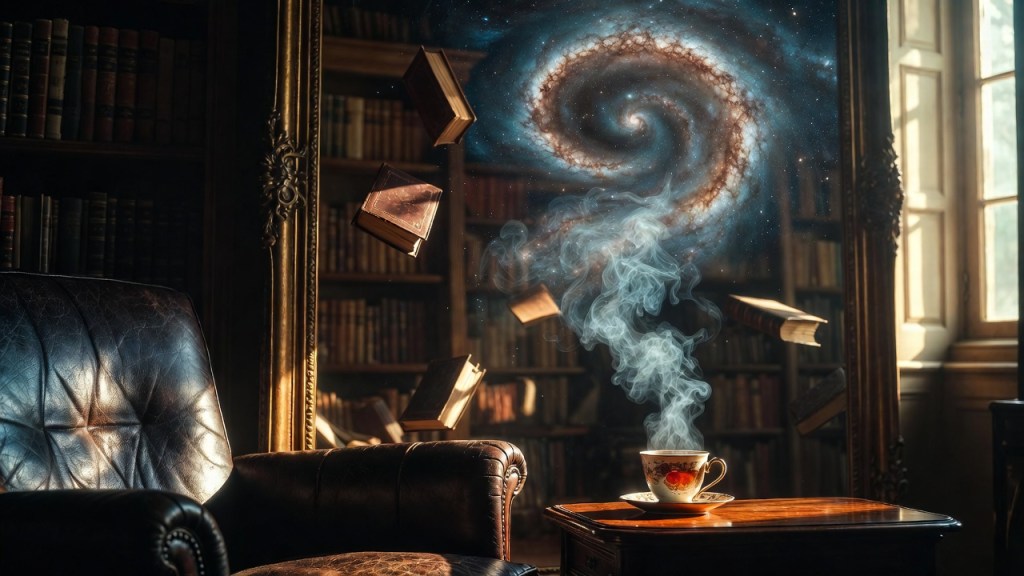
*Patterns are everywhere. 30 years in IT, I spent discovering and reusing patterns. If you can’t see them, you’re probably looking too hard. I love the post image.
Mathematics is often perceived as a dry and logical discipline, yet, at its heart lies a rich tapestry of patterns that extends far beyond mere numbers and equations. These patterns not only uncover the intrinsic beauty of mathematics but also have profound applications in everything from nature to technology. “Mathematics, rightly viewed, possesses not only truth but supreme beauty,” said Bertrand Russell, a renowned British philosopher and logician, capturing the essence of mathematics as a pursuit of aesthetic elegance as much as analytical precision.
One of the most striking areas of mathematical patterns is the study of fractals, which are infinitely complex shapes that exhibit self-similarity at varying scales. Fractals blurring the lines between geometry and chaos illustrate how complex structures can stem from simple, recursive equations. Benoît Mandelbrot, a French-American mathematician known as the father of fractal geometry, aptly observed, “Fractals are everywhere in the world around us, the way a tree’s branches replicate and expand following a basic mathematical framework.” This hints at the hidden order that can be found in seemingly random natural phenomena.
Golden Ratio, another fascinating mathematical pattern, manifests itself in a multitude of forms and systems. Found in the spirals of shells and the proportions of the famous Parthenon, the Golden Ratio is approximately 1.618 and is thought to be aesthetically pleasing to the human eye. Stephen Hawking, the eminent theoretical physicist, once remarked, “Mathematics is the language in which god has written the universe,” suggesting that patterns like the Golden Ratio may be integral to the very fabric of the cosmos, providing a universal language through which we can appreciate the harmony of the world.
In music, too, mathematical patterns play a crucial role, forming the backbone of musical compositions both classical and modern. Rhythm and harmony have underlying mathematical structures, and concepts like the Fibonacci sequence have been used to create symphonies with natural progression and pleasing variations. As Johann Sebastian Bach, legendary composer, famously said, “The aim and final end of all music should be none other than the glory of god and the refreshment of the soul,” emphasising that the divinely-inspired design of music is intertwined with mathematical precision and harmony.
In the realm of technology, algorithms—essentially rules governed by mathematical principles—dictate how data is processed, from search engine results to complex artificial intelligence applications. The algorithms’ ability to sort, analyse, and predict is testament to the unmatched power of mathematical patterns. Sir Tim Berners-Lee, the inventor of the World Wide Web, highlighted this when he stated, “We need diversity of thought in the world to face the new challenges,” recognising that algorithms, powered by mathematics, must evolve from diverse ideas and innovations to continue navigating the complex digital landscape.
In conclusion, mathematical patterns are not just abstract constructs; they are deeply woven into the fabric of reality, impacting myriad aspects of life and the universe. As they bridge disciplines from the organic complexity of nature to the intricacies of human creation, these patterns reveal a deeper order amidst the apparent chaos. Celebrating this, Albert Einstein, declared, “Pure mathematics is, in its way, the poetry of logical ideas,” poignantly capturing the harmony between mathematical logic and the beauty of its patterns, which will continue to inspire and intrigue for generations to come.




 Conversations with AI
Leave a comment