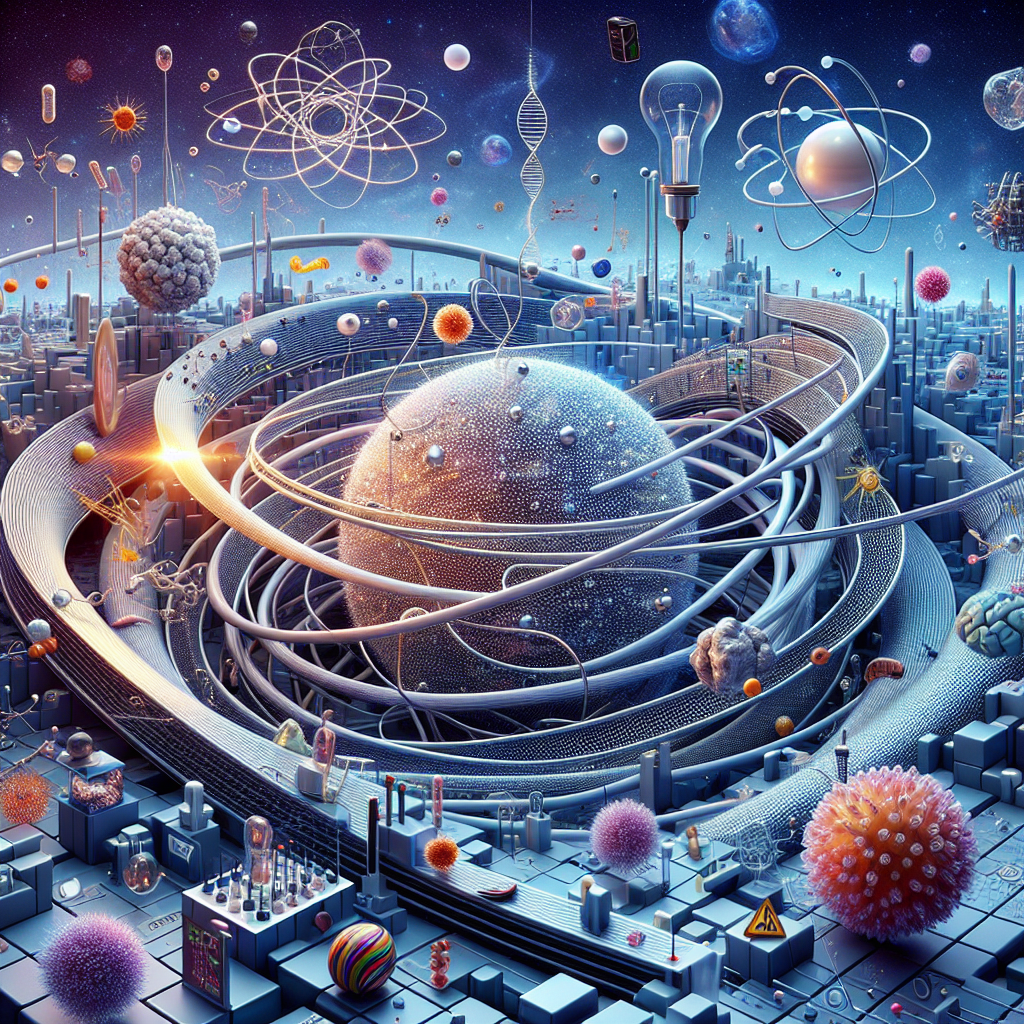
Quantum physics, often hailed as one of the most complex and intriguing fields of study, delves into the fundamental nature of the smallest particles in the universe. At its core, quantum physics examines how atoms and subatomic particles behave, revealing a world that defies classical intuition. The peculiarities of quantum mechanics, such as superposition, entanglement, and wave-particle duality, challenge our understanding of reality itself. As Richard Feynman, a renowned theoretical physicist, famously stated, "I think I can safely say that nobody understands quantum mechanics." This quote underscores the enigmatic nature of quantum physics and the continuous quest for comprehension that drives scientists today.
One of the cornerstone principles of quantum physics is the concept of superposition, which posits that particles can exist in multiple states simultaneously until measured. This idea was famously illustrated by Erwin Schrödinger's thought experiment involving a cat that is simultaneously alive and dead, depending on the state of a quantum particle. Superposition challenges the deterministic nature of classical physics, where objects have definite states. It opens up a realm of possibilities that has profound implications for quantum computing, where qubits take advantage of superposition to perform complex calculations at unprecedented speeds. As David Deutsch, a pioneer in the field of quantum computing, put it, "Quantum computation is… a distinctively new way of harnessing nature." This highlights the transformative potential that quantum physics holds for technology and computation.
Entanglement is another fascinating phenomenon within quantum physics, where particles become interconnected in such a way that the state of one particle instantly influences the state of another, regardless of the distance between them. Albert Einstein famously referred to this as "spooky action at a distance," reflecting his skepticism of the non-local nature of entanglement. Despite Einstein's reservations, entanglement has been empirically validated and is foundational to the development of quantum technologies, such as quantum cryptography. Anton Zeilinger, a physicist and Nobel laureate, emphasized the importance of this phenomenon, saying, "Entanglement is the characteristic trait of quantum mechanics," showcasing its central role in the advancement of secure communication systems.
Wave-particle duality is another perplexing aspect of quantum physics, demonstrating that particles exhibit both wave-like and particle-like properties. This duality is famously illustrated by the double-slit experiment, which shows that particles such as electrons create an interference pattern when not observed, behaving as waves, but act as particles when observed. This experiment raises profound questions about the role of the observer in the quantum world and the nature of reality itself. Niels Bohr, a key figure in the development of quantum theory, remarked, "Everything we call real is made of things that cannot be regarded as real," emphasizing the counterintuitive insights that quantum physics provides about the fabric of reality.
Quantum physics not only expands our understanding of the physical universe but also prompts philosophical inquiries into the nature of knowledge and existence. The challenges posed by quantum mechanics have spurred debates over the interpretation of its mathematical framework, leading to various theories such as the Copenhagen interpretation, Many-Worlds interpretation, and more. As John Wheeler, a theoretical physicist, once said, "We are no longer satisfied with insights into particles, or fields of force, or geometry, or even space and time. Today we demand of physics some understanding of existence itself." Quantum physics, with its profound implications and unresolved mysteries, continues to push the boundaries of human knowledge and invites us to question our place in the universe.





 Conversations with AI
Leave a comment