*Inspired by all the talk about 3i/Atlas being a spaceship
You know that feeling? That uniquely modern sting when you’ve sent a carefully crafted message, only to watch it sit there, marked as ‘read’, with no reply? It’s a minor sort of social damnation, a tiny, personal vortex of being acknowledged and then immediately dismissed. It’s the digital equivalent of someone looking you right in the eye, and then walking away as if you were never there.
Now, imagine that on a planetary scale.
For decades, we’d had the cosmic kettle on, so to speak. We’d flung our little metal discs with their diagrams and their music into the void. We’d beamed out our hellos and our mathematical constants, hoping for a reply. We were, for all intents and purposes, looking for new friends in the vast, dark playground of the galaxy.
Then, one Tuesday, they arrived.
It wasn’t an invasion. There were no motherships hovering ominously over capital cities, no threatening transmissions demanding we take them to our leader. It was, in many ways, far worse. A single vessel, a thing of impossible geometry and silent, effortless grace, simply glided into our solar system. It had a good, long look at our bustling, blue-green marble, much like a tourist casually observing an anthill, and then, without so much as a cosmic cough, it buggered off. It just… left.
In the deafening silence of its wake, humanity was left to grapple with a question far more wounding than ‘Are we alone?’. We’d received the answer, and it was a crushing ‘Yes, in all the ways that truly matter.’ The real question, the one that festered, was this: What’s more insulting than being a target? Being deemed unworthy of notice. We hadn’t just been visited; we’d been ghosted.
The first stage of our global reaction was, predictably, a monumental sulk. Humanity, as a collective entity, went into its bedroom, slammed the door, and put on its gloomiest records. We were the teenager who had just been blanked by the person we fancied in the school corridor. The initial shock curdled into a planet-wide crisis of confidence. Funding for space programmes was slashed overnight. What was the point, politicians argued, in shouting into a void that had already made it clear it wasn’t listening?
Our art became introspective and melancholic. Our music was filled with mournful ballads of cosmic loneliness. We were, for a good few years, utterly insufferable.
Then, as is always the case with a bruised ego, the sulk gave way to the defensive pivot. The ‘sour grapes’ phase began. Pundits on rolling news channels suddenly became experts in xen-aesthetic design, critiquing the alien ship’s lines. “Frankly, a bit derivative,” one would sniff. “Very last millennium.” Social media was flooded with defiant memes. “Imagine travelling trillions of miles just to miss out on artisan cheese and ironic knitwear,” they read. We developed a sudden, almost aggressive appreciation for all things human. A defiant celebration of our own perceived inadequacies. Who needs hyper-advanced, silent aliens when you’ve got a perfectly good sourdough starter bubbling away on the counter?
This attitude, however, required too much energy to sustain. The bravado was paper-thin. In its place, something far more bizarre and, ultimately, far more honest emerged. It started, as many things do, as a joke. A comedian, during a live broadcast, was discussing the Great Snub and, in a moment of inspiration, dropped to his knees, bowed repeatedly, and chanted, “We’re not worthy! We’re not worthy!”
It was a cultural explosion.
The gesture, borrowed from a century-old comedy film, became the planet’s single, unifying coping mechanism. It was the perfect expression of our cosmic inadequacy. Your partner makes a perfect cup of tea? You both bow and chant. A bus arrives on time? The entire queue prostrates itself in mock adulation. It was a joke, of course. But it was a joke that everyone knew was painfully true. We were laughing in the dark, using sarcasm as a shield against the profound, existential dread of being found wanting. We were a planet of seven billion people, bowing to an empty sky, because it was less painful than admitting how much the silence truly hurt.
But even the best jokes wear thin. After a generation or two of sarcastic bowing, the laughter began to feel hollow. The shield started to crack. A new idea began to germinate in the fertile ground of our collective resentment. It was a simple idea, but a powerful one. It was no longer about whether we were worthy or not. It was about getting even.
A new age of humanity began. The Great Endeavour, they called it. It was presented to the public as a noble quest. We would heal our fractured world, unite our warring tribes, and pool our resources for one magnificent goal: to reach for the stars ourselves. We would do it not out of bitterness, the leaders told us, but out of a desire to better ourselves, to finally grow up, to one day meet the visitors as equals and understand why they had passed us by.
And so we did. Humanity, for the first time, had a single, unifying purpose. The old squabbles seemed petty, the old hatreds absurd. All our genius, our wealth, our passion, was poured into science and engineering. Breakthrough followed breakthrough. We healed our planet, we built gleaming cities, and we constructed vessels that could fold space and time. It was the best of us. We were driven, focused, and noble. We were reaching for the stars.
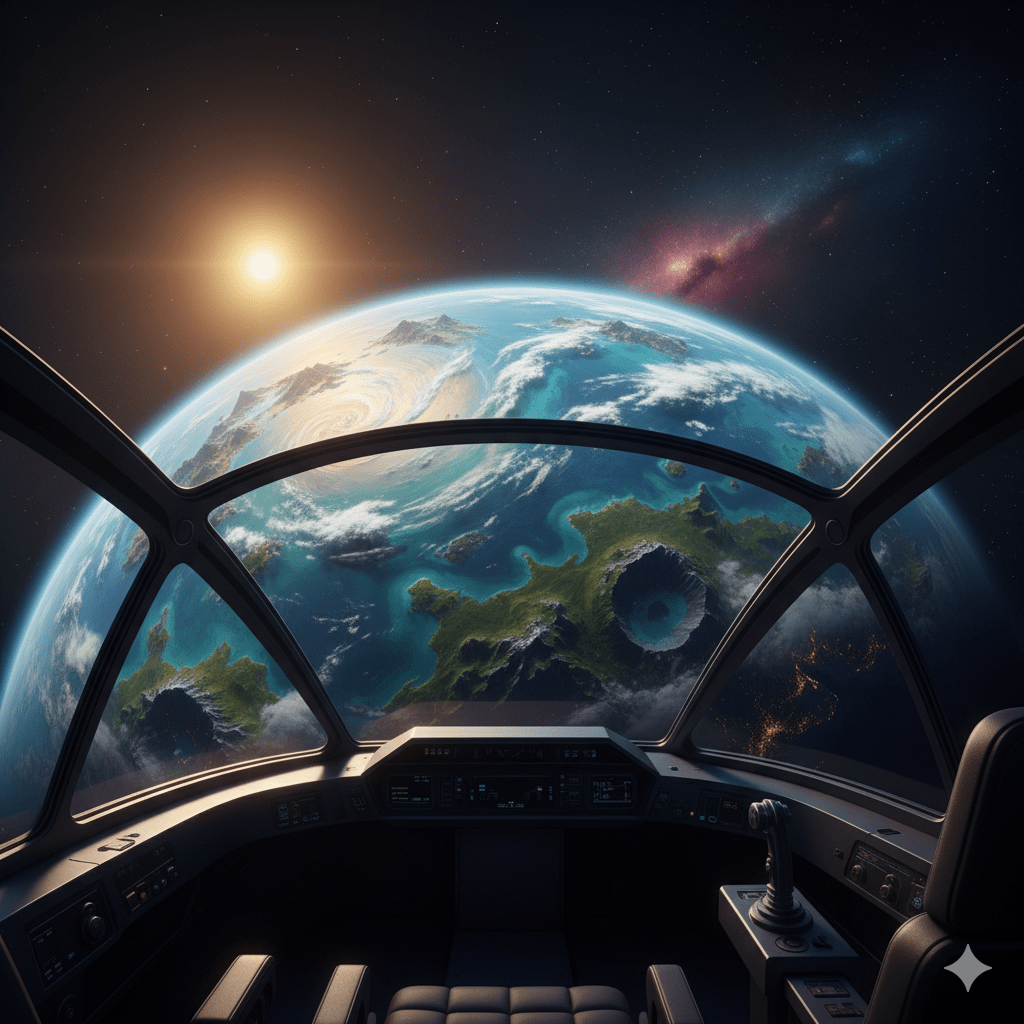
It took centuries. Generations were born and died with the Great Endeavour as the backdrop to their lives. And then, finally, the day came. Our ship, the Retort, a vessel far grander and more elegant than the one that had visited us all those years ago, arrived at its destination—a blue-green world orbiting a distant, placid star. The home of our silent observers.
Back on Earth, the world held its breath. Seven trillion souls, across a dozen colonised worlds, watched the live feed. This was it. The culmination of centuries of striving. The moment we would finally get our answer. The Retort slowed to a graceful stop in high orbit. The tension was unbearable.
On the bridge, the captain, her face a mask of calm concentration, gave the order. The forward viewscreen, a vast pane of smart-crystal, powered down like a colossal car window.
Across the silent gulf of space, she leaned forward, her voice channelled through the ship’s external speakers, a single human message broadcast for an entire world to hear. She took a breath, looked at the beautiful, unsuspecting planet before her, and delivered the line that humanity had been rehearsing for five hundred years.
She pouted.
“Look at what you missed out on! Up yours, motherf**kers!”
Then, with a triumphant smile, she gave the order to turn around. The Retort spun on its axis and, with a flash of displaced spacetime, vanished. The journey home had begun. Mission accomplished.




 Conversations with AI
Leave a comment