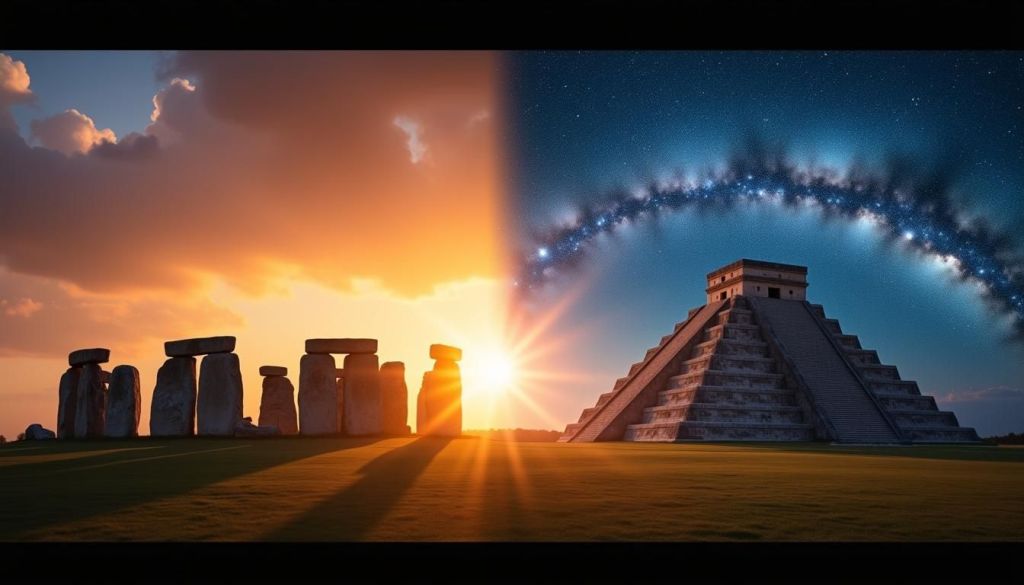
Have you ever gazed up at the night sky and felt a connection to the past, wondering how ancient civilisations understood the cosmos without the aid of modern technology? Long before the invention of telescopes and computers, people across the globe were keen observers of the heavens. Their survival and understanding of the world often depended on deciphering celestial patterns. This exploration delves into two remarkable examples of such ancient ingenuity: Stonehenge in England and Chichen Itza in Mexico. These sites, separated by thousands of miles and centuries, stand as testaments to the enduring human fascination with the stars and our early attempts to map and understand the universe. Unravelling their astronomical secrets not only sheds light on the scientific capabilities of these ancient cultures but also reveals the profound influence the cosmos had on their beliefs, rituals, and daily lives.
The story of these early astronomical observatories begins deep in our past, at a time when the rhythms of the sun, moon, and stars were inextricably linked to the cycles of nature and, consequently, to human existence. For early agricultural societies, knowing when to plant and when to harvest was a matter of life and death. The regular movements of celestial bodies provided a reliable calendar. Solstices, marking the longest and shortest days of the year, and equinoxes, when day and night are of equal length, were particularly significant. Beyond their practical applications, the heavens were often imbued with spiritual meaning, with celestial events seen as messages from the gods or as integral parts of creation myths. Stonehenge, with its construction phases spanning from roughly 3000 BCE to 1600 BCE, emerged during the Neolithic period and Bronze Age in Britain. This was a time of significant social and technological development, with communities becoming more settled and capable of undertaking monumental construction projects. Across the Atlantic, the Mayan civilisation, which flourished from around 250 CE to 900 CE in Mesoamerica, developed a highly sophisticated understanding of mathematics and astronomy. Chichen Itza, particularly its later structures built between the 9th and 12th centuries CE, reflects this advanced knowledge. Understanding this historical backdrop is crucial to appreciating why these ancient peoples would invest such tremendous effort in building these astronomically aligned structures.
Stonehenge, standing majestically on Salisbury Plain, is perhaps one of the most iconic and enigmatic ancient monuments in the world. Its massive sarsen stones and smaller bluestones, transported over considerable distances, are arranged in a complex circular pattern. For centuries, its purpose was debated, with theories ranging from a druidic temple to a burial ground. However, the work of pioneering researchers like Gerald Hawkins in the 1960s brought its astronomical alignments to the forefront. Hawkins, using early computer analysis, demonstrated that key features of Stonehenge align with significant solar and lunar events. For instance, the main axis of the monument is famously aligned with the sunrise on the summer solstice and the sunset on the winter solstice. Standing within the stone circle on the summer solstice, one can see the sun rise almost directly over the Heel Stone, a large, unshaped sarsen stone located outside the main circle. Similarly, the winter solstice sunset is framed by the trilithons, the iconic three-stone arrangements. As Professor Mike Parker Pearson, a leading expert on Stonehenge, has stated, “Stonehenge was a monument that, in its main phase, was orientated on the solstices, and it would have been the midwinter and midsummer solstices which were the absolutely key times of year.” This suggests that the monument was a focal point for seasonal rituals, marking the turning points of the year.
The astronomical connections at Stonehenge may extend beyond the solstices. Alignments with lunar standstills — the most northerly and southerly points of the moon’s rising and setting during its 18.6-year cycle — have also been proposed, although these are subject to more debate among scholars. The fifty-six Aubrey Holes, a ring of pits surrounding the main stone settings, have been interpreted by some as a means of predicting lunar eclipses. While the exact methods and the full extent of astronomical knowledge possessed by the builders of Stonehenge remain subjects of ongoing research, there is a strong consensus that the site was intentionally designed to align with key celestial events. The sheer effort involved in its construction underscores the importance of these astronomical observations to the society that built it. It wasn’t just a calendar; it was likely a ceremonial centre where the movements of the cosmos were celebrated and perhaps used to legitimise the power of chieftains or priests. The changing landscape around Stonehenge, with evidence of large feasting events coinciding with the solstices, further supports this interpretation.
Thousands of miles away, in the Yucatán Peninsula of Mexico, the ancient Mayan city of Chichen Itza offers another compelling example of sophisticated astronomical observation. The Maya were renowned for their advanced understanding of mathematics, including the concept of zero, and their intricate calendar systems. Their astronomical knowledge was deeply interwoven with their religion and worldview. One of the most striking structures at Chichen Itza is the pyramid known as El Castillo, or the Temple of Kukulcan. This pyramid is a masterpiece of architectural and astronomical alignment. Twice a year, on the spring and autumn equinoxes, a remarkable phenomenon occurs. As the sun sets, the northwest corner of the pyramid casts a series of triangular shadows that appear to slither down the side of the northern staircase, creating the illusion of a feathered serpent descending the pyramid. This serpent is believed to represent Kukulcan, the feathered serpent deity, a prominent figure in Mayan mythology. Anthony Aveni, a pioneer in the field of archaeoastronomy, has extensively studied Mayan astronomy and notes that “the Maya were interested in bringing the sky down to earth, in making their buildings a replica of the sky world.” El Castillo is a prime example of this, a physical manifestation of a celestial event tied directly to their agricultural calendar and religious beliefs.
Another significant astronomical structure at Chichen Itza is El Caracol, often referred to as the Observatory. Its unusual circular design, with a partially collapsed tower, stands out from the predominantly rectangular architecture of the Maya. The windows and doorways in El Caracol’s tower appear to align with key astronomical events, particularly the cycles of Venus. The Maya had a deep fascination with Venus, which they associated with warfare and their god Kukulcan in his aspect as the morning and evening star. They meticulously tracked its heliacal risings — its first appearance in the morning sky after a period of invisibility — and its other appearances. The Dresden Codex, one of the few surviving Mayan books, contains detailed astronomical tables, including incredibly accurate predictions of the phases of Venus and eclipses. El Caracol, with its strategically placed observation points, would have been crucial for gathering the data needed for such predictions. Scholars like Ivan Šprajc have conducted detailed surveys of El Caracol, confirming numerous Venus alignments and also suggesting alignments with other celestial bodies and events, including the solstices and equinoxes. The precision of these alignments indicates a sophisticated understanding of celestial mechanics and a long tradition of careful observation.
The implications of these ancient observatories are profound. They demonstrate that well before the rise of modern science, ancient cultures possessed a significant understanding of astronomy and applied this knowledge in complex ways. Stonehenge and Chichen Itza were not simply isolated curiosities; they represent a widespread human endeavour to connect with and understand the cosmos. The construction of these sites required immense social organisation, resources, and engineering skills, indicating the high value placed on astronomical knowledge. This knowledge was likely held by a specialised group, perhaps priests or a ruling elite, who used it for calendrical purposes, agricultural planning, religious ceremonies, and possibly to reinforce their authority. The astronomical alignments embedded in these structures served as powerful visual reminders of the connection between the earthly realm and the celestial order.
However, the interpretation of these sites is not without its controversies. While the solstitial alignments at Stonehenge are widely accepted, the extent of its use for more complex predictions, such as eclipses, remains a topic of academic debate. Some researchers argue that attributing overly sophisticated astronomical knowledge to prehistoric peoples can be a form of anachronism, projecting modern scientific concerns onto the past. Similarly, while the primary alignments at Chichen Itza are clear, the precise function of every architectural feature and the full scope of Mayan astronomical practice are still being pieced together. It’s important to approach these interpretations with a critical eye, acknowledging what is well-supported by evidence and what remains speculative. Furthermore, focusing solely on the astronomical aspects risks overlooking other functions these complex sites undoubtedly served, such as social gathering places, ritual centres, and expressions of power and identity.
In conclusion, Stonehenge and Chichen Itza stand as awe-inspiring monuments to the astronomical ingenuity of ancient civilisations. They reveal a deep-seated human desire to understand our place in the universe, a quest that began long before the advent of modern science. These sites were not merely passive backdrops for daily life; they were active instruments for engaging with the cosmos, for marking time, for structuring society, and for connecting with the divine. The careful alignment of massive stones and intricate temples with the movements of the sun, moon, and stars speaks volumes about the observational skills, mathematical understanding, and sophisticated worldviews of their builders. As we continue to study these ancient wonders, we gain not only a deeper appreciation for the achievements of past cultures but also a reminder of the timeless human connection to the celestial sphere. What other silent stone sentinels or jungle-clad pyramids around the world still hold astronomical secrets waiting to be deciphered, and what further insights might they offer into humanity’s enduring relationship with the cosmos?
References and Further Reading:
1. Hawkins, G. S. (1965). *Stonehenge Decoded*. Doubleday.
2. Parker Pearson, M. (2012). *Stonehenge: Exploring the Greatest Stone Age Mystery*. Simon & Schuster.
3. Aveni, A. F. (2001). *Skywatchers: A Revised and Updated Version of Skywatchers of Ancient Mexico*. University of Texas Press.
4. Milbrath, S. (1999). *Star Gods of the Maya: Astronomy in Art, Folklore, and Calendars*. University of Texas Press.
5. Ruggles, C. (2005). *Ancient Astronomy: An Encyclopedia of Cosmologies and Myth*. ABC-CLIO.
6. Šprajc, I. (2001). *Orientaciones astronómicas en la arquitectura prehispánica del centro de México*. Instituto Nacional de Antropología e Historia. (Note: This is a key Spanish-language text on Mesoamerican archaeoastronomy, further English summaries of Šprajc’s work on Chichen Itza can be found in archaeoastronomy journals and edited collections).
7. North, J. D. (1996). *Stonehenge: Neolithic Man and the Cosmos*. HarperCollins.
8. Krupp, E. C. (1991). *Beyond the Blue Horizon: Myths and Legends of the Sun, Moon, Stars, and Planets*. Oxford University Press.
9. Magli, G. (2009). *Mysteries and Discoveries of Archaeoastronomy: From Giza to Easter Island*. Springer.
10. Brennan, M. (1983). *The Stars and the Stones: Ancient Art and Astronomy in Ireland*. Thames & Hudson. (While focusing on Ireland, this provides good context for megalithic astronomy in general).




 Conversations with AI
Leave a comment