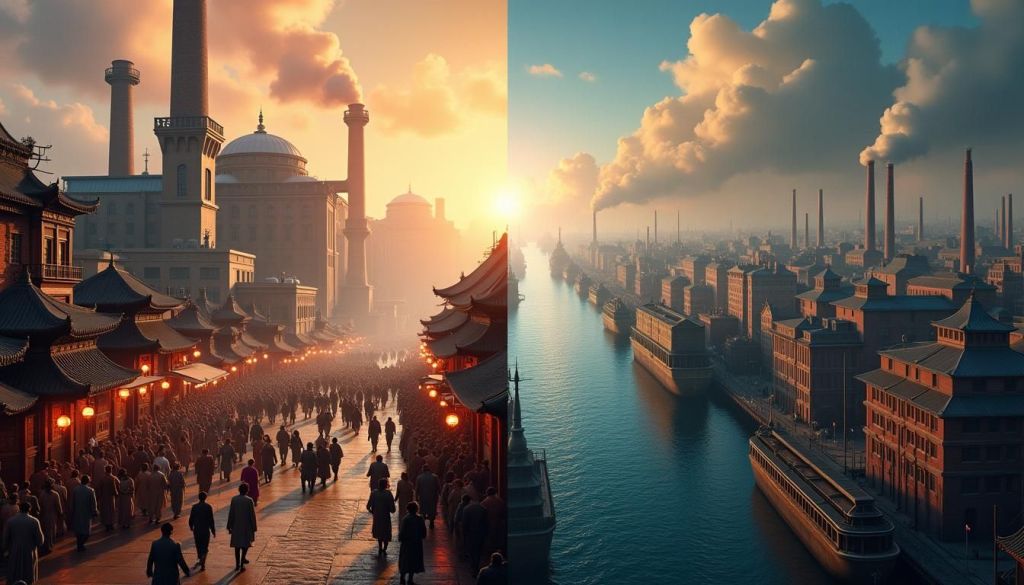
Have you ever wondered why the world looks the way it does today? Why some countries are historically wealthier and more technologically advanced than others? For a huge part of human history, different regions of the world were actually quite similar in their levels of development. China, India, and the Middle East, for instance, were often leaders in science, technology, and economic prosperity. Yet, somewhere around the late 18th century, a profound shift began, primarily in a small corner of the world: Western Europe, and particularly Great Britain. This shift, known as the Industrial Revolution, didn’t just change Europe; it fundamentally reshaped the entire globe, creating a vast gap in wealth and power between the West and the rest. This growing chasm is what historians call “The Great Divergence”. Understanding why Europe industrialised first is not just an interesting historical puzzle; it’s crucial for understanding the roots of modern global economics, international relations, and even some of the inequalities we still see today. This post will delve into the complex web of factors that might explain why Europe, and not other advanced regions of the time, became the cradle of industrialisation.
Before we dive into the “why,” let’s set the scene. For centuries leading up to around 1750, Europe was by no means the undisputed global leader in all fields. The great empires of Asia, such as Qing Dynasty China and Mughal India, possessed sophisticated economies, large populations, and impressive technological traditions. Chinese inventions like gunpowder, the compass, and printing had been world-changing. Indian textiles were highly sought after globally for their quality and beauty. The Ottoman Empire controlled vast territories and crucial trade routes. In many ways, as historian Kenneth Pomeranz has argued, core regions in Eurasia were, as late as 1750, “more alike than different” [1]. Europe, though it had seen significant advancements during the Renaissance and the beginnings of the Scientific Revolution, was still just one of several major players on the world stage. Industrialisation itself refers to a monumental transformation: the shift from societies predominantly based on agriculture and handcrafted goods to economies driven by machine-based manufacturing, new energy sources like coal and steam, and the factory system. This process began in Great Britain in the latter half of the 18th century (roughly 1760 onwards) with innovations like the steam engine, the spinning jenny, and the power loom, and then gradually spread to other parts of Europe and North America during the 19th century. The “divergence” happened because this process was initially concentrated in Europe, allowing it to surge ahead economically and technologically, creating a widening gap with other regions that either did not industrialise or did so much later and often under very different circumstances.
So, what were the ingredients in Europe’s recipe for industrialisation? Historians debate this intensely, and there’s certainly no single, simple answer. Instead, a complex interplay of factors seems to be at work. One significant line of argument points to unique developments *within* Europe. The Scientific Revolution from the 16th century, followed by the Enlightenment in the 18th century, fostered a new way of thinking. Figures like Isaac Newton and Francis Bacon championed observation, experimentation, and the idea that the natural world could be understood and manipulated. This “culture of reason and inquiry,” as historian Joel Mokyr terms it, created an environment where practical knowledge and technological innovation were increasingly valued and pursued [3]. Mokyr speaks of an “Industrial Enlightenment,” suggesting that “the scientific and intellectual developments of the eighteenth century had a profound impact on the attitudes and actions of those who brought about the technological breakthroughs” [3, p. 29]. This intellectual ferment led to the establishment of scientific societies and a network for sharing knowledge, creating a fertile ground for new inventions to take root and spread.
Political fragmentation within Europe might have also played an unexpected role. Unlike China, which was a vast, unified empire for much of its history, Europe was a patchwork of competing states. This constant rivalry, while leading to frequent wars, also spurred innovation. Rulers and states were keen to adopt new technologies and economic policies that could give them an edge over their neighbours. This competitive environment arguably encouraged a more dynamic approach to economic development and technological advancement than might have existed under a single, overarching imperial authority which might prioritise stability over disruptive change.
Furthermore, the legal and institutional frameworks developing in some parts of Europe, particularly in Britain, are often highlighted. The strengthening of property rights, for example, gave individuals and businesses greater security in their investments and the fruits of their labour. This encouraged risk-taking and long-term capital investment, both crucial for industrial ventures. The development of sophisticated financial institutions, like banks and stock exchanges, also made it easier to mobilise capital for new enterprises. Some scholars, like Douglass North, have emphasised the importance of institutions that reduced transaction costs and enforced contracts, creating a more predictable and favourable environment for economic growth.
Access to specific natural resources, particularly coal, was another crucial factor, especially for Britain, the pioneer of industrialisation. Britain had abundant and easily accessible coal deposits, often located near iron ore – the two key raw materials for early industrial machinery and steam power. The steam engine, initially developed to pump water out of coal mines, became the workhorse of the Industrial Revolution, powering factories and, later, railways and steamships. Without this cheap and plentiful energy source, the scale and pace of industrialisation would have been vastly different. As Robert C. Allen points out, “The high wages and cheap energy [in Britain] were the immediate impetus for the technological breakthroughs of the eighteenth century” [2, p. 2]. He argues that Britain’s unique combination of high labour costs (compared to other parts of the world and even other parts of Europe) and very cheap coal created a strong incentive to invent and adopt labour-saving, coal-using technologies. This “high-wage, cheap-energy economy” explanation is a compelling one for Britain’s early lead.
Demographic patterns in Europe also differed from many other parts of the world. The “European Marriage Pattern,” characterised by later marriages and a higher proportion of people never marrying, tended to result in smaller family sizes. This may have contributed to higher levels of human capital (skills and education per person) and greater per capita wealth accumulation, potentially providing both a skilled workforce and more disposable income for new consumer goods. Some also argue that a particular “culture of entrepreneurship” or what Max Weber famously (and controversially) termed the “Protestant Ethic” might have fostered values like hard work, thrift, and rational pursuit of gain, conducive to capitalist development. However, such cultural explanations are heavily debated and hard to prove definitively.
It’s impossible, however, to understand Europe’s industrialisation without looking at its growing interactions with the wider world. From the 16th century onwards, European nations, with their advancing naval technologies, began to establish extensive global trade networks and colonial empires. This expansion had profound consequences. Colonies provided Europe, and especially Britain, with vast new sources of raw materials, such as cotton from the Americas (initially reliant on enslaved labour) and later from India, and sugar from the Caribbean. These raw materials were essential for burgeoning industries, like textile manufacturing, which was a leading sector in the early Industrial Revolution. As Kenneth Pomeranz stresses, access to the resources of the New World was a critical factor, providing “ghost acreage” that relieved ecological pressures in Europe and supplied vital inputs [1].
Moreover, these colonies and global trade routes also provided captive markets for European manufactured goods. British policies, for instance, often actively discouraged industrial development in its colonies, ensuring they remained suppliers of raw materials and consumers of British products. The wealth extracted from these colonial ventures, including the immense profits from the transatlantic slave trade and plantation economies, also contributed capital that could be invested back into European industries. Historians like Eric Williams argued forcefully that profits from slavery helped finance Britain’s industrial take-off [4], a view that continues to spark discussion about the ethical and economic underpinnings of European prosperity. This “world-systems” perspective suggests that Europe’s industrialisation was not just an internal affair but was deeply intertwined with its dominant position in an emerging global economy, a position often established and maintained through coercion and unequal power relations. The flow of silver from the Americas, for example, allowed Europe to purchase goods from Asia for centuries, and eventually, to use its industrial might to reshape global trade patterns to its advantage.
To fully appreciate why Europe pulled ahead, we also need to consider why other advanced civilisations did not industrialise at the same time. China, for instance, had a long history of technological innovation. Why did it not experience an industrial revolution in the 18th or 19th century? One theory, proposed by Mark Elvin, is the “high-level equilibrium trap” [5]. He suggested that China’s pre-industrial economy was so efficient and its population so large that, while it could produce a great deal through intensive agriculture and traditional manufacturing, there was little incentive to invest in radical, labour-saving (and therefore capital-intensive) technologies. Labour was relatively cheap and plentiful, making the British model of substituting machines for workers less attractive. Furthermore, the vast, centralized Chinese state, while ensuring stability for long periods, may have been less conducive to the kind of disruptive innovation and competitive pressures seen in Europe. There’s also the argument that China’s focus turned more inward during the Qing dynasty, perhaps missing opportunities or incentives from extensive global maritime exploration and colonisation that characterised European states during this period.
India, another major economic power with a sophisticated textile industry, also did not industrialise. Under British colonial rule from the mid-18th century onwards, its economy was increasingly geared towards serving British interests. Scholars like Amiya Kumar Bagchi have documented a process of “de-industrialisation” in India, where British manufactured textiles, produced more cheaply by machines, flooded Indian markets and undermined local artisans and traditional industries [6]. Instead of becoming an industrial competitor, India became a major supplier of raw cotton to British mills and a market for their finished goods. The Ottoman Empire faced its own set of internal political and economic challenges, along with increasing pressure from expanding European powers, which made an indigenous industrial revolution difficult.
Analysing the Great Divergence reveals a complex tapestry of interacting causes, and historians continue to debate their relative importance. Was it Europe’s unique internal conditions – its science, institutions, and resource endowments? Or was its rise predominantly fuelled by its exploitation of other parts of the world through colonialism and unequal trade? The truth likely lies in a combination of these factors. Simplistic narratives of European exceptionalism or sole culpability rarely capture the full picture. What is clear is that the Great Divergence was not a predetermined outcome. Different choices, different policies, or even different geographical “luck” (as Jared Diamond explores in *Guns, Germs, and Steel*, though his theories are also debated [7]) could have led to different global trajectories.
The implications of the Great Divergence have been profound and long-lasting. It laid the foundations for the global economic inequalities that persist to this day, with early industrialisers and their offshoots (like the USA) generally enjoying higher standards of living. It also ushered in an era of Western political and cultural dominance that shaped the modern world. The industrial model of development, with its reliance on fossil fuels, also set humanity on a path towards significant environmental challenges that we are grappling with today. Understanding this historical turning point helps us to critically examine narratives of progress and development, to appreciate the interconnectedness of global history, and to reflect on the diverse paths nations have taken.
In summary, Europe’s industrialisation before other regions was not down to a single cause but a confluence of factors: a dynamic intellectual environment born from the Scientific Revolution and Enlightenment, a competitive state system, evolving legal and financial institutions, fortunate access to critical resources like coal, and, crucially, its central role in an expanding global network of trade and colonialism that often involved exploitation and created dependencies. While regions like China and India possessed sophisticated economies and technologies, they faced different sets of incentives, pressures, and political circumstances that did not lead to a similar industrial take-off at that point in history. The Great Divergence remains a pivotal and much-debated chapter in world history, a period that dramatically reshaped global power dynamics and economic fortunes. Reflecting on its complex causes and far-reaching consequences is essential for understanding the world we inhabit. Given the varied factors, can we ever truly pinpoint a ‘primary’ cause for the Great Divergence, or will it always remain a compelling puzzle of interacting forces and historical contingency?
References and Further Reading:
1. Pomeranz, K. (2000). *The Great Divergence: China, Europe, and the Making of the Modern World Economy*. Princeton University Press.
2. Allen, R. C. (2009). *The British Industrial Revolution in Global Perspective*. Cambridge University Press.
3. Mokyr, J. (2002). *The Gifts of Athena: Historical Origins of the Knowledge Economy*. Princeton University Press.
4. Williams, E. (1944). *Capitalism and Slavery*. University of North Carolina Press.
5. Elvin, M. (1973). *The Pattern of the Chinese Past*. Stanford University Press.
6. Bagchi, A. K. (1976). De-industrialization in India in the nineteenth century: Some theoretical implications. *The Journal of Development Studies*, 12(2), 135-164.
7. Diamond, J. (1997). *Guns, Germs, and Steel: The Fates of Human Societies*. W. W. Norton & Company.
8. Landes, D. S. (1998). *The Wealth and Poverty of Nations: Why Some Are So Rich and Some So Poor*. W. W. Norton & Company.
9. Frank, A. G. (1998). *ReOrient: Global Economy in the Asian Age*. University of California Press.
10. Findlay, R., & O’Rourke, K. H. (2007). *Power and Plenty: Trade, War, and the World Economy in the Second Millennium*. Princeton University Press.





 Conversations with AI
Leave a comment