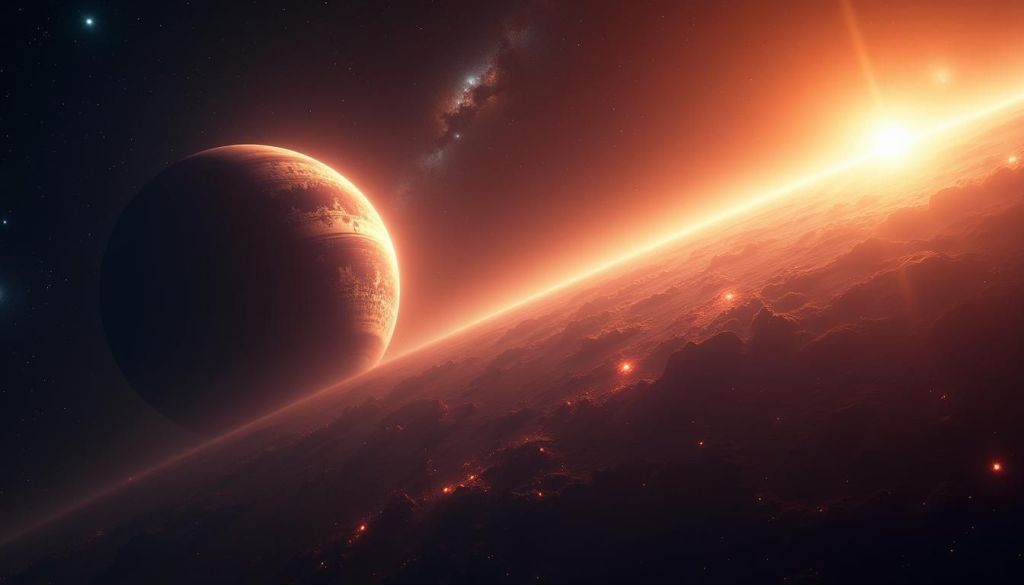
Are we alone in the vast expanse of the cosmos? This question, once relegated to the realm of science fiction, now stands as one of the most profound and actively researched inquiries in modern science. Gazing up at the night sky, glittering with countless stars, it’s hard not to wonder if, orbiting some distant sun, there might be another world teeming with life. The purpose of this exploration is to delve into the fascinating and rapidly advancing field of exoplanet research, specifically focusing on the global quest to find biosignatures – tell-tale signs of life – on these alien worlds. This isn’t just an academic exercise; the discovery of life beyond Earth would reshape our understanding of our place in the universe, touching upon the deepest philosophical, ethical, and scientific questions humanity has ever pondered.
The idea that stars other than our Sun might host planets is not new, with philosophers like Giordano Bruno speculating on “innumerable earths” as far back as the 16th century. However, for centuries, these remained mere conjectures. The actual scientific journey began much more recently. While early claims of exoplanet detections in the late 20th century were met with scepticism or later retracted, the field truly opened up in 1992 with the confirmed discovery of planets orbiting a pulsar, a type of neutron star, by Aleksander Wolszczan and Dale Frail. These were not the Earth-like worlds many had dreamt of, but they were definitive proof that planets existed beyond our solar system. The floodgates truly opened in 1995 when Michel Mayor and Didier Queloz announced the discovery of 51 Pegasi b, a ‘hot Jupiter’ orbiting a Sun-like star. This watershed moment, for which they later received the Nobel Prize in Physics, ignited an explosion in exoplanet research. The early 2000s saw the development and refinement of detection techniques, primarily the radial velocity method (which spots the wobble of a star caused by an orbiting planet’s gravity) and the transit method (which detects the slight dimming of a star as a planet passes in front of it). Space-based telescopes revolutionised the hunt. NASA’s Kepler Space Telescope, launched in 2009, was a game-changer, staring intently at a patch of sky for years and discovering thousands of exoplanet candidates. Its successor, the Transiting Exoplanet Survey Satellite (TESS), launched in 2018, is now scanning nearly the entire sky for closer, brighter stars, providing a rich catalogue of targets for follow-up observations. As of early 2025, the number of confirmed exoplanets stands at well over 5,500, a testament to the incredible progress in just a few decades.
With such a growing menagerie of alien worlds, the focus has naturally shifted from mere detection to characterisation, and the ultimate goal: the search for life. This brings us to the concept of biosignatures. Simply put, a biosignature is any substance, group of substances, or phenomenon that provides scientific evidence of past or present life. On Earth, life has profoundly altered our planet, particularly its atmosphere. The oxygen we breathe is largely a product of photosynthesis by plants and microorganisms. Therefore, scientists are looking for similar chemical fingerprints in the atmospheres of exoplanets. These could be gases like oxygen (O2), ozone (O3) – which is a photochemical byproduct of oxygen – methane (CH4), or nitrous oxide (N2O). The presence of liquid water is also considered crucial for life as we know it, so identifying planets within their star’s ‘habitable zone’ – the region where temperatures could allow liquid water to exist on the surface – is a key first step, though the concept itself is evolving as we learn more about planetary environments. As Dr. Sara Seager, a renowned planetary scientist and astrophysicist at MIT, puts it, “We are at a pivotal moment in human history where for the first time ever, we have the capacity to find life on other worlds.”
The primary method for sniffing out these atmospheric biosignatures is called transmission spectroscopy. When an exoplanet transits, or passes in front of its host star from our point of view, a tiny fraction of the starlight filters through the planet’s atmosphere. Different gases in that atmosphere absorb specific wavelengths (colours) of light. By observing the starlight before, during, and after the transit using powerful telescopes, astronomers can identify these missing slivers of light, creating a spectrum that reveals the chemical composition of the atmosphere. It’s akin to analysing a coded message carried on starlight, millions of light-years across space. The launch of the James Webb Space Telescope (JWST) in late 2021 marked a monumental leap in our ability to perform such analyses. With its large mirror and exquisite sensitivity to infrared light, JWST is capable of dissecting the atmospheres of exoplanets, particularly those orbiting smaller, cooler stars called M-dwarfs, with unprecedented detail. Already, JWST has provided stunning insights into the atmospheres of several exoplanets, detecting water vapour, carbon dioxide, sulphur dioxide, and even puzzling hints of other molecules.
One of the most sought-after biosignatures is oxygen. On Earth, the accumulation of significant oxygen in our atmosphere, known as the Great Oxidation Event, was a direct consequence of the evolution of photosynthetic cyanobacteria. Finding abundant oxygen on an exoplanet, especially in conjunction with gases like methane, would be a very strong indication of life. Methane itself can be produced by living organisms (methanogens, a type of archaea, produce it as a metabolic byproduct), but it can also arise from geological processes like volcanism. However, oxygen and methane are chemically reactive with each other. In an atmosphere, they would quickly destroy one another unless they were being continuously replenished. Finding both in significant quantities simultaneously would suggest a persistent source for each, potentially biological. This is often referred to as a ‘disequilibrium biosignature’. Dr. Victoria Meadows, principal investigator for NASA’s Virtual Planetary Laboratory, has emphasised the importance of context, stating, “It’s not just about finding one molecule, but about understanding the planetary environment as a whole to rule out non-biological explanations.” Ozone is another key target because its presence implies the existence of oxygen, and it also provides a shield against harmful ultraviolet radiation, which could be beneficial for surface life.
However, the search is fraught with challenges. A major hurdle is the issue of ‘false positives’. For instance, abundant oxygen could potentially be produced abiotically (without life) through processes like water vapour being broken apart by intense ultraviolet radiation from the host star, with the lighter hydrogen escaping to space, leaving oxygen behind. This might be more common on planets orbiting M-dwarf stars, which often have strong stellar flares. Similarly, methane can be produced by geological activity, as mentioned. Therefore, a comprehensive understanding of the planet’s geology, its host star’s activity, and the overall atmospheric chemistry is vital to confidently interpret a potential biosignature. Scientists are working on developing frameworks to assess the likelihood that a detected signal is truly from life, considering all possible non-biological sources. This involves detailed computer modelling of planetary atmospheres and geological processes. The sheer distance to these exoplanets also makes observation incredibly difficult. The signals we are trying to detect are minuscule, requiring extremely precise instruments and sophisticated data analysis techniques. Furthermore, our current understanding of life is based on the only example we have: life on Earth. What if extraterrestrial life is fundamentally different, utilising different solvents than water, or based on different biochemistry, producing biosignatures we haven’t even conceived of? This is the “life as we don’t know it” problem, which encourages scientists to think broadly about what could constitute a sign of life.
Beyond JWST, future missions are being planned and conceptualised to further advance the search. The European Space Agency’s Ariel (Atmospheric Remote-sensing Infrared Exoplanet Large-survey) mission, slated for launch in 2029, will dedicate itself to studying the atmospheres of about 1,000 known exoplanets. Looking further ahead, concepts for even more ambitious space telescopes, like NASA’s Habitable Worlds Observatory (HWO), are being developed. These future observatories aim not only to characterise atmospheres but potentially to directly image Earth-like exoplanets, a feat that would allow us to see them as pale blue dots, much like the iconic image of Earth from space. Direct imaging could also reveal surface features or the ‘red edge’, a sharp change in reflectivity at near-infrared wavelengths caused by vegetation on Earth, which could be another potential biosignature if found on an exoplanet.
The implications of discovering life elsewhere are staggering. If we find simple microbial life, it would suggest that the origin of life is a common process in the universe. If we were to find evidence of complex, or even intelligent, life, the societal and philosophical impact would be immeasurable. It could provide a new perspective on our own existence and our responsibilities as a species. Conversely, if decades of searching yield nothing, it might suggest that life, or at least technologically advanced life, is incredibly rare, making our own existence even more precious. This touches upon concepts like the ‘Great Filter’, a hypothetical barrier that could prevent life from reaching advanced stages. Is that filter behind us (meaning we are rare survivors) or ahead of us (portending a difficult future)? The search for biosignatures is, in a way, a search for our own context in the cosmic story. As the late Carl Sagan often mused, “The universe is a pretty big place. If it’s just us, seems like an awful waste of space.”
In summary, the quest for biosignatures on exoplanets represents a golden age of exploration. Armed with increasingly sophisticated tools like the JWST and a growing catalogue of diverse alien worlds, scientists are systematically sifting through the light from distant stars for the subtle chemical hints of life. While the challenges are immense, from the faintness of the signals to the potential for non-biological mimics, the meticulous work of astronomers, astrobiologists, and planetary scientists is steadily paving the way. We are moving from asking “Are there other planets?” to “Are any of those planets inhabited?” The answers, whatever they may be, will undoubtedly enrich our understanding of the universe and our place within it. The journey is as important as the destination, pushing the boundaries of science and technology, and inspiring us to look outwards with wonder. What new understanding of life itself awaits us among the stars?
References and Further Reading:
1. Wolszczan, A., & Frail, D. A. (1992). A planetary system around the millisecond pulsar PSR1257 + 12. *Nature*, 355(6356), 145-147. (Covers early exoplanet discoveries)
2. Borucki, W. J., Koch, D., Basri, G., Batalha, N., Brown, T., Caldwell, D., … & Sasselov, D. (2010). Kepler Planet-Detection Mission: Introduction and First Results. *Science*, 327(5968), 977-980. (Details the Kepler mission)
3. Ricker, G. R., Winn, J. N., Vanderspek, R., Latham, D. W., Bakos, G. Á., Bean, J. L., … & Seager, S. (2015). Transiting Exoplanet Survey Satellite (TESS). *Journal of Astronomical Telescopes, Instruments, and Systems*, 1(1), 014003. (Describes the TESS mission)
4. NASA Exoplanet Archive. (2024). *Confirmed Planets*. [https://exoplanetarchive.ipac.caltech.edu/](https://exoplanetarchive.ipac.caltech.edu/) (Provides up-to-date exoplanet counts)
5. Schwieterman, E. W., Kiang, N. Y., Parenteau, M. N., Harman, C. E., DasSarma, S., Fisher, T. M., … & Meadows, V. S. (2018). Exoplanet biosignatures: A review of remotely detectable signs of life. *Astrobiology*, 18(6), 663-708. (Comprehensive review of biosignatures)
6. Kopparapu, R. K., Ramirez, R., Kasting, J. F., Eymet, V., Robinson, T. D., Mahadevan, S., … & Deshpande, R. (2013). Habitable zones around main-sequence stars: new estimates. *The Astrophysical Journal*, 765(2), 131. (Discusses the habitable zone)
7. Seager, S., & Sasselov, D. D. (2000). Theoretical transmission spectra during extrasolar giant planet transits. *The Astrophysical Journal*, 537(2), 916. (Explains transmission spectroscopy)
8. Gardner, J. P., Mather, J. C., Clampin, M., Doyon, R., Greenhouse, M. A., Hammel, H. B., … & Wright, G. S. (2006). The James Webb Space Telescope. *Space Science Reviews*, 123(4), 485-606. (Overview of JWST)
9. NASA. (2023). *Webb Scores Another Win for Exoplanet Science, Spots Gaseous СО2, Methane on K2-18 b*. [https://www.nasa.gov/universe/exoplanets/webb-scores-another-win-for-exoplanet-science-spots-gaseous-%D1%81%D0%BE2-methane-on-k2-18-b/](https://www.nasa.gov/universe/exoplanets/webb-scores-another-win-for-exoplanet-science-spots-gaseous-%D1%81%D0%BE2-methane-on-k2-18-b/) (Example of JWST exoplanet atmosphere results)
10. Meadows, V. S., Reinhard, C. T., Arney, G. N., Parenteau, M. N., Schwieterman, E. W., Domagal-Goldman, S. D., … & Stapelfeldt, K. (2018). Exoplanet biosignatures: Understanding oxygen as a biosignature in the context of its environment. *Astrobiology*, 18(6), 709-738. (Discusses oxygen false positives)
11. Tinetti, G., Drossart, P., Eccleston, P., Hartogh, P., Heske, A., Leconte, J., … & Puig, L. (2018). Ariel: L’Atmospheric Remote-sensing Infrared Exoplanet Large-survey. *Experimental Astronomy*, 46, 135-209. (Details the Ariel mission)
12. Kiang, N. Y., Segura, A., Tinetti, G., Govindjee, Blankenship, R. E., Cohen, M., … & Meadows, V. S. (2007). Spectral signatures of photosynthesis. II. Coevolution with other stars and the atmosphere on extrasolar worlds. *Astrobiology*, 7(1), 252-274. (Discusses the red edge biosignature)
13. Catling, D. C., & Kasting, J. F. (2017). *Atmospheric Evolution on Inhabited and Lifeless Worlds*. Cambridge University Press. (A good book for deeper reading)
14. Seager, S. (2010). *Exoplanet Atmospheres: Physical Processes*. Princeton University Press. (A technical book on exoplanet atmospheres)
15. NASA Astrobiology Program. [https://astrobiology.nasa.gov/](https://astrobiology.nasa.gov/) (A great resource for ongoing research and news)





 Conversations with AI
Leave a comment