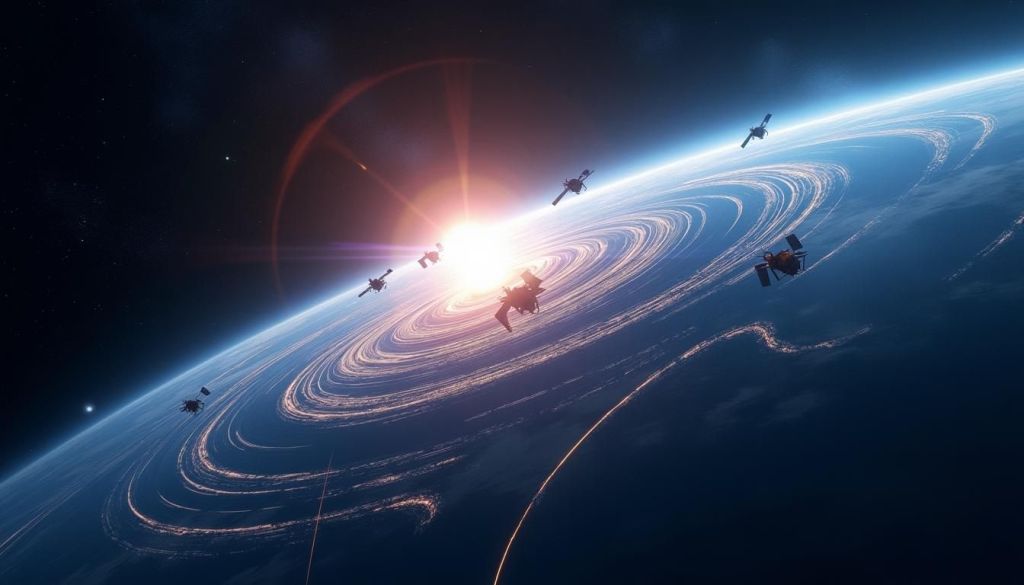
Imagine waking up one morning to find your trusty compass pointing not towards the familiar North Pole, but stubbornly towards Antarctica. Sounds like science fiction, doesn’t it? Yet, deep within the geological history of our planet, this exact scenario has played out countless times. Earth’s magnetic field, the invisible shield protecting us from harmful solar radiation and guiding navigators for centuries, isn’t static. It waxes, wanes, wanders, and, most dramatically, completely flips its polarity. This phenomenon, known as a geomagnetic reversal, is a fundamental aspect of our planet’s behaviour, a testament to the dynamic engine churning deep beneath our feet. Understanding the science behind these reversals, their historical occurrences, and their potential effects on life and technology is crucial not just for geophysicists, but for anyone curious about the powerful, hidden forces that shape our world. This isn’t about predicting an imminent apocalypse, but rather appreciating the intricate, long-term processes governing our planet and considering how they interact with life and our modern civilisation.
To grasp the concept of a reversal, we first need to understand the magnetic field itself. Think of Earth as harbouring a giant bar magnet roughly aligned with its rotational axis, with a North and South magnetic pole. This field extends thousands of kilometres out into space, forming the magnetosphere, a protective bubble that deflects the majority of charged particles streaming from the Sun (the solar wind) and high-energy cosmic rays from deep space. Without it, Earth’s atmosphere could be gradually stripped away, and surface life would be exposed to much higher levels of damaging radiation. But where does this field come from? It’s not a permanent magnet like the one on your fridge. Instead, it’s generated by the geodynamo effect. Deep inside Earth, beneath the rocky mantle, lies a core composed primarily of iron and nickel. The outer part of this core is molten liquid, swirling and convecting due to heat escaping from the solid inner core and the planet’s rotation. This movement of electrically conductive molten iron generates powerful electrical currents, which in turn create the magnetic field, much like an electrical dynamo. It’s a complex, self-sustaining process, but one that isn’t perfectly stable.
The realisation that this field hasn’t always pointed the same way emerged in the early 20th century. In 1906, French physicist Bernard Brunhes was studying ancient volcanic rocks in France. He discovered rocks whose magnetic minerals were magnetised in a direction opposite to the Earth’s current field [1]. This was puzzling. How could these rocks remember a time when ‘North’ was ‘South’? The answer lies in paleomagnetism – the study of the Earth’s past magnetic field as recorded in rocks. When volcanic lava cools, tiny crystals of magnetic minerals, like magnetite, align themselves with the prevailing magnetic field at that time, acting like microscopic compass needles. Once the rock solidifies, this magnetic orientation is locked in, preserving a snapshot of the field’s direction and intensity. Over the following decades, particularly with the study of magnetic patterns on the ocean floor in the 1950s and 60s, scientists found overwhelming evidence. As new oceanic crust forms at mid-ocean ridges and spreads outwards, it records the magnetic field’s polarity at the time of its formation. This creates symmetrical ‘stripes’ of normal and reversed polarity on either side of the ridges, providing a detailed timeline of reversals stretching back millions of years [2]. This discovery was pivotal, not only confirming reversals but also providing crucial evidence for the theory of plate tectonics. We now know that the last full reversal, known as the Brunhes–Matuyama reversal, occurred around 780,000 years ago [3]. Before that, the field was reversed (what we now call North was South) for a long period. Looking further back, the geological record shows hundreds of reversals, occurring at irregular intervals – sometimes staying in one polarity for tens of millions of years, other times flipping multiple times within a million years.
So, what actually happens during a reversal? It’s crucial to understand that it’s not an instantaneous switch. The process is believed to unfold over thousands of years, typically between 1,000 and 10,000 years [4]. It likely begins with a significant weakening of the main dipole field – the familiar North-South structure. As the main field weakens, the non-dipole components, weaker, more complex magnetic fields generated closer to the core-mantle boundary, become more prominent on the surface. This could result in a period where Earth has multiple ‘North’ and ‘South’ magnetic poles scattered across the globe, making a compass spin erratically depending on location. The overall field strength might drop to as low as 10% of its usual strength during the transition [5]. Eventually, the dipole field re-establishes itself, but with the opposite polarity. The exact mechanisms driving this complex dance within the core are still a subject of intense research and computer modelling. Scientists use sophisticated simulations trying to replicate the behaviour of the geodynamo. As Professor Richard Holme, Professor of Geomagnetism at the University of Liverpool, notes, understanding the core’s dynamics is key: “The magnetic field is generated by fluid motion in the Earth’s liquid iron core. Reversals happen when this normally stable process becomes unstable, likely due to changes in the pattern of flow” (paraphrased for clarity from general geophysics principles). These simulations suggest that reversals are a natural, albeit chaotic, consequence of the physics governing the geodynamo. Sometimes the field attempts to reverse but doesn’t fully succeed, resulting in a ‘geomagnetic excursion’ – a large wobble and weakening of the field followed by a return to the original polarity, like the Laschamp excursion around 41,000 years ago [6].
What might the effects of such a prolonged weakening and flipping of the magnetic field be? One major area of concern is the increased exposure to radiation. The magnetosphere acts as our primary shield against energetic solar particles and galactic cosmic rays. During a reversal, with the field potentially weakened to 10% of its normal strength, significantly more of this radiation would penetrate deeper into the atmosphere and reach the Earth’s surface [7]. This raises questions about potential impacts on life. Could increased radiation cause higher mutation rates or contribute to mass extinctions? The fossil record, however, shows no clear, consistent correlation between past reversals and major extinction events [8]. Life has persisted and evolved through hundreds of reversals. While individual organisms might experience slightly higher radiation doses, it seems the atmosphere itself provides substantial secondary shielding. Ozone in the stratosphere absorbs much of the harmful UV radiation, and the atmosphere as a whole slows down and absorbs many energetic particles. There are some suggestions that increased cosmic rays could potentially influence cloud formation or atmospheric chemistry, possibly leading to subtle climate shifts [9], but the evidence remains debated and inconclusive. It seems unlikely that a reversal itself would trigger a catastrophic environmental disaster as sometimes depicted in fiction. As the U.S. Geological Survey states, “The geologic record shows no catastrophes associated with past reversals. Life has existed through many reversals, and there’s no reason to think the next one would be different” [10].
However, the effects on our modern technological civilisation might be more noticeable. We rely heavily on technologies vulnerable to space weather – the fluctuating conditions in space driven by solar activity. Satellites orbiting Earth are constantly bombarded by radiation, and a weakened magnetic field would significantly increase this exposure, potentially shortening their lifespan, causing malfunctions, or requiring more robust shielding [11]. Astronauts, particularly those outside the protection of the main Van Allen radiation belts (like on missions to the Moon or Mars), would face increased radiation hazards. Down on Earth, increased fluxes of charged particles interacting with the upper atmosphere can induce currents in long electrical conductors. Power grids could become more vulnerable to geomagnetically induced currents (GICs), which can overload transformers and cause widespread blackouts, similar to the one triggered by a solar storm in Quebec in 1989, but potentially more frequent or severe during a reversal [12]. Navigation systems could also be affected. While GPS relies on satellites (which themselves could be impacted), traditional magnetic compasses would become unreliable during the transitional phase with multiple or wandering poles. Perhaps more fundamentally, many animal species rely on the Earth’s magnetic field for navigation and migration. Birds, sea turtles, salmon, bees, and even some mammals possess a sense called magnetoreception [13]. How would a weakened, chaotic, and eventually flipped field affect them? Studies suggest that some animals might use field intensity or inclination angle rather than just polarity, potentially allowing them to adapt [14]. However, a prolonged period of a weak and confusing field could certainly disrupt migration patterns and pose challenges for survival for some species. It’s an area needing much more research, but it highlights how deeply Earth’s magnetism is intertwined with the biosphere.
Looking at the current state of the magnetic field, we observe some intriguing changes. Over the last couple of centuries, the overall strength of the dipole field has decreased by about 10-15% [15]. Furthermore, the North Magnetic Pole is currently drifting away from Arctic Canada towards Siberia at an accelerating rate – now moving at around 55 kilometres per year, compared to about 15 km/year in the mid-20th century [16]. Does this herald an impending reversal or excursion? While these changes are significant on human timescales, they are quite typical when viewed against the long geological record of magnetic field behaviour. Field strength fluctuates considerably, and the poles wander constantly. Current weakening is not necessarily a prelude to an immediate reversal, which, as mentioned, takes thousands of years to complete. As Ciaran Beggan, a geomagnetism specialist at the British Geological Survey, puts it, “Predictions range from the field continuing to decay and reversing in the next couple of thousand years, to it recovering strength… Geomagnetic reversals are geologically instantaneous, but on a human timescale, they are very slow” [17]. While the current weakening is faster than average over the past few millennia, similar or faster rates have occurred in the past without leading to a full reversal. We might be seeing the beginnings of a reversal, or perhaps just a significant fluctuation or the lead-up to an excursion. Continued monitoring by satellites like the European Space Agency’s Swarm constellation [18] and ground-based observatories is crucial for tracking these changes and improving our models of the geodynamo.
In analysing the implications, it’s important to maintain perspective. Geomagnetic reversals are a natural part of Earth’s planetary processes, driven by the complex fluid dynamics deep within its core. They are not sudden, apocalyptic events but slow transitions occurring over millennia. While a weakened field during a reversal would increase radiation exposure at the surface and in orbit, our atmosphere provides significant protection, and life has weathered countless such events in the past. The most significant direct impacts are likely to be on our technology – satellites, power grids, and navigation systems would need to be more resilient to cope with enhanced space weather effects. The irregular timing of reversals makes prediction difficult; while the field has weakened recently and the last full reversal was quite a long time ago by historical standards, there’s no indication that a flip is imminent within the next few centuries. The current changes, particularly the rapid drift of the North Magnetic Pole, are fascinating indicators of the dynamic processes within the core, but they don’t signal immediate danger. The real value lies in understanding these long-term planetary rhythms and how they shape the environment we inhabit.
To conclude, the science of geomagnetic reversals unveils a hidden dynamism within our planet. Far from being static, Earth’s magnetic field is constantly evolving, generated by the turbulent flow of molten iron deep underground. The geological record, etched into ancient rocks and seafloor sediments, tells a story of countless polarity flips throughout Earth’s history. These reversals, unfolding over thousands of years, involve a weakening of the main field and a period of multi-polar complexity before the field re-establishes itself in the opposite direction. While not linked to mass extinctions, a reversal would increase radiation levels and pose significant challenges for our technologically dependent society, impacting satellites and power grids. Current observations show a weakening field and a rapidly drifting North Magnetic Pole, prompting intense scientific scrutiny but not signalling an immediate flip. Understanding these grand, slow processes reminds us that Earth is a constantly changing system. It challenges us to consider the long-term forces that operate beyond human timescales and prompts a crucial question: As we continue to unravel the mysteries of the geodynamo, what other profound, slow-motion planetary changes might be underway, subtly reshaping the future of our world?
References and Further Reading:
- Brunhes, B. (1906). Recherches sur la direction d’aimantation des roches volcaniques. Journal de Physique Théorique et Appliquée, 5(1), 705-724. (Note: This is the original historical reference, often cited in reviews).
- Vine, F. J., & Matthews, D. H. (1963). Magnetic anomalies over oceanic ridges. Nature, 199(4897), 947-949.
- Singer, B. S. (2014). A Quaternary geomagnetic instability time scale. Quaternary Geochronology, 21, 29-52. DOI: 10.1016/j.quageo.2013.10.003
- Clement, B. M. (2004). Dependence of the duration of geomagnetic polarity reversals on site latitude. Nature, 428(6983), 637-640. DOI: 10.1038/nature02459
- Valet, J. P., Meynadier, L., & Guyodo, Y. (2005). Geomagnetic field strength and reversal rate over the past two million years. Nature, 435(7043), 802-805. DOI: 10.1038/nature03674
- Stoner, J. S., & Channell, J. E. T. (2003). The Laschamp excursion (41,000 yr BP): paleointensity estimate from the Labrador Sea. Earth and Planetary Science Letters, 207(1-4), 19-33. DOI: 10.1016/S0012-821X(02)01142-6
- Glassmeier, K. H., & Vogt, J. (2010). Magnetic polarity transitions and atmospheric ozone: A connection? Space Science Reviews, 155(1-4), 387-410. DOI: 10.1007/s11214-010-9693-6
- Courtillot, V., & Olson, P. (2007). Mantle plumes link magnetic field reversals to conventions and core heat loss. Earth and Planetary Science Letters, 260(3-4), 495-504. (Discusses links, often finding weak correlation with mass extinctions).
- Svensmark, H. (2007). Cosmoclimatology: a new theory emerges. Astronomy & Geophysics, 48(1), 1.18-1.24. (Note: This link is controversial and heavily debated within the scientific community).
- U.S. Geological Survey. (n.d.). Geomagnetic Polarity Reversals. USGS Geomagnetism Program. Retrieved from https://www.usgs.gov/programs/geomagnetism/geomagnetic-polarity-reversals
- NASA Science. (2011, October 4). Earth’s Inconstant Magnetic Field. NASA. Retrieved from https://science.nasa.gov/science-news/science-at-nasa/2003/29dec_magneticfield (Discusses field changes and space weather).
- Boteler, D. H. (2019). Geomagnetic Hazards. In Geomagnetism, Aeronomy and Space Weather. Springer, Cham. pp. 349-385. DOI: 10.1007/978-3-319-99343-0_11
- Wiltschko, R., & Wiltschko, W. (2019). Magnetoreception in birds. Journal of the Royal Society Interface, 16(158), 20190295. DOI: 10.1098/rsif.2019.0295
- Lohmann, K. J., Lohmann, C. M. F., & Putman, N. F. (2007). Magnetic maps in animals: a theory takes shape. Journal of Comparative Physiology A, 193(10), 1027-1035. DOI: 10.1007/s00359-007-0262-1
- Finlay, C. C., Kloss, C., Olsen, N., Hammer, M. D., Tøffner-Clausen, L., Grayver, A., & Kuvshinov, A. (2020). The CHAOS-7 geomagnetic field model and observed changes in the South Atlantic Anomaly. Earth, Planets and Space, 72(1), 156. DOI: 10.1186/s40623-020-01252-9
- Livermore, P. W., Finlay, C. C., & Bayliff, M. (2020). Recent north magnetic pole acceleration towards Siberia caused by flux lobe elongation. Nature Geoscience, 13(5), 387-391. DOI: 10.1038/s41561-020-0570-9
- British Geological Survey. (n.d.). Geomagnetic Reversals. BGS. Retrieved from https://www.bgs.ac.uk/discovering-geology/earth-hazards/geomagnetism/geomagnetic-reversals/ (Provides accessible overview and context).
- European Space Agency. (n.d.). Swarm. ESA. Retrieved from https://www.esa.int/Applications/ObservingtheEarth/Swarm (Information on the satellite mission monitoring the field).





 Conversations with AI
Leave a comment