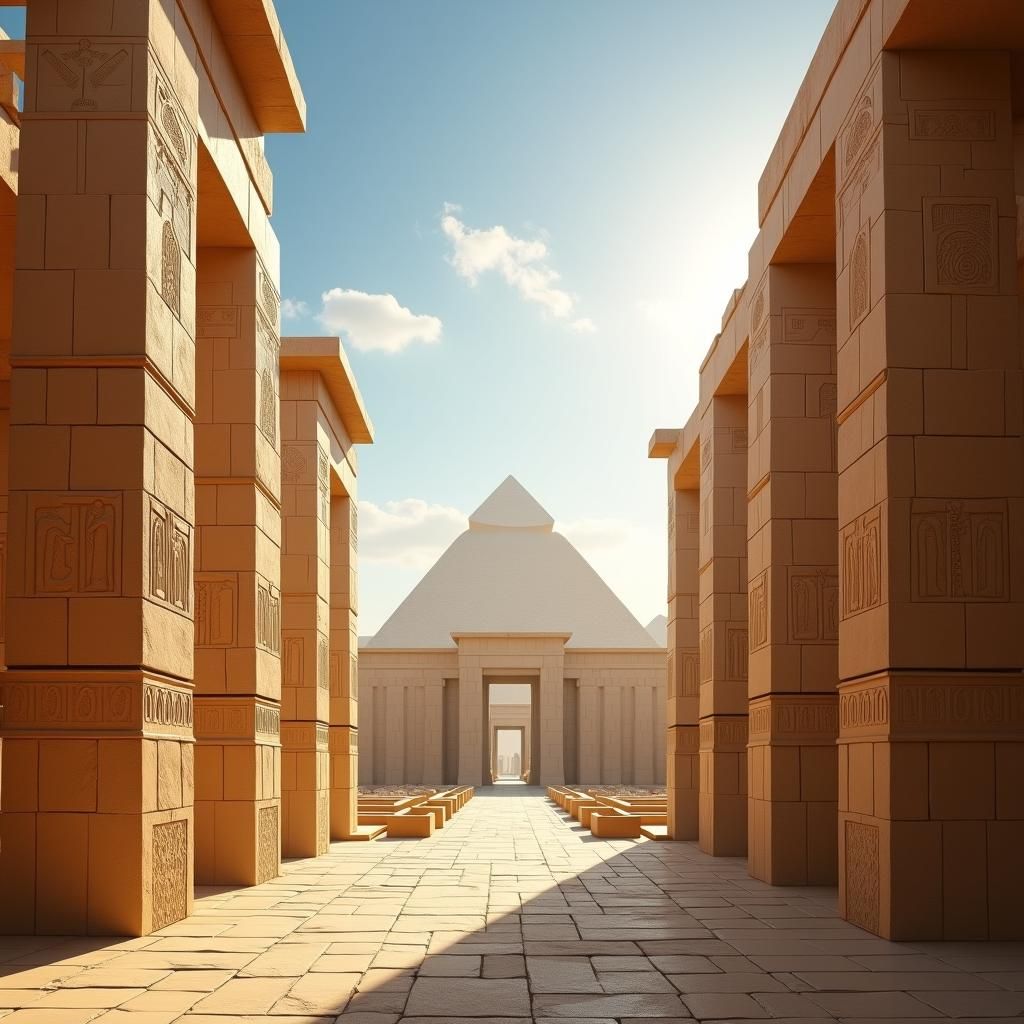
Imagine standing before a structure so vast, so ancient, that it seems almost alien. Picture the Great Pyramid of Giza, perfectly aligned with the cardinal points, its sheer scale baffling engineers even today. Or wander, in your mind’s eye, through the colossal Hypostyle Hall at Karnak Temple, a forest of gigantic stone columns carved with intricate scenes. These are not mere buildings; they are enduring testaments to the ingenuity, power, and unique worldview of the ancient Egyptians. Their architectural achievements, born from the fertile banks of the Nile thousands of years ago, were not only groundbreaking for their time but have continued to echo through history, influencing design and capturing the human imagination. Understanding their contributions is more than just a history lesson; it’s about appreciating the foundations upon which much of Western architecture was built and recognising the incredible capacity of human creativity and organisation in the face of immense challenges. This exploration delves into the heart of ancient Egyptian architecture, uncovering the techniques, beliefs, and innovations that allowed them to shape stone into eternity.
To truly grasp the Egyptians’ architectural prowess, we need to step back into their world, a civilisation uniquely shaped by the River Nile and its predictable rhythms. Flourishing from around 3100 BCE with the unification of Upper and Lower Egypt, the civilisation is typically divided into key periods: the Early Dynastic Period, the Old Kingdom (c. 2686–2181 BCE), the First Intermediate Period, the Middle Kingdom (c. 2055–1650 BCE), the Second Intermediate Period, the New Kingdom (c. 1550–1069 BCE), the Third Intermediate Period, and the Late Period, before falling under foreign rule. It was during the Old Kingdom that the most iconic pyramids were constructed, showcasing a mastery of large-scale stone construction early in their history. The New Kingdom saw the focus shift towards elaborate temple complexes, such as Karnak and Luxor, dedicated to the gods and the divine pharaoh. The landscape itself played a crucial role. The Nile valley provided fertile black land (Kemet) for agriculture, supporting a large population, while the surrounding deserts (Deshret) offered abundant stone – limestone primarily, but also sandstone further south, and hard granite from Aswan. Mudbrick, formed from Nile silt and dried in the sun, was the primary material for everyday buildings like houses and palaces, which is why fewer of these survive compared to the stone-built ‘eternal’ structures like tombs and temples [1]. Central to understanding why the Egyptians built on such a monumental scale is their deep-seated religious belief system. The pharaoh was considered a living god, the intermediary between the divine and the mortal realms, responsible for maintaining Ma’at – the cosmic order, truth, and justice. Tombs were built as eternal homes for the deceased, particularly the pharaoh, equipped for the afterlife. Temples were houses for the gods on Earth, where rituals were performed to maintain Ma’at and ensure the continued prosperity of Egypt. This religious imperative, combined with centralised state power vested in the pharaoh, provided both the motivation and the means for these colossal undertakings.
The sheer size and precision of structures like the Giza pyramids have fuelled speculation for centuries, but archaeological evidence points towards remarkable organisation and skill, rather than mystical means. The workforce wasn’t primarily composed of slaves, as often depicted in popular culture. Instead, it involved a large contingent of skilled artisans, engineers, surveyors, and a rotating workforce of Egyptian farmers, likely conscripted during the annual Nile inundation when agricultural work was impossible [2]. Excavations of workers’ villages near Giza, led by Egyptologist Mark Lehner, have revealed evidence of well-organised communities with barracks, bakeries, and cemeteries, suggesting the labourers were relatively well-cared-for state employees engaged in a national project [3]. Lehner notes, “The pyramid builders were not slaves… They were builders, conscripted, perhaps, fed, clothed and housed by the state” [3]. Building these monuments required quarrying unimaginable quantities of stone. Softer limestone and sandstone were quarried using copper (later bronze) chisels and saws, often aided by sand as an abrasive. For harder granite, used for sarcophagi, obelisks, and lining chambers, they employed incredibly laborious techniques, pounding the stone with hard dolerite balls and using fire and water to crack the rock. Wooden wedges, soaked with water to make them expand, were also used to split stone blocks along predetermined lines [4]. Transporting multi-tonne blocks was another feat. Evidence suggests blocks were hauled overland on large wooden sledges. Experiments, and depictions like one in a Middle Kingdom tomb at Deir el-Bersha, show water being poured on the sand in front of the sledge to reduce friction significantly [5]. For longer distances, especially for granite from Aswan, the Nile was the main highway, with blocks loaded onto massive barges.
The fundamental structural system employed by the Egyptians was the post-and-lintel (or trabeated) system. This involves strong horizontal elements (lintels) supported by strong vertical elements (posts or columns), creating openings. While simple in concept, the Egyptians elevated it to an art form, particularly in their temples. The vast hypostyle halls, like the Great Hypostyle Hall at Karnak with its 134 massive columns arranged in 16 rows, are breathtaking examples [6]. These columns weren’t just structural; they were deeply symbolic, often carved to resemble plants native to the Nile valley. Common forms include papyrus bundles (both closed-bud and open-flower, known as campaniform), lotus flowers, and palmiform columns mimicking palm fronds [7]. These organic forms symbolically recreated the mythical marshy environment of creation within the temple precinct. The columns, often reaching heights of over 20 metres, supported huge stone architraves and roofing slabs, creating awe-inspiring internal spaces.
Perhaps no architectural form is more synonymous with ancient Egypt than the pyramid. These were not isolated inventions but the culmination of earlier burial architecture. The precursor was the mastaba, a rectangular, flat-topped structure built over a burial shaft. During the Third Dynasty, around 2650 BCE, the brilliant architect Imhotep, serving Pharaoh Djoser, stacked several mastabas of decreasing size on top of one another, creating the world’s first large-scale stone monument – the Step Pyramid at Saqqara [1]. This was a revolutionary leap. The transition to the smooth-sided true pyramid occurred during the Fourth Dynasty. Pharaoh Sneferu experimented with the form, building the collapsed pyramid at Meidum, the distinctive Bent Pyramid at Dahshur (which changed angle part-way up), and finally, the first successful true pyramid, the Red Pyramid, also at Dahshur [8]. His son, Khufu, then built the largest of them all, the Great Pyramid of Giza, followed by the pyramids of Khafre (which appears taller due to being on higher ground and retaining some of its casing stones) and Menkaure. The construction methods remain debated, but most theories involve ramps for hauling the stones – perhaps a single long, straight ramp, a ramp that zigzagged up one face, or even an internal ramp spiralling within the pyramid’s structure, as proposed by architect Jean-Pierre Houdin [9]. Whatever the method, the precision is astonishing. The base of the Great Pyramid is almost perfectly level, and its sides are aligned to the cardinal points with remarkable accuracy, demonstrating the Egyptians’ sophisticated understanding of surveying and practical geometry. Mark Lehner states, regarding the Giza plateau, “It is the product of a sophisticated society, well organised, with specialists, managers, and a clear chain of command” [3].
Another uniquely Egyptian architectural element is the obelisk. These are tall, four-sided, tapering monolithic pillars, typically carved from a single piece of red granite from Aswan, ending in a pyramid-shaped top called a pyramidion, which was often gilded to catch the sun’s rays. Obelisks were usually erected in pairs at the entrances of temples and were associated with the sun god Ra, symbolising rays of sunlight and stability [7]. Quarrying and transporting these massive monoliths, some weighing hundreds of tonnes, was an immense challenge. Raising them upright likely involved complex systems of ropes, levers, and earthen ramps. The largest surviving example still in Egypt stands at Karnak Temple, erected by Queen Hatshepsut, and originally had a twin [6]. Many ancient Egyptian obelisks were later transported to other parts of the world, standing today in cities like Rome, Paris, London, and New York.
Egyptian temples followed a relatively standard plan, evolving over time but generally representing a journey from the chaotic outside world to the sacred, ordered inner sanctuary. Worshippers would typically pass through massive gateway towers called pylons, often adorned with reliefs depicting the pharaoh victorious over enemies. These led into an open peristyle courtyard, accessible to a wider public during festivals. Moving deeper, one entered the covered hypostyle hall, its dense columns creating a dim, impressive atmosphere, accessible only to priests and officials. Beyond this lay the inner sanctuary, the ‘holy of holies,’ housing the cult statue of the god, shrouded in darkness and accessible only to the high priest and the pharaoh [10]. The entire temple complex was often enclosed by a high mudbrick wall. An ingenious feature often employed in hypostyle halls was clerestory lighting. The central rows of columns were taller than the side rows, allowing for openings high in the walls between the different roof levels. These slatted stone windows permitted shafts of light to penetrate the otherwise dim interior, creating dramatic illumination effects [7]. Temple walls, both inside and out, as well as columns and ceilings, were extensively decorated with brightly painted carved reliefs and hieroglyphs. These weren’t merely decorative but served crucial functions: illustrating religious myths, depicting rituals performed by the pharaoh to appease the gods, recording historical events (often from a propagandistic viewpoint), and providing magical protection through sacred texts [1]. The use of sunk relief, where the figures are carved below the level of the surrounding stone surface, was particularly effective in the bright Egyptian sunlight, creating strong shadows and ensuring the carvings endured weathering.
The construction of such precisely aligned and massive structures clearly required advanced practical knowledge of mathematics and engineering. While we lack texts detailing abstract mathematical theories like those of the later Greeks, surviving papyri, such as the Rhind Mathematical Papyrus, show the Egyptians had sophisticated methods for calculation, including fractions, geometry (calculating areas and volumes), and basic algebra, all geared towards practical problems like land surveying and resource calculation [11]. Surveying skills were essential, particularly for re-establishing field boundaries after the annual Nile flood and for laying out the foundations of temples and pyramids with precise orientations. Astronomical observation played a key role in aligning structures, especially pyramids, to the cardinal points or specific celestial events. The standard unit of length was the royal cubit (around 52 cm), subdivided into palms and digits, ensuring standardisation across major building projects [4]. The Egyptians were master builders who developed empirical, effective solutions to complex engineering challenges through generations of experience.
The enduring legacy of ancient Egyptian architecture is undeniable. Their monumental structures were designed for eternity, expressing profound religious beliefs and the immense power of the pharaohs. They demonstrated an exceptional ability to organise labour and resources, quarry and transport unimaginable weights of stone, and achieve remarkable precision using relatively simple tools combined with immense skill and practical knowledge. The visual language they developed – pylons, obelisks, papyrus and lotus columns, hieroglyphic inscriptions, specific temple layouts – created instantly recognisable and awe-inspiring environments intended to maintain cosmic order and guide the deceased into the afterlife. While some mysteries remain, particularly regarding the exact methods used to construct the pyramids, ongoing archaeological work continues to shed light on their incredible achievements. Their innovations weren’t just confined to antiquity. The grandeur and symbolism of Egyptian architecture sparked fascination in later cultures, notably the Romans, who transported numerous obelisks to Rome. A significant ‘Egyptian Revival’ occurred in the 19th and early 20th centuries, influencing decorative arts, furniture, and architecture across Europe and America, seen in everything from cemetery gates to cinemas and Masonic temples [12]. This enduring appeal speaks to the fundamental power of the forms and symbols the Egyptians created.
In conclusion, the ancient Egyptians were far more than just builders of pyramids. They were pioneers of monumental stone architecture, developing sophisticated quarrying, transport, and construction techniques driven by their unique religious beliefs and societal structure. From the evolution of the pyramid form and the symbolic forests of columns in their temples to the monolithic obelisks piercing the sky, their contributions fundamentally shaped the built environment of their time. They mastered the post-and-lintel system on an unprecedented scale, integrated intricate decorative schemes with structural forms, and applied practical mathematics and engineering to achieve astounding precision and longevity. Their work wasn’t just about shelter or function; it was architecture as a statement of power, a pathway to the divine, and a means of achieving immortality. The stone structures they left behind continue to dwarf the millennia, challenging our perceptions of the past and standing as powerful reminders of a civilisation that truly built for eternity. What might we, in our own age of advanced technology, learn from their focused dedication, organisational prowess, and ambition to leave a mark that lasts forever?
References and Further Reading:
- Shaw, Ian. The Oxford History of Ancient Egypt. Oxford University Press, 2003.
- David, Rosalie. Handbook to Life in Ancient Egypt. Revised Edition, Facts On File, 2003.
- Lehner, Mark. The Complete Pyramids: Solving the Ancient Mysteries. Thames & Hudson, 2008.
- Arnold, Dieter. Building in Egypt: Pharaonic Stone Masonry. Oxford University Press, 1991.
- Fall, A., B. Weber, M. Pakpour, N. Lenoir, N. Shahidzadeh, J. Fiscina, C. Wagner, and D. Bonn. “Sliding Friction on Wet and Dry Sand.” Physical Review Letters 112, no. 17 (2014): 175502. (This paper scientifically demonstrated the wet sand technique).
- Wilkinson, Richard H. The Complete Temples of Ancient Egypt. Thames & Hudson, 2000.
- Arnold, Dieter. The Encyclopedia of Ancient Egyptian Architecture. Translated by Sabine H. Gardiner and Helen Strudwick. Princeton University Press, 2003.
- Verner, Miroslav. The Pyramids: The Mystery, Culture, and Science of Egypt’s Great Monuments. Grove Press, 2001.
- Houdin, Jean-Pierre. Khufu: The Secrets Behind the Building of the Great Pyramid. Farid Atiya Press, 2006. (Presents the internal ramp theory).
- Baines, John, and Jaromír Málek. Cultural Atlas of Ancient Egypt. Revised Edition, Checkmark Books, 2000.
- Imhausen, Annette. Mathematics in Ancient Egypt: A Contextual History. Princeton University Press, 2016.
- Curl, James Stevens. The Egyptian Revival: Ancient Egypt as the Inspiration for Design Motifs in the West. Routledge, 2005.





 Conversations with AI
Leave a comment