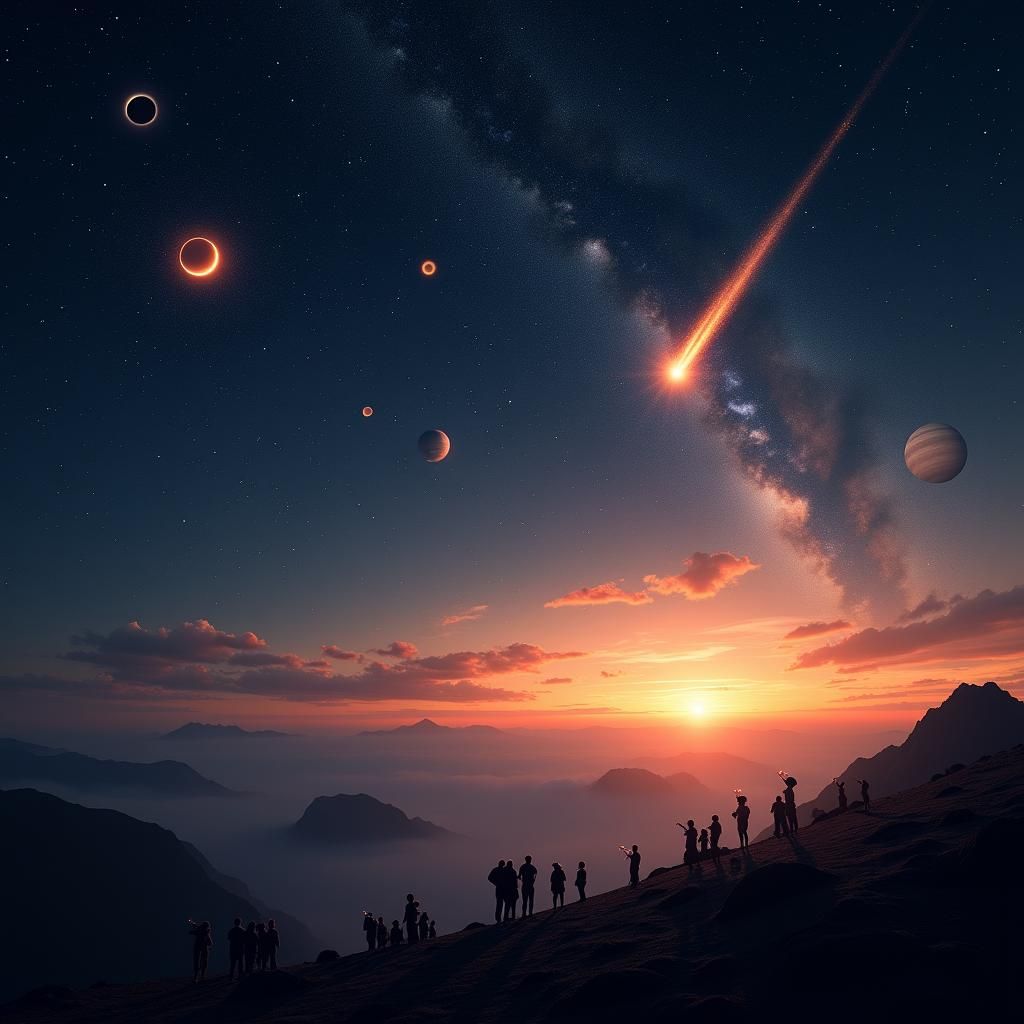
Imagine stepping outside on a crisp, clear night and gazing up at the stars. Now, imagine knowing that in the next decade, that same sky will host some of the most spectacular astronomical events of the 21st century. From jaw-dropping eclipses to rare planetary alignments and close encounters with asteroids, the next ten years promise a celestial showcase that will captivate both seasoned stargazers and curious newcomers alike. This blog post will guide you through these unmissable events, explaining their significance and how you can witness them. Whether you’re a teenager with a budding interest in space or simply someone who loves a good cosmic light show, the coming decade has something extraordinary in store.
Astronomy has always been a gateway to understanding our place in the universe. Ancient civilisations tracked the movements of planets and stars to mark seasons, navigate oceans, and weave myths. Today, while we no longer rely on the stars for practical daily needs, astronomical events still hold a unique fascination. They remind us of the vast, dynamic cosmos we inhabit—and the next decade will offer plenty of reminders. Advances in technology mean we can predict these events with pinpoint accuracy, while social media and livestreams allow global audiences to share the experience. But what makes the 2020s and early 2030s particularly special? Let’s dive in.
One of the most anticipated events is the total solar eclipse on 8 April 2024, which will sweep across North America, from Mexico through the United States and into Canada. Total solar eclipses occur when the Moon passes directly between the Earth and the Sun, casting a shadow that briefly turns day into night. The 2024 eclipse is notable for its exceptionally long totality—up to 4 minutes and 28 seconds in certain areas—making it one of the longest totality durations in recent history. Dr. Patricia Reiff, a space physicist at Rice University, notes, “Eclipses are not just awe-inspiring; they’ve been crucial for scientific discoveries, like confirming Einstein’s theory of relativity” [1]. If you miss this one, mark your calendar for 2 August 2027, when another total eclipse will be visible from Spain, North Africa, and the Arabian Peninsula, offering up to 6 minutes of totality [2].
But eclipses are just the beginning. In 2029, the asteroid 99942 Apophis, a 340-metre-wide space rock, will pass within 32,000 kilometres of Earth—closer than some satellites. Initially thought to pose a slight risk of impact in 2068, refined calculations have ruled this out, but its 2029 flyby will be a historic opportunity for study. “Apophis will be visible to the naked eye in parts of Europe, Africa, and Asia,” explains Dr. Lance Benner of NASA’s Jet Propulsion Laboratory. “It’s a once-in-a-millennium event for an asteroid of this size” [3]. Scientists plan to use radar and optical telescopes to analyse its composition, shedding light on the early solar system.
The 2030s will also treat us to a rare alignment of all five naked-eye planets—Mercury, Venus, Mars, Jupiter, and Saturn—in June 2030. Such a “planetary parade” last occurred in 2020, but the 2030 alignment will be particularly striking, with the planets clustered tightly in the pre-dawn sky. These alignments are more than just pretty sights; they’ve historically driven advancements in orbital mechanics. Johannes Kepler’s observations of planetary motions in the early 1600s, for instance, laid the groundwork for Newton’s laws of gravity [4].
Comet enthusiasts, meanwhile, have reason to celebrate. Comet Tsuchinshan-ATLAS, discovered in 2023, is projected to make its closest approach to the Sun in September 2024. If it survives the encounter, it could become one of the brightest comets since Comet NEOWISE in 2020, with a tail stretching across the sky. Comets are icy relics from the solar system’s formation, and studying their composition can reveal clues about Earth’s water and organic molecules. As Dr. Emily Kramer of NASA’s NEOWISE mission puts it, “Every comet is a time capsule. When one arrives, it’s like getting a delivery from the past” [5].
Another highlight will be the occultation of Uranus by Mars on 15 February 2034, a rare event where Mars will pass directly in front of Uranus from Earth’s perspective. While Uranus will be too faint to see without binoculars, the occultation will allow astronomers to study both planets’ atmospheres in detail. Such events are invaluable for refining measurements of planetary orbits and atmospheric properties [6].
Meteor showers, though annual, will have standout years. The Perseids in August 2027 are expected to produce up to 150 meteors per hour under ideal conditions, thanks to Earth passing through a dense debris trail left by Comet Swift-Tuttle. Similarly, the Geminids in December 2030 could rival this rate, offering a winter spectacle. Meteor showers occur when Earth crosses the debris left by comets or asteroids, and their study helps scientists understand the composition of these parent bodies [7].
Looking further ahead, the transit of Mercury on 13 November 2032 will see the tiny planet glide across the Sun’s face—a event observable with proper solar filters. Transits helped 18th-century astronomers calculate the distance between Earth and the Sun, a measurement known as the astronomical unit [8]. Today, they’re used to calibrate instruments for exoplanet research.
The Great Solar Storm of the 2030s—while not a single event—is a looming possibility. Solar activity follows an 11-year cycle, with the next peak (Solar Maximum) due around 2025 and another in the mid-2030s. Intense solar storms can disrupt satellites, power grids, and communications. The infamous 1859 Carrington Event, which caused telegraph lines to spark and auroras visible in the tropics, serves as a reminder of our vulnerability. Dr. Mike Hapgood of the British Geological Survey warns, “We’re more technologically dependent than ever. A major storm today could cause trillions in damage” [9].
But let’s not forget the human angle. These events inspire wonder and curiosity, bridging cultures and generations. The 2024 eclipse, for instance, is expected to draw millions of spectators, echoing the 2017 “Great American Eclipse” that united people across the U.S. in shared awe. Schools and astronomy clubs worldwide will likely organise viewing parties, fostering a sense of global community.
However, not all events are purely celebratory. Apophis’s close approach, while harmless, highlights planetary defence efforts. NASA’s DART mission, which successfully altered an asteroid’s orbit in 2022, demonstrated our growing capability to mitigate potential threats [10]. The 2029 flyby will test our tracking systems and public communication strategies—key skills if a future asteroid ever poses a real risk.
Controversies exist too. Some critics argue that hyping rare events risks overshadowing the steady, less glamorous work of astronomy—like monitoring near-Earth objects or studying climate change through planetary atmospheres. Others worry light pollution, now affecting 80% of the global population [11], could diminish these experiences. Dr. Fabio Falchi, a light pollution researcher, notes, “A child born today in a city might never see the Milky Way. We’re losing our connection to the cosmos” [12].
What does this mean for you? First, seize the chance to witness these events. Many require minimal equipment: a pair of eclipse glasses, a telescope app, or just a clear sky. Second, consider their broader implications. Each eclipse, comet, or planetary alignment is a reminder that we’re part of a dynamic, ever-changing universe—one that still holds countless mysteries.
In closing, the next decade’s astronomical calendar is a testament to both the predictability and the surprises of our cosmos. From the precise clockwork of eclipses to the wildcard arrival of comets, these events invite us to look up and ponder. They connect us to our ancestors who marvelled at the same skies and to future generations who will build on today’s discoveries. As you read this, somewhere an asteroid is hurtling through space, a comet is warming under the Sun’s rays, and the Moon’s shadow is racing toward Earth. The question is: will you be watching?
References and Further Reading
- NASA Eclipse Science Overview, https://eclipse.gsfc.nasa.gov/SEhelp/safety2.html
- Royal Astronomical Society, “Eclipse 2027: A Guide”, https://ras.ac.uk
- NASA Jet Propulsion Laboratory, “Apophis 2029 Flyby”, https://www.jpl.nasa.gov
- Encyclopaedia Britannica, “Johannes Kepler”, https://www.britannica.com
- ESA Comet Atlas Mission, https://www.esa.int
- Sky & Telescope, “Planetary Occultations”, https://skyandtelescope.org
- American Meteor Society, https://www.amsmeteors.org
- Royal Museums Greenwich, “Transit of Mercury”, https://www.rmg.co.uk
- British Geological Survey, Space Weather Reports, https://www.bgs.ac.uk
- NASA DART Mission Update, https://www.nasa.gov
- International Dark-Sky Association, https://www.darksky.org
- Falchi, F. et al., “The New World Atlas of Artificial Night Sky Brightness”, Science Advances, 2016.



 Conversations with AI
Leave a comment