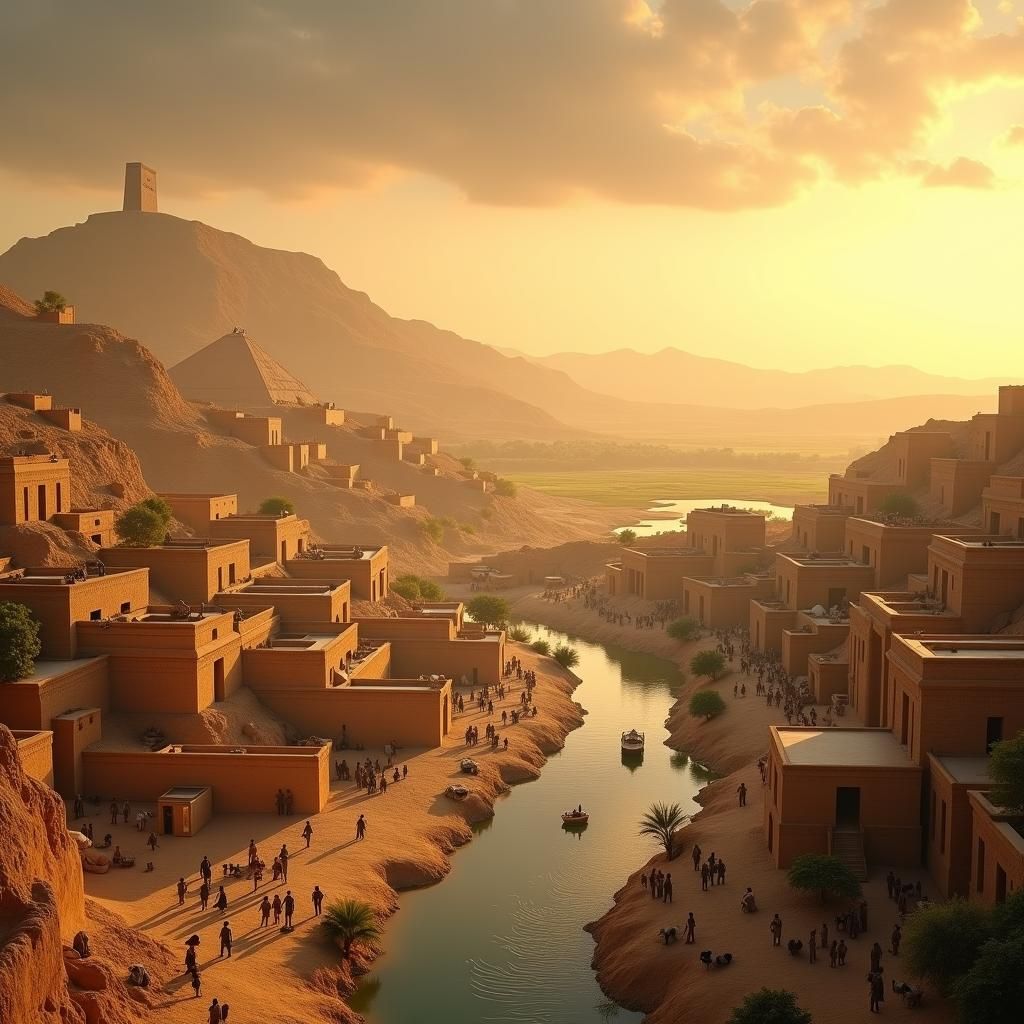
Imagine a world without laws, bureaucracies, or even the concept of cities. No mayors, no courts, no written rules to settle disputes. That’s the reality humans lived in for tens of thousands of years—until around 3500 BCE, when something extraordinary happened in the dusty plains between the Tigris and Euphrates rivers. The ancient Mesopotamians didn’t just invent the wheel or writing; they essentially created the blueprint for how societies govern themselves. From tax collection to legal codes, their innovations still shape how countries operate today. For teenagers growing up in a world of voter registration apps and parliamentary debates, understanding Mesopotamia’s contributions isn’t just about dusty history books—it’s about seeing where the very idea of “government” began.
Mesopotamia—literally “the land between the rivers” in Greek—covered modern-day Iraq, Kuwait, and parts of Syria and Turkey. This region saw the rise and fall of several influential civilisations between 3500 BCE and 539 BCE, including the Sumerians, Akkadians, Babylonians, and Assyrians. What made Mesopotamia unique wasn’t just its fertile soil but its need for organisation. Annual floods from the Tigris and Euphrates required coordinated irrigation systems, which led to the world’s first cities like Uruk and Ur. As populations grew, so did the complexity of managing resources, resolving conflicts, and maintaining order. Out of this chaos emerged governance structures so sophisticated that a Babylonian tax collector from 1800 BCE could probably navigate a modern bureaucracy with minimal training.
One of Mesopotamia’s most revolutionary ideas was bureaucracy—a word that might make modern teens groan but was utterly groundbreaking at the time. The Sumerians, around 3200 BCE, developed cuneiform writing primarily for administrative purposes. Temple officials used clay tablets to track grain harvests, livestock, and labour assignments. A tablet from the city of Lagash lists 6,000 workers and their daily beer rations, proving even ancient bureaucrats loved a good spreadsheet. This record-keeping allowed for resource distribution during famines and audits to prevent corruption. As historian Marc Van De Mieroop notes, “The Mesopotamians didn’t invent writing to write poetry; they invented it to keep track of barley.” [1]
Legal systems also took root here. The Code of Ur-Nammu (c. 2100 BCE), from the Sumerian city of Ur, is the oldest surviving law code. It established fines for bodily harm instead of tribal vengeance—a major shift towards state-administered justice. But it’s the Code of Hammurabi (c. 1754 BCE) that truly showcases Mesopotamian legal thinking. Carved on a 2.25-metre basalt stele, its 282 laws covered everything from property disputes to marital rights. The famous “eye for an eye” principle (law 196) actually applied only to equals; harming a lower-class person incurred mere fines. While this hierarchy seems unfair today, it introduced the radical idea that laws should be publicly displayed and consistently applied. As legal scholar Martha Roth observes, “Hammurabi’s code wasn’t about equality—it was about predictability.” [2]
City-states like Ur and Babylon functioned as independent political units with their own governments, much like modern Singapore or Monaco. Each had a ruler (ensi or lugal), a bureaucracy, and a patron deity. Temples doubled as economic hubs, storing surplus grain and redistributing it during lean times. Conflicts between city-states over water rights led to early diplomatic practices, including treaties carved on stone tablets. The Epic of Gilgamesh, humanity’s oldest surviving epic, even depicts a primitive parliament where elders and young men debate whether to go to war—a startling echo of modern legislative processes. [3]
Kingship evolved dramatically here. Early Sumerian rulers were priest-like figures managing temple economies. But by 2300 BCE, Sargon of Akkad had created history’s first empire, stretching from the Persian Gulf to the Mediterranean. His administration used standardised weights and measures, installed governors in conquered cities, and maintained a standing army—all concepts foundational to modern states. Later Assyrian kings like Tiglath-Pileser III (ruled 745–727 BCE) introduced provincial systems and a royal mail service, essentially creating an Iron Age version of federalism. [4]
The Mesopotamians also pioneered administrative technologies. They used cylinder seals as signatures, developed standardised contracts for business deals, and even had a form of census-taking. Tax collection was systematised, with the palace demanding a portion of crops, livestock, and labour. A Babylonian tablet from Sippar details a tax exemption for a widow—proof that bureaucracy could have a human face. [5]
But what does this mean for us today? Mesopotamian governance models spread through trade and conquest, influencing the Greeks, Romans, and ultimately modern democracies. Their concept of written laws underpins everything from national constitutions to school codes of conduct. The bureaucratic systems they devised to manage irrigation evolved into today’s civil services. Even their struggles—corruption, balancing central authority with local needs, managing multi-ethnic populations—feel eerily contemporary.
However, it wasn’t all progress. Mesopotamian societies were deeply hierarchical, with slaves and women having limited rights. Hammurabi’s Code, while advanced for its time, prescribed the death penalty for theft and allowed husbands to drown adulterous wives. The Assyrians used brutal tactics to suppress rebellions, foreshadowing modern authoritarian regimes. Yet these flaws make their achievements more human—a reminder that governance has always been a work in progress.
In the end, Mesopotamia challenges us to rethink what “modern” really means. The next time you scroll through a government website or sit in a town hall meeting, remember: you’re participating in a system first sketched on clay tablets under the blazing Middle Eastern sun. As we grapple with AI governance and climate policy, perhaps the real question is this: have we truly advanced beyond the innovations of those ancient bureaucrats, or are we still building on foundations they laid over 5,000 years ago?
References and Further Reading
- Van De Mieroop, M. A History of the Ancient Near East, ca. 3000–323 BC. 3rd ed., Wiley-Blackwell, 2016.
- Roth, M. T. Law Collections from Mesopotamia and Asia Minor. 2nd ed., Society of Biblical Literature, 1997.
- George, A. R. The Babylonian Gilgamesh Epic: Introduction, Critical Edition, and Cuneiform Texts. Oxford University Press, 2003.
- Liverani, M. The Ancient Near East: History, Society, and Economy. Routledge, 2014.
- British Museum. Cuneiform Tablet with Tax Exemption. BM 92689, http://www.britishmuseum.org/collection/object/W_1896-0409-2353.
Further Reading
- The Sumerians: Their History, Culture, and Character by Samuel Noah Kramer
- Babylon: Mesopotamia and the Birth of Civilization by Paul Kriwaczek
- Ancient Mesopotamia: Portrait of a Dead Civilization by A. Leo Oppenheim





 Conversations with AI
Leave a comment