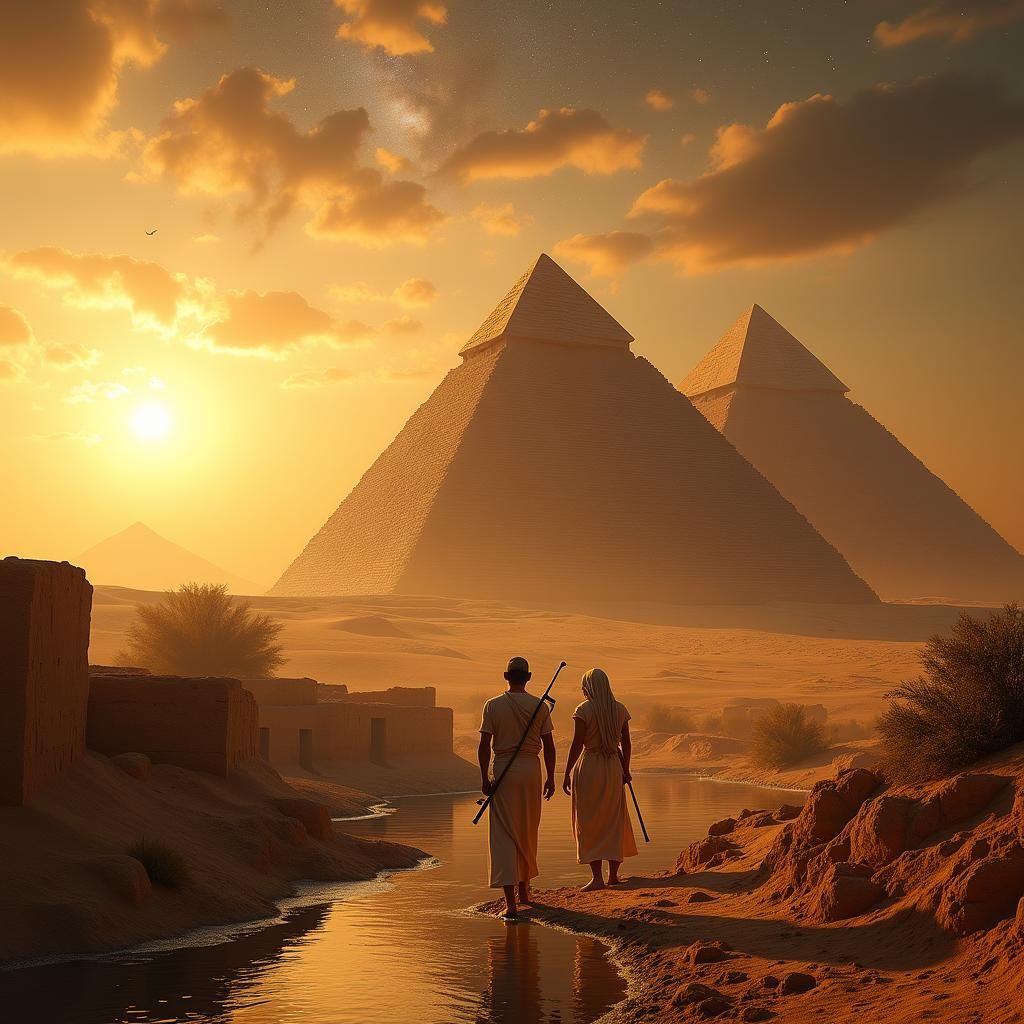
*I read something the other day that there could be more under the Giza Pyramids!
The Pyramids of Giza have stood for over 4,500 years, silently guarding the secrets of an ancient civilisation. These monumental structures, built as tombs for pharaohs, continue to captivate archaeologists, historians, and curious minds alike. But how much do we really know about them? Recent archaeological breakthroughs—powered by cutting-edge technology and relentless curiosity—are rewriting long-held assumptions. From hidden chambers to the daily lives of the workers who built these wonders, the Giza Plateau is yielding new stories. This article dives into the latest discoveries, exploring how they reshape our understanding of ancient Egypt and the people who called it home.
The Pyramids of Giza were constructed during Egypt’s Fourth Dynasty, roughly between 2580 and 2560 BCE, under the reign of Pharaoh Khufu. His Great Pyramid, originally standing at 146.6 metres, was the tallest human-made structure for nearly 4,000 years. The smaller pyramids of Khafre and Menkaure followed, accompanied by the enigmatic Sphinx, whose weathered face still gazes eastward. For centuries, these structures were shrouded in myth—medieval Arab writers speculated they were built by giants or survivors of Atlantis. Even today, wild theories persist, but modern archaeology grounds us in evidence.
Until the 19th century, most exploration focused on looting treasures rather than systematic study. This changed with pioneers like Flinders Petrie, who in the 1880s applied rigorous surveying techniques, mapping the pyramids’ precise alignments to celestial bodies. The 20th century saw the rise of Egyptology as a science, with researchers like Zahi Hawass and Mark Lehner uncovering clues about the labour force, tools, and logistics behind the pyramids’ construction. Now, 21st-century technologies—3D scanning, muon radiography, and AI-driven data analysis—are peeling back layers of history once thought inaccessible.
One of the most persistent mysteries is how the pyramids were built. The Great Pyramid alone contains an estimated 2.3 million limestone blocks, each weighing 2.5 to 15 tonnes. Traditional theories suggested armies of slaves toiling under whips, but this image was upended in the 1990s. Excavations near Giza revealed a vast workers’ settlement, complete with bakeries, breweries, and medical facilities. Bones found in nearby tombs showed signs of healed fractures, indicating injured labourers received care. “These were not slaves,” asserts Zahi Hawass, Egypt’s former Minister of Antiquities. “They were skilled workers, well-fed and organised into crews with names like ‘Friends of Khufu’” [1].
The logistics of moving such massive stones remain debated. A 2014 discovery in a desert quarry uncovered a ramp system with staircases and postholes, suggesting workers used sledges and ropes to drag blocks upward. Physicists have since tested this method, showing that wetting the sand reduced friction by up to 50% [2]. Meanwhile, recent satellite imagery and sediment analysis reveal a long-lost branch of the Nile, dubbed the “Ahramat” (Arabic for “pyramids”), which once flowed close to Giza. This waterway likely served as a transport route for materials [3].
In 2017, the ScanPyramids project made headlines by detecting a mysterious void deep within the Great Pyramid. Using muon tomography—a technique that tracks cosmic rays penetrating stone—researchers found a 30-metre chamber above the Grand Gallery. Dubbed the “Big Void,” its purpose remains unknown. Some speculate it’s a structural feature to redistribute weight, while others hope it could hold artefacts. “This is the first major inner structure found in the pyramid since the 19th century,” said Mehdi Tayoubi of the Heritage Innovation Preservation Institute [4].
Robotic exploration has also advanced. In 2010, a robot named Djedi, equipped with a bendy camera, navigated narrow shafts in the Queen’s Chamber. Behind a limestone door adorned with copper handles, it revealed hieroglyphs written in red ochre—possibly left by the original builders [5]. These markings, still being deciphered, might offer clues about the pyramid’s construction timeline or symbolic purpose.
The pyramids’ alignments have long fuelled speculation. The Great Pyramid’s sides are aligned to true north with astonishing precision, deviating by just 0.05 degrees. How did ancient Egyptians achieve this? Astronomer Kate Spence proposed that they tracked the stars Kochab and Mizar, which aligned with the pole around 2467 BCE [6]. This celestial connection extended to the pyramid’s internal shafts, which some argue pointed toward Sirius and Orion’s Belt—stars linked to the afterlife.
Not all theories withstand scrutiny. The idea that the pyramids were grain stores, popularised by a 2016 U.S. presidential candidate, has been widely debunked. Similarly, claims of “advanced ancient technology” often ignore the archaeological record. As Egyptologist Salima Ikram notes, “The real story—of ingenuity, teamwork, and resource management—is far more impressive than any fiction” [7].
The social impact of pyramid-building cannot be overstated. Feeding 10,000–20,000 workers required vast agricultural surpluses, suggesting a highly centralised state. Recent isotope analysis of animal bones at Giza shows cattle were imported from the Nile Delta, indicating a sophisticated supply network [8]. Meanwhile, graffiti left by labourers—such as “The Friends of Khufu Gang”—hint at a culture of camaraderie and pride.
Controversies persist. Some scholars argue the pyramids’ construction coincided with periods of climate instability, possibly exacerbating social inequality. Others highlight the ethical dilemma of invasive research. When robotic drills pierced the “Door of the Lady” in the Great Pyramid in 2002, critics accused archaeologists of prioritising discovery over preservation [9].
What does the future hold? Non-invasive techniques like ground-penetrating radar and AI-assisted artifact analysis promise further revelations. A 2023 project using thermal scanning identified subtle temperature anomalies in the Sphinx, hinting at possible hidden chambers [10]. Meanwhile, genetic studies of worker remains could trace their origins, revealing whether they were local volunteers or conscripts from conquered territories.
The Pyramids of Giza are more than static monuments—they’re living puzzles, challenging us to rethink antiquity. Each discovery peels back a layer, yet the deeper we dig, the more questions arise. Were the pyramids purely tombs, or did they serve another cosmological function? How did a society with copper tools and no wheels achieve such precision? And what lessons might their resource management hold for our era of climate crisis?
As the sands of Giza continue to shift, one thing is clear: these ancient wonders still have much to teach us. The next time you see a photo of the pyramids, remember—they’re not relics of a dead past, but gateways to stories we’re only beginning to understand. What secrets do you think lie waiting beneath the stones?
References and Further Reading
- Hawass, Z. (1999). The Pyramids of Ancient Egypt. Cairo: American University in Cairo Press.
- Bonn, D. et al. (2014). “Sliding Friction Reducted by Pouring Water.” Physical Review Letters, 112(17).
- Sheisha, H. et al. (2022). “Nile Waterscapes Facilitated the Construction of the Giza Pyramids.” Proceedings of the National Academy of Sciences, 119(37).
- Tayoubi, M. et al. (2017). “Discovery of a Big Void in Khufu’s Pyramid by Observation of Cosmic-Ray Muons.” Nature, 552(7685).
- Richardson, R. (2011). “The Djedi Project: Exploring the Great Pyramid.” Journal of Field Robotics, 28(3).
- Spence, K. (2000). “Ancient Egyptian Chronology and the Astronomical Orientation of Pyramids.” Nature, 408(6810).
- Ikram, S. (2018). Egyptology: An Introduction. Cambridge University Press.
- Yeakel, J. et al. (2020). “Stable Isotope Evidence for Livestock Management in the Old Kingdom.” Antiquity, 94(374).
- Reeves, N. (2002). The Complete Pyramids. Thames & Hudson.
- Parra, J. M. (2023). Thermal Anomalies in the Sphinx: Preliminary Findings. Giza Thermal Scanning Project.
Further Reading
- Lehner, M. (1997). The Complete Pyramids: Solving the Ancient Mysteries.
- Verner, M. (2001). The Pyramids: The Mystery, Culture, and Science of Egypt’s Great Monuments.
- National Geographic’s Egypt’s Ancient Engineering Marvels documentary series.





 Conversations with AI
Leave a comment