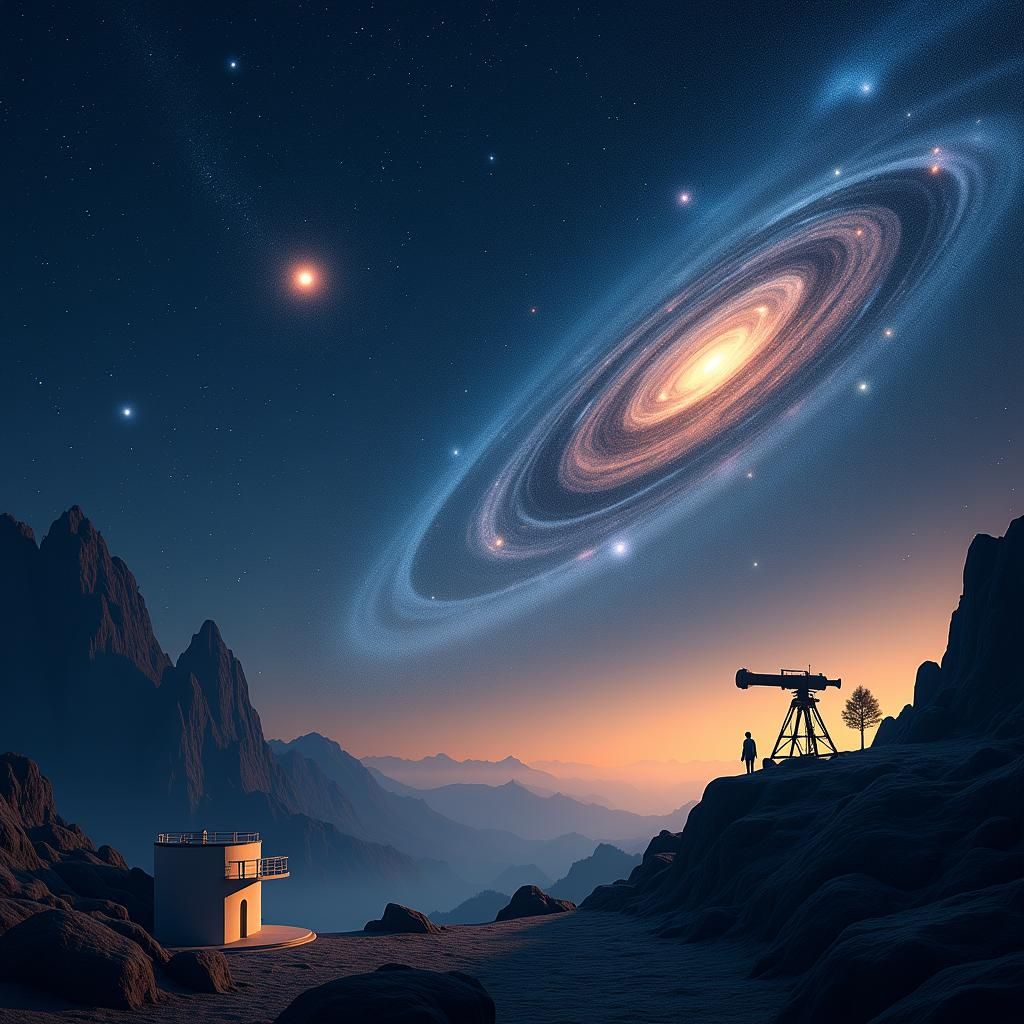
*Interesting, according to the BBC there might be more to Dark Matter than we believe (BBC)
Imagine gazing up at the night sky, dotted with countless stars, and realising that everything you can see—planets, galaxies, even the glowing gas between them—accounts for less than 5% of the universe’s total mass and energy. The rest? A cosmic mystery dubbed ‘dark matter’ and ‘dark energy’. While dark energy remains even more enigmatic, dark matter has become one of the most tantalising puzzles in modern physics. Though invisible and undetectable through conventional means, its gravitational effects are undeniable. Without it, galaxies would fly apart, and the universe as we know it wouldn’t exist. This article dives into the century-long quest to uncover dark matter: the theories, the experiments, and what its discovery could mean for our understanding of reality.
The story of dark matter begins in the 1930s, when Swiss astronomer Fritz Zwicky noticed something peculiar about the Coma galaxy cluster. By measuring the velocities of galaxies within the cluster, he calculated that their collective mass was far too small to keep them gravitationally bound. Zwicky proposed the existence of dunkle Materie (dark matter) to account for the missing mass, but his ideas were largely ignored for decades[1]. It wasn’t until the 1970s that Vera Rubin and Kent Ford provided irrefutable evidence. Studying the rotation curves of spiral galaxies, they found that stars at the edges orbited just as quickly as those near the centre—a phenomenon impossible unless an invisible mass was holding them together[2]. This cemented dark matter’s place in astrophysics, sparking a global race to identify its true nature.
So, what is dark matter? The prevailing theory suggests it consists of Weakly Interacting Massive Particles (WIMPs). These hypothetical particles don’t emit, absorb, or reflect light, interacting only through gravity and the weak nuclear force. WIMPs emerged naturally from supersymmetry theories in particle physics, which propose that every known particle has a heavier ‘superpartner’[3]. Alternatively, some scientists argue for axions—ultra-light particles theorised to solve a quirk in quantum chromodynamics—or MACHOs (Massive Astrophysical Compact Halo Objects), like black holes or neutron stars. However, MACHOs have largely been ruled out due to gravitational lensing surveys showing they can’t account for enough mass[4].
Detecting something that doesn’t interact with light or ordinary matter is, unsurprisingly, challenging. Experiments typically fall into three categories: direct detection, indirect detection, and collider production. Direct detection efforts, like the Large Underground Xenon (LUX) experiment in South Dakota, aim to spot rare collisions between dark matter particles and atomic nuclei in ultra-pure detectors buried deep underground to shield from cosmic rays[5]. As physicist Dr. Elena Aprile, lead of the XENON collaboration, explains: “It’s like listening for a whisper in a hurricane. We need perfect silence to catch that faint signal.”[6] Indirect detection involves searching for secondary particles—gamma rays, neutrinos, or antimatter—produced when dark matter particles annihilate. Instruments like the Fermi Gamma-ray Space Telescope have scanned galactic centres for such signatures, though results remain inconclusive[7]. Meanwhile, particle colliders like the Large Hadron Collider (LHC) attempt to create dark matter by smashing protons together at near-light speeds, hoping to spot missing energy that could indicate invisible particles[8].
Recent years have seen both excitement and frustration. In 2020, the DAMA/LIBRA experiment, which uses sodium iodide crystals in an Italian mountain lab, claimed a seasonal signal variation—potentially tied to Earth’s movement through the galaxy’s dark matter halo[9]. However, other experiments, including LUX and XENON1T, failed to replicate this. Then came 2021’s tantalising results from the XENON1T team, which observed an unexpected excess of electron recoil events. While possibly due to solar axions or neutrinos’ magnetic moments, the findings remain hotly debated[10]. “We’re in a golden age of dark matter research,” says astrophysicist Dr. Dan Hooper, “but also a period of healthy scepticism. Every anomaly must be scrutinised.”[11]
The implications of discovering dark matter can’t be overstated. Confirming WIMPs would validate supersymmetry and reshape the Standard Model of particle physics. Axions might explain additional cosmic puzzles, like why the universe has more matter than antimatter. Conversely, if all searches fail, it could force a radical rethinking of gravity itself. Modified Newtonian Dynamics (MOND), which tweaks gravitational laws to explain galactic rotations without dark matter, has niche support but struggles to account for phenomena like the Bullet Cluster, where visible and gravitational masses clearly separate[12]. As philosopher of science Dr. Katie Mack notes: “Dark matter isn’t just a gap in our knowledge—it’s a mirror reflecting how much we still have to learn about the cosmos.”[13]
Controversies abound. Some argue that funding for multi-billion-pound projects like the LHC prioritises speculative physics over pressing terrestrial issues. Others counter that understanding dark matter is fundamental to humanity’s quest for knowledge. Meanwhile, alternative theories gain traction: primordial black holes from the early universe, or even dark matter ‘fluid’ with negative mass[14]. The lack of a definitive answer, however, underscores the scientific process. As with the Higgs boson, patience and precision are key. Upcoming projects like the James Webb Space Telescope and the European Space Agency’s Euclid mission aim to map dark matter’s distribution via gravitational lensing, potentially narrowing the search[15].
In the end, the hunt for dark matter is more than a technical challenge—it’s a testament to human curiosity. From Zwicky’s lonely hypothesis to today’s global collaborations, each step reveals how little we truly know. Whether dark matter particles are found in the next decade or the mystery deepens, one thing is certain: the universe is far stranger and more wonderful than we’ve dared to imagine. So, the next time you look up at the stars, ask yourself: what invisible threads hold the cosmos together? And what will we discover when we finally pull back the veil?
References and Further Reading
- Zwicky, F. (1933). Helvetica Physica Acta. 6: 110–127.
- Rubin, V.C., Ford, W.K. (1970). Astrophysical Journal. 159: 379–403.
- Jungman, G. et al. (1996). Physics Reports. 267(5–6): 195–373.
- Alcock, C. et al. (2000). The Astrophysical Journal. 542(1): 281–307.
- Akerib, D.S. et al. (2017). Physical Review Letters. 118(2): 021303.
- Aprile, E. (2020). Interview with CERN Courier.
- Ackermann, M. et al. (2015). The Astrophysical Journal. 799(1): 86.
- Bertone, G. et al. (2005). Physics Reports. 405(5–6): 279–390.
- Bernabei, R. et al. (2018). Universe. 4(11): 116.
- Aprile, E. et al. (2020). Physical Review D. 102(7): 072004.
- Hooper, D. (2022). Dark Matter: A Primer. Cambridge University Press.
- Clowe, D. et al. (2006). The Astrophysical Journal. 648(2): L109–L113.
- Mack, K. (2020). The End of Everything. Scribner.
- Farnes, J.S. (2018). Astronomy & Astrophysics. 620: A92.
- Laureijs, R. et al. (2011). Euclid Definition Study Report. ESA.
Further Reading
- The Particle at the End of the Universe by Sean Carroll (2012)
- NASA’s Dark Matter Exploration Portal (nasa.gov/dark-matter)
- CERN’s Dark Matter FAQ (home.cern/science/physics/dark-matter)





 Conversations with AI
Leave a comment