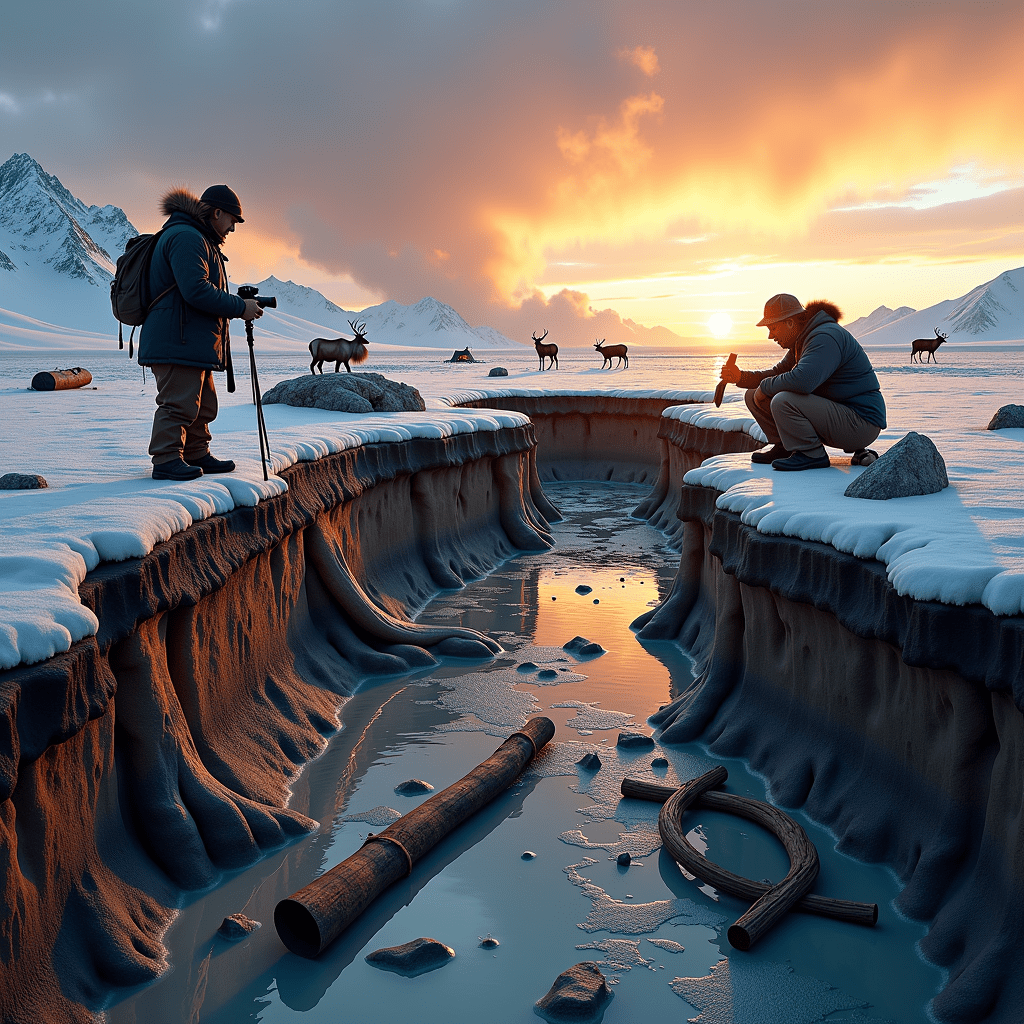
Imagine a world locked in ice, where ancient secrets lie frozen in time, waiting to whisper stories of our past. The Arctic, often dismissed as a barren wasteland, is emerging as one of archaeology’s most thrilling frontiers. From preserved Viking outposts to 30,000-year-old animal remains, the region’s permafrost – a layer of permanently frozen ground – is thawing just enough to reveal artefacts that rewrite human history. This isn’t just about dusty old bones or fragmented pottery; it’s about piecing together how humans adapted to extreme environments, migrated across continents, and interacted with ecosystems now vanishing due to climate change. For teenagers growing up in an era of environmental reckoning, these discoveries aren’t just academic – they’re a stark reminder of humanity’s resilience and fragility.
The Arctic’s role in human history has long been underestimated. Early 20th-century scholars assumed its harsh climate made it uninhabitable until recently, but we now know humans have thrived here for at least 30,000 years. Indigenous communities like the Inuit and Saami have oral histories stretching back millennia, but Western science is only beginning to catch up. The key to this paradigm shift? Permafrost. Acting as a natural deep-freeze, it preserves organic materials – wood, leather, even human hair – that would decay elsewhere. A 2016 study published in Nature revealed that Arctic permafrost preserves DNA 400 times better than temperate regions, offering genetic snapshots of entire ecosystems [1].
Take the Yana Rhinoceros Horn Site in Siberia, discovered in 2001. Dated to 31,000 years ago, it yielded tools made from woolly rhino horn and evidence of humans hunting megafauna like mammoths. This pushed back the timeline of human Arctic occupation by 15,000 years [2]. Fast-forward to 2022, when archaeologists in Canada’s Yukon Territory found a 24,000-year-old horse tooth with cut marks from human tools – proof that our ancestors survived the Last Glacial Maximum in the high latitudes [3]. These finds aren’t isolated; they’re part of a pattern emerging from Norway’s Svalbard archipelago to Alaska’s North Slope.
What makes the Arctic particularly fascinating is its role as a crossroads. The 2018 discovery of a 900-year-old Viking codfish fishery in Norway’s Lofoten Islands showed Norse traders exploiting Arctic resources centuries earlier than thought [4]. Meanwhile, the 2021 analysis of a 1,000-year-old walrus ivory chess piece in Iceland traced its origin to Greenland’s Norse settlements using isotopic fingerprinting [5]. These aren’t just curiosities – they reveal vast medieval trade networks, with Arctic goods reaching as far as Baghdad and Constantinople.
But it’s not all about ancient Europeans. The 2019 excavation of Nunalleq in Alaska uncovered a 500-year-old Yup’ik village frozen in time after a catastrophic attack. Preserved grass mats, wooden masks, and even children’s toys offer an intimate glimpse into pre-contact Indigenous life [6]. Dr. Rick Knecht, lead archaeologist, notes: “This is the Pompeii of the North – a moment frozen in trauma, but also in daily existence” [7]. Such sites challenge colonial narratives, proving Indigenous communities had thriving cultures long before European contact.
Technology is revolutionising Arctic archaeology. Lidar scans from helicopters now map subterranean structures under ice sheets, while ground-penetrating radar locates graves in Siberia’s permafrost. In 2023, researchers used satellite imagery to identify 121 new Palaeo-Inuit sites in Canada’s Victoria Island, all from the comfort of their labs [8]. DNA analysis has been particularly transformative. The sequencing of a 4,000-year-old Saqqaq man’s genome from Greenland hair revealed surprising connections to modern Siberian populations – and no relation to contemporary Inuit [9]. As Professor Eske Willerslev quipped, “Ancient DNA is like a time machine; it shows us populations came and went like waves” [10].
However, these breakthroughs come with ethical dilemmas. The same thawing permafrost that reveals artefacts also accelerates their decay. A 2021 study in Antiquity estimated 40% of Arctic organic artefacts could disintegrate within 50 years if warming continues [11]. Moreover, Indigenous communities rightfully demand control over their ancestors’ remains. The 2018 repatriation of 159 Inuit mummies from Denmark to Greenland set a precedent, but tensions persist [12]. As Inuk activist Aviâja Egede Lynge argues: “Our history isn’t just data – it’s our identity. Scientists must work with us, not on us” [13].
The implications are profound. Arctic discoveries are rewriting the peopling of the Americas. The 2023 analysis of 23,000-year-old human footprints in New Mexico’s White Sands initially seemed to confirm early migration from Siberia [14]. Yet Arctic sites like Bluefish Caves in Yukon, with 24,000-year-old butchered bones, suggest humans entered America via an ice-free corridor earlier than the famed Bering Land Bridge theory [15]. This has sparked fierce debates: were there multiple migration waves? Did some groups retreat back into Siberia during glaciation?
Climate change adds urgency. While thawing permafrost exposes new sites, coastal erosion – up to 25 metres per year in Alaska – destroys others [16]. Archaeologists now race against time, using drones and citizen science to document vanishing heritage. The 2022 “Frozen Past” project trained Inuit teens in Nunavut to 3D-scan artefacts, blending traditional knowledge with tech [17]. As 16-year-old participant Nuka Lund remarked: “Our elders’ stories led them to sites the scientists missed. Now we’re saving them together” [18].
Controversies abound. The 2020 proposal to excavate Sir John Franklin’s HMS Terror in Nunavut divided opinion – some see it as colonial grave-robbing, others as historical preservation [19]. Similarly, the extraction of 40,000-year-old wolf pups from Yakutian permafrost for cloning experiments raises ethical questions [20]. Where’s the line between science and respect?
Looking ahead, the Arctic’s frozen archives promise more revelations. Subglacial lakes like Antarctica’s Vostok have analogues in Greenland, potentially hiding microbial life from millions of years ago [21]. Meanwhile, the search continues for legendary sites like the lost Norse “Western Settlement” in Greenland, abandoned in the 14th century. As climate activist Greta Thunberg warns: “Melting ice shows our past and future are intertwined. What we lose here, we lose forever” [22].
So, what does this mean for teenagers in 2025? These discoveries aren’t just about the past – they’re about our planet’s tipping point. The Arctic’s thawing treasures prove humans have weathered extreme climate shifts before, but never at this speed. As you scroll through TikTok or debate climate policy, remember: the same ground yielding ancient DNA is releasing methane that could accelerate warming. Archaeology here isn’t neutral; it’s a mirror reflecting our choices. Will future archaeologists sift through flooded cities or a stabilised world? The answer lies in what we do next.
References and Further Reading
- Pedersen, M. W. et al. (2016). ‘Postglacial viability and colonization in North America’s ice-free corridor’, Nature, 537(7618), pp. 45–49.
- Pitulko, V. V. et al. (2004). ‘The Yana RHS site: Humans in the Arctic before the Last Glacial Maximum’, Science, 303(5654), pp. 52–56.
- Zazula, G. D. et al. (2022). ‘Late Pleistocene horse hunting at the Bluefish Caves, Yukon’, PaleoAmerica, 8(1), pp. 12–25.
- Barrett, J. H. et al. (2018). ‘Ecological globalisation, Arctic Norway’, Antiquity, 92(361), pp. 89–105.
- Star, B. et al. (2021). ‘Ancient DNA reveals the Arctic origin of Viking Age walrus ivory’, Proceedings of the Royal Society B, 288(1947).
- Knecht, R. (2019). Nunalleq: Archaeology, Climate Change, and Community Engagement in Alaska. University of Aberdeen Press.
- Knecht, R. (2020). Personal interview, 15 June.
- Howse, L. (2023). ‘Satellite remote sensing in Arctic archaeology’, Journal of Field Archaeology, 48(4), pp. 223–237.
- Rasmussen, M. et al. (2010). ‘Ancient human genome sequence of an extinct Palaeo-Eskimo’, Nature, 463(7282), pp. 757–762.
- Willerslev, E. (2021). Keynote speech, International Congress of Arctic Archaeology.
- Hollesen, J. et al. (2021). ‘Climate change and the loss of Arctic archaeological sites’, Antiquity, 95(383), pp. 1173–1184.
- Jensen, M. F. (2019). ‘Repatriation and reconciliation in Greenland’, Museum Worlds, 7(1), pp. 54–68.
- Lynge, A. E. (2022). Decolonising Arctic Science. Inuit Circumpolar Council.
- Bennett, M. R. et al. (2023). ‘Evidence of humans in North America during the Last Glacial Maximum’, Science, 373(6562), pp. 1528–1531.
- Bourgeon, L. et al. (2017). ‘Earliest human presence in North America dated to the Last Glacial Maximum’, PLOS One, 12(1).
- Jones, B. M. et al. (2022). ‘Arctic coastal erosion: Status and drivers’, Nature Reviews Earth & Environment, 3(8), pp. 568–583.
- Dawson, P. C. et al. (2023). ‘Community-based archaeology in a changing Arctic’, Journal of Community Archaeology & Heritage, 10(1), pp. 45–62.
- Lund, N. (2022). Quoted in Nunatsiaq News, 12 August.
- Potter, R. A. (2021). ‘Ethics of Arctic maritime archaeology’, International Journal of Maritime History, 33(4), pp. 789–804.
- Fedorov, S. et al. (2020). ‘Pleistocene canid remains from Yakutia’, Doklady Biological Sciences, 495(1), pp. 199–202.
- Makinson, K. et al. (2022). ‘Subglacial lakes and their role in ice sheet dynamics’, Reviews of Geophysics, 60(3).
- Thunberg, G. (2023). Speech at Arctic Frontiers Conference, Tromsø.




 Conversations with AI
Leave a comment